- Animals
- ›Chordates
- ›Vertebrates
- ›Reptiles
- ›Snakes and Lizards
- ›Lizards
- ›Wall lizards, amphisbaenians, and allies
- ›Wall Lizards
- ›Canarian Lizards and Psammodromuses
- ›Psammodromus
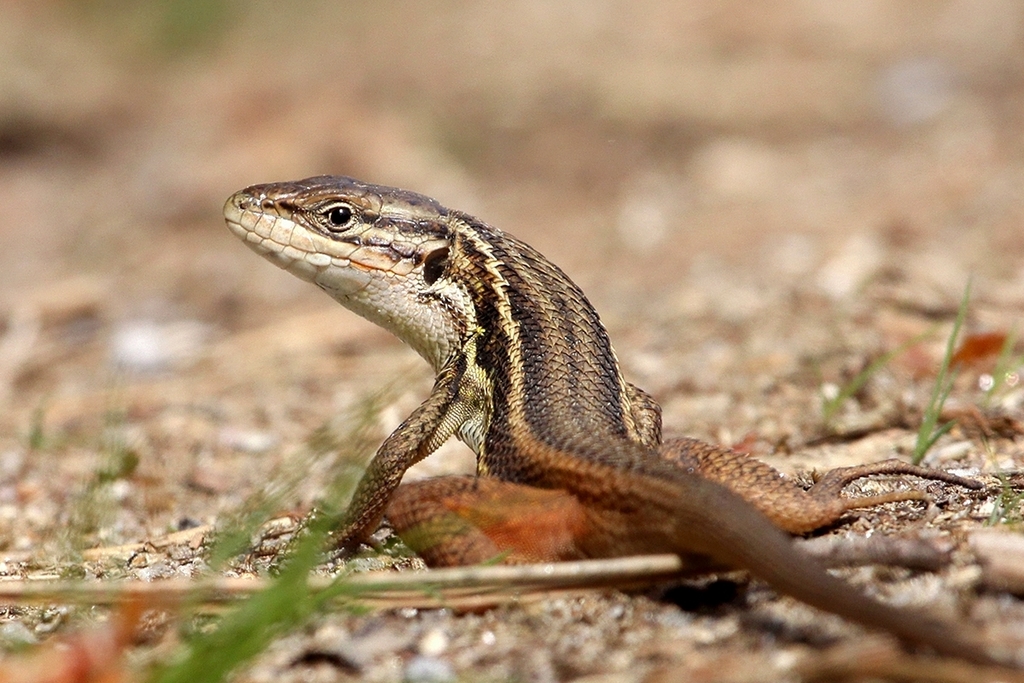
Large Psammodromus
Psammodromus algirus
Psammodromus algirus, known commonly as the Algerian psammodromus or the large psammodromus, is a species of lizard in the family Lacertidae. The species is found in southwestern Europe and northwestern Africa.
From the article Psammodromus algirus on Wikipedia (CC BY-SA), quoted section by section
Description
Ppsammodromus algirus commonly reaches a snout-to-vent length (SVL) of about 7.5 cm (3.0 in), occasionally 9 cm (3.5 in). The tail is 2–3 times the body length. Dorsal colouration is usually metallic brownish with a pair of conspicuous white or yellowish stripes on both sides.
Range & habitat
Psammodromus algirus is found in North Africa (Morocco, Algeria, and Tunisia) and in Southwestern Europe (Iberian Peninsula: Portugal, Spain, Andorra, Gibraltar; southernmost France, and Italy near Lampedusa). The IUCN assessment from 2009 treats Psammodromus algirus nollii and Psammodromus algirus ketamensis as full species and restricts Psammodromus algirus to North Africa.
Wikipedia: “Geographic range”
What it does
Psammodromus algirus preys mainly on terrestrial arthropods, specifically Orthoptera, Formicidae, Coleoptera, Hemiptera, and Araneae.
Wikipedia: “Diet”
Where it lives
Recorded sightings
—
geo-referenced records in GBIF, from museums, herbaria and field observers.
Drag the globe to turn it. Dots are where records exist, not a range map; darker means more records.
In the stacks
Searching the stacks…
Every page naming Psammodromus algirus in the Biodiversity Heritage Library →
This page is assembled live from iNaturalist, GBIF, Wikipedia, the Source Library and the Internet Archive. It is not yet part of the hand-edited codex. iNaturalist taxon 35519.