On eBird ↗
Scaled Dove
Live sightings near you, the range map, bar charts of when it is seen, and Macaulay Library photos and recordings.
Scaled Dove
Columbina squammata
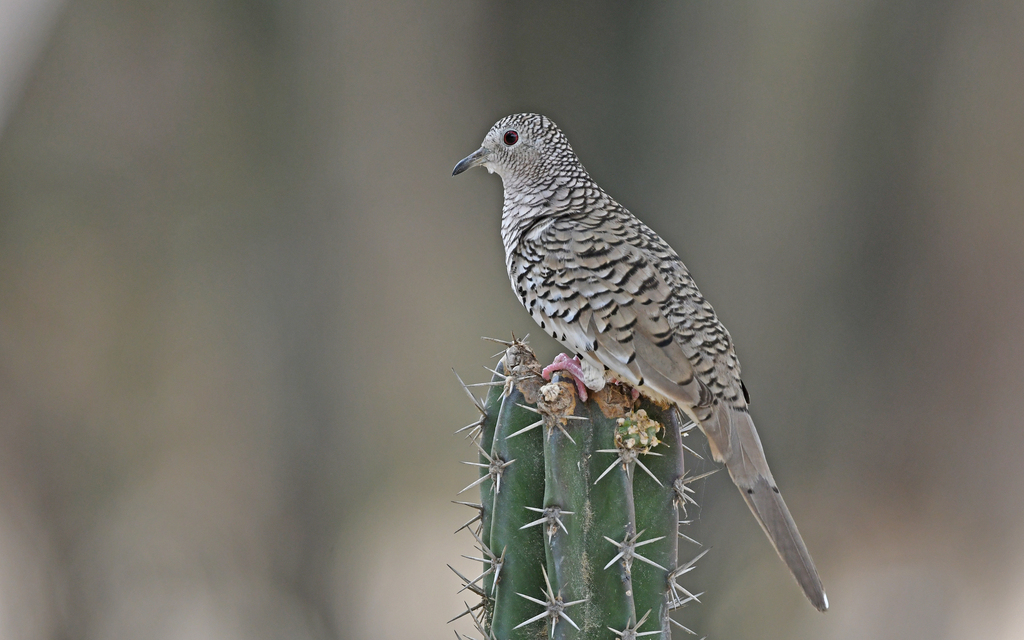
The scaled dove (Columbina squammata), also known as scaly dove, Ridgway's dove, mottled dove, and South American zebra dove, is found in Brazil, Bolivia, Argentina, Colombia, French Guiana, Paraguay, Trinidad and Tobago,Venezuela and Uruguay.
Its natural habitats are subtropical or tropical dry shrubland, subtropical or tropical moist shrubland, subtropical or tropical seasonally wet or flooded lowland grassland, and heavily degraded former forest.
From the article Scaled dove on Wikipedia (CC BY-SA), quoted section by section
Description
It measures between 18 and 22 centimeters in length and weighs between 48 and 60 grams. The species has grayish-brown upper parts and a pinkish-gray face and chest. The throat is white and the distal wing coverts are also white and form a visible white spot on the wings when they are closed. The tail is dark with the tips of the rectrices being white, forming a white band on the side of the tail, noticeable when the bird is in flight. The species has dark eyes, pink legs and gray beak. It has a "scaly" appearance caused by the dark edges of the feathers. The most striking feature of this species is the scaling pattern of the plumage, which provides it with efficient camouflage. When in flight you can see a white stripe at the base of the wing. Its primaries are brown in color.
What it does
Columbina squammata is a dove of generally discreet habits, that walks in pairs or small groups by the edges of forests, savannahs, orchards, and other types of vegetation, while tending to avoid very open or very closed habitats. It is normally silent, except when vocalizing, which the bird only does while perched in well-hidden places, and except for the noise produced by the wings when the bird takes flight. In southeastern Brazil, it is considered as a skittish species, being much more heard than seen in cities like Campinas or Ribeirão Preto, but in other parts of Brazil, such as Brasília or Goiânia this species can be found much closer to people, scratching on sidewalks in the same way as its congener, the ruddy ground-dove (Columbina talpacoti). Ornithologists and bird watchers in the state of São Paulo have been reporting a decline in the populations of this species, potentially attributing this decline to competition with the eared dove (Zenaida auriculata), which has been increasing in both range and abundance.
Breeding. It makes a nest of twigs in the shape of a cup, usually 1 or 2 meters above the ground, but may sometimes also nest on the ground. This species usually lays 2 white eggs.
Diet. It feeds on the ground, walking with its belly almost dragging on the ground. When scared, it flies sharply to nearby trees. …
Wikipedia: “Behaviour”
Listen
Looking for field recordings…
Where it lives
Recorded sightings
—
geo-referenced records in GBIF, from museums, herbaria and field observers.
Drag the globe to turn it. Dots are where records exist, not a range map; darker means more records.
In the stacks
Searching the stacks…
Every page naming Columbina squammata in the Biodiversity Heritage Library →
This page is assembled live from iNaturalist, GBIF, Wikipedia, the Source Library and the Internet Archive. It is not yet part of the hand-edited codex. iNaturalist taxon 3564.