On eBird ↗
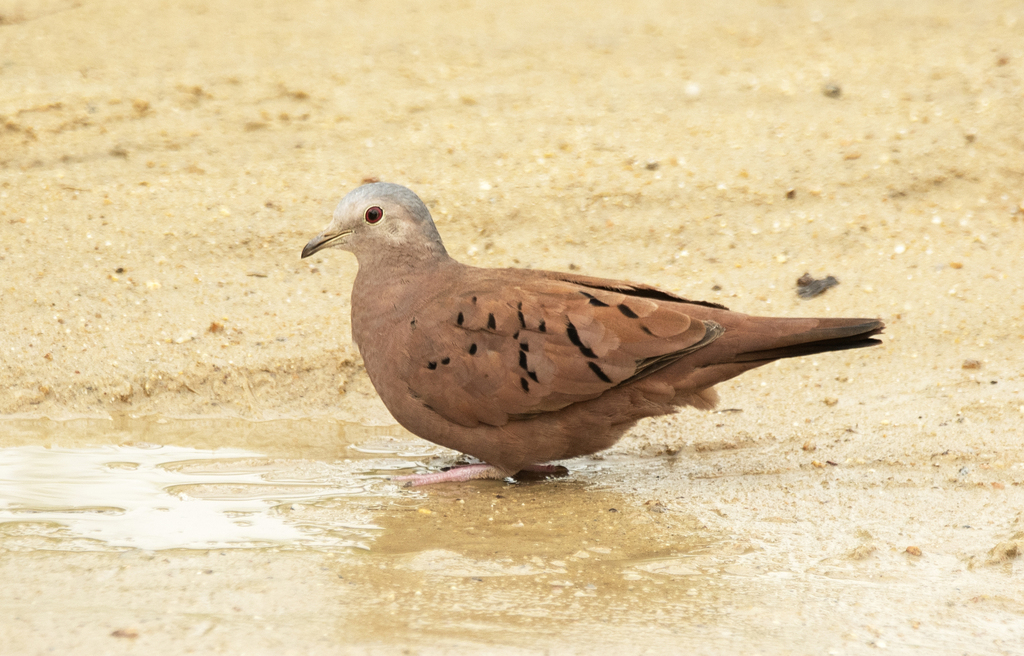
Ruddy Ground Dove
Live sightings near you, the range map, bar charts of when it is seen, and Macaulay Library photos and recordings.
Ruddy Ground Dove
Columbina talpacoti
The ruddy ground dove (Columbina talpacoti) is a small New World tropical dove. It is a resident breeder from Mexico south to Brazil, Peru and Paraguay, and northern Argentina, and on Trinidad and Tobago. Individual birds can sometimes be seen in the southwestern USA, from southern Texas to southernmost California, primarily during winter.
The ruddy ground dove is very common in scrub and other open country, including cultivated land and urban centers, where it can be seen feeding on grain alongside feral pigeons. It builds a solid but sparsely lined cup-shaped stick nest in a tree and lays two white eggs. Incubation is 12–13 days with another 12–14 days to fledging. There may be a second or third brood. Chick mortality through predation and falls from the nest is high.
From the article Ruddy ground dove on Wikipedia (CC BY-SA), quoted section by section
Description
It measures 12–18 cm (4.7–7.1 in) in length and weighs about 35–56 g (1.2–2.0 oz). The male, with reddish brown feathers, dominant color on the adult's body, in contrast to the head, bluish gray. The female is all brown. In both sexes, on the wing there are a series of black spots on the feathers. The chicks come out with traces of the plumage of each sex. Subspecies It has 4 subspecies, only one of which occurs in Brazil:
Columbina talpacoti caucae (Chapman, 1915) - occurs in the Colca River valley in western Colombia. Columbina talpacoti eluta (Bangs, 1901) - occurs on the coast of the Pacific Ocean in Mexico from the north of the state of Sinaloa to the south of the state of Chiapas. Columbina talpacoti rufipennis (Bonaparte, 1855) - Central and Eastern Mexico, Central America to Colombia and Northern Venezuela including Margarita Island and the islands of Trinidad and Tobago. Columbina talpacoti talpacoti (Temminck, 1810) - Eastern Ecuador and Eastern and Northern Peru, Eastern Guyana, Bolivia, Paraguay, Uruguay, Northern Argentina and Brazil. Occasionally as a visitor in the central region and the Lakes region in Chile.
Range & habitat
Adapts to artificial environments created by human action. Lives in open areas; the deforestation facilitated its expansion, especially in the areas formed to pasture or grain farming. They entered the big cities in the southeast and midwest regions of Brazil. Very aggressive with each other, although they can form groups, they compete for food and defend territories using one of the wings to strike hard at the opponent. The males are more bellicose. In disputes or when they sunbathe, lying on their side on the ground and with the wing stretched upwards, they show the large area of black feathers under the wing. Bird watchers in the south-central part of the United States have been observing a "replacement" of this species by another pigeon, Zenaida auriculata, also known as dove-of-band, or amargosinha eared dove. The latter species has been conquering the urban environment more and more effectively and is apparently competing with the dove, which is already less frequent than the flock pigeon in most cities in the interior of São Paulo. In any case, this friendly and even naive species is far from disappearing from the backyards of our houses and from the squares and gardens of our cities, even if they are in large buildings.
Wikipedia: “Habitat”
Listen
Looking for field recordings…
Where it lives
Recorded sightings
—
geo-referenced records in GBIF, from museums, herbaria and field observers.
Drag the globe to turn it. Dots are where records exist, not a range map; darker means more records.
In the stacks
Searching the stacks…
Every page naming Columbina talpacoti in the Biodiversity Heritage Library →
This page is assembled live from iNaturalist, GBIF, Wikipedia, the Source Library and the Internet Archive. It is not yet part of the hand-edited codex. iNaturalist taxon 3580.