- Animals
- ›Chordates
- ›Vertebrates
- ›Reptiles
- ›Snakes and Lizards
- ›Lizards
- ›Wall lizards, amphisbaenians, and allies
- ›Wall Lizards
- ›Eremiadinae
- ›Latastia
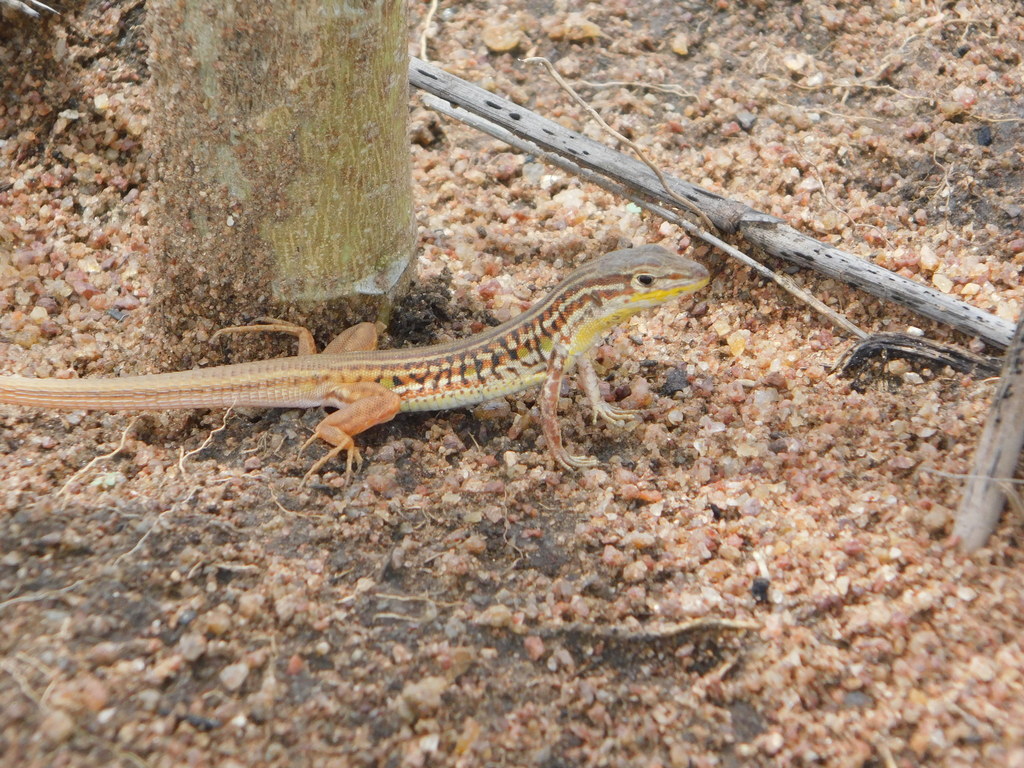
Johnston’s long-tailed lizard
Latastia johnstonii
Latastia johnstonii, also known commonly as Johnston's long-tailed lizard, the Malawi long-tailed lizard, and the Nyasaland long-tailed lizard, is a species of lizard in the family Lacertidae. The species is native to East Africa.
From the article Latastia johnstonii on Wikipedia (CC BY-SA), quoted section by section
Description
L. johnstonii has keeled dorsal scales, which are arranged in 39–52 rows at midbody. The tail of juveniles is red, the color fading at adulthood. Adults have a total length (including tail) of 15–20 cm (5.9–7.9 in). The tail length is 65–75% of the total length.
Range & habitat
L. johnstonii is found in Democratic Republic of the Congo, Malawi, Mozambique, Tanzania, Zambia, and Zimbabwe. The preferred natural habitats of L. johnstonii are grassland and savanna, at altitudes of 330–1,000 m (1,080–3,280 ft).
Wikipedia: “Distribution and habitat”
What it does
L. johnstonii is terrestrial, diurnal, and fast-moving. L. johnstonii preys upon invertebrates. L. johnstonii is oviparous. Clutch size is three or four eggs, and each egg measures 12 mm × 7 mm (0.47 in × 0.28 in).
Wikipedia: “Ecology and behavior”
Where it lives
Recorded sightings
—
geo-referenced records in GBIF, from museums, herbaria and field observers.
Drag the globe to turn it. Dots are where records exist, not a range map; darker means more records.
In the stacks
Searching the stacks…
Every page naming Latastia johnstonii in the Biodiversity Heritage Library →
This page is assembled live from iNaturalist, GBIF, Wikipedia, the Source Library and the Internet Archive. It is not yet part of the hand-edited codex. iNaturalist taxon 35833.