- Animals
- ›Chordates
- ›Vertebrates
- ›Reptiles
- ›Snakes and Lizards
- ›Lizards
- ›Wall lizards, amphisbaenians, and allies
- ›Wall Lizards
- ›Lacertinae
- ›Lacerta
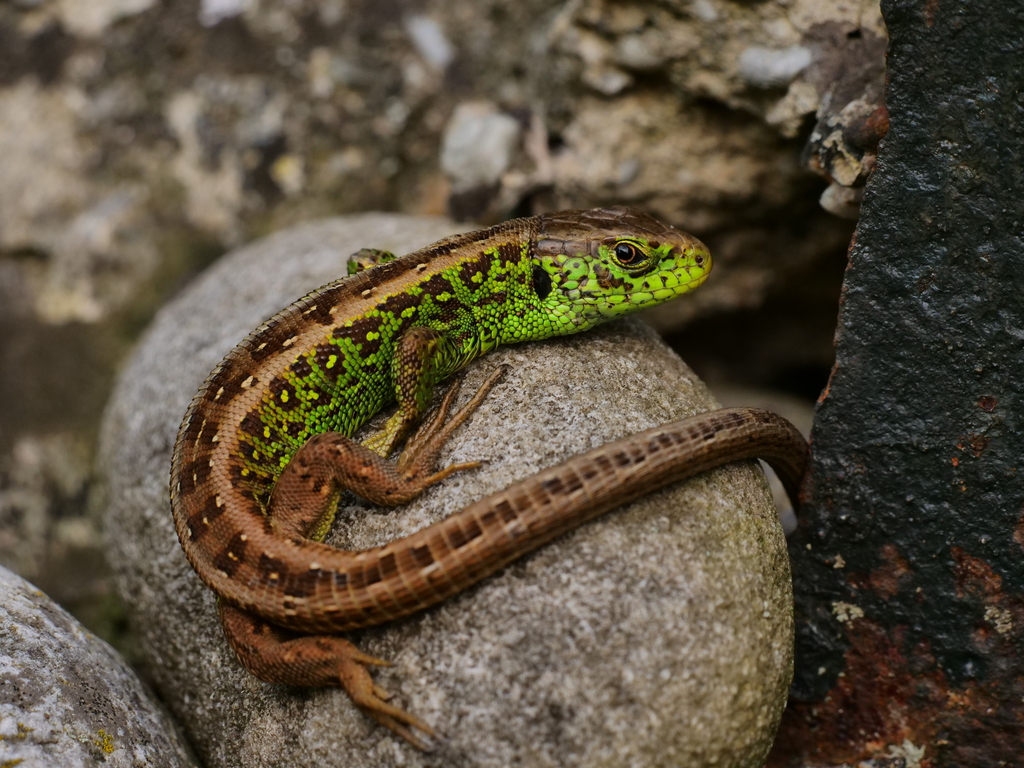
Sand Lizard
Lacerta agilis
The sand lizard (Lacerta agilis) is a lacertid lizard. There are several subspecies, including L. a. agilis, L. a. argus, and L. a. exigua.
The sand lizard is distributed across most of Europe from the southern coast of Britain and across the continent to Lake Baikal in Russia. It does not occur in European Turkey. Its distribution is often patchy. In the northern extremes of the sand lizard's distribution, it survives by inhabiting seaside heathlands, where the ground temperature is elevated by the sun. The sand lizard uses warm sand to thermoregulate itself and to incubate its eggs.
From the article Sand lizard on Wikipedia (CC BY-SA), quoted section by section
Description
The sand lizard is a sexually dimorphic legged lizard. In northwest Europe, both sexes are characterised by lateral and dorsal strips of ocellated (eye-shaped) markings, which appear as dark patches with pale centres. Colouration varies across their European and Russian range. Males have finer markings than females, and their flanks turn bright green during the spring mating season, fading again in the late summer. Male adults may reach a total body length of 19.3 cm, where female adults may reach 18.5 cm. In the two main western subspecies (L. a. agilis and L. a. argus), the dorsal stripe is thin and interrupted, or not present at all. L. a. argus also includes a plain red or brown-backed phase without any dorsal markings. In these two subspecies, only the flanks of the males turn green in the mating season, but in the eastern subspecies (predominantly L. a. exigua), males can be wholly green, even outside the breeding season. Sand lizards can self-amputate their tails as a defence mechanism. This ability is called autotomy. In males, the bright green genital coloration has been shown to be brighter depending on body mass and fighting ability. Males with brighter colors were more likely to initiate aggressive behaviors and win fights, which generally leads to them having a higher mating success. …
Range & habitat
The sand lizard can be found in a variety of habitats. They prefer dry habitats, such as outcrops, fields, hills, beaches, heathland, sand dunes, and rock gardens. While in continental Europe the sand lizard has a wide variety of habitat, in colder places like Great Britain they depend on sand to incubate their eggs and such are restricted to coastal habitats. Male sand lizards have home ranges with an extremely high amount of overlap; however, female sand lizards have much smaller home ranges (generally less than 100 meters squared) that neighbor each other, or they will even share burrows or basking areas with each other. They highly prefer and are much more active in areas with a wide variety of structural characteristics. This can create different temperature micro areas that they are able to move between depending on their needs.
Wikipedia: “Habitat and distribution”
What it does
Generally, males reach sexual maturity at a smaller size compared with females. Vitellogenesis happens when females are 45 days for the whole population. Both sexes tend to lose body fat during mating period, since their main energy resources come from body fat and from the liver and proximal at the tail. After a few weeks from the hibernation, male adults become extremely aggressive towards each other, trying to mate as many females as they can. The female sand lizard lays eggs in loose sand in a sunny location, leaving them to be incubated by the warmth of the ground. Female sand lizards usually lay only a single clutch each year and clutch sizes that range between six and 15 eggs in a single one. However, there is a lot of variation in the time of year when females end up laying their eggs. But generally a single female sand lizard has a relatively consistent egg laying timing from year-to-year, with the first ones to do so generally being larger, more physically fit females. These early clutches ended up producing offspring that were larger, more successful, and had higher survival rates. Generally offspring from earlier clutches were higher quality offspring. When female sand lizards produce larger clutch sizes, the size of each individual offspring in it has been observed to decrease. On the opposite side, smaller clutch sizes had fewer, but larger, offspring. …
Wikipedia: “Reproduction”
Where it lives
Recorded sightings
—
geo-referenced records in GBIF, from museums, herbaria and field observers.
Drag the globe to turn it. Dots are where records exist, not a range map; darker means more records.
In the stacks
Searching the stacks…
Every page naming Lacerta agilis in the Biodiversity Heritage Library →
This page is assembled live from iNaturalist, GBIF, Wikipedia, the Source Library and the Internet Archive. It is not yet part of the hand-edited codex. iNaturalist taxon 35912.