- Animals
- ›Chordates
- ›Vertebrates
- ›Ray-finned Fishes
- ›Spiny-rayed fishes
- ›Jacks, Flounders, Barracudas, and Allies
- ›Flatfishes
- ›Large-tooth Flounders
- ›Paralichthys
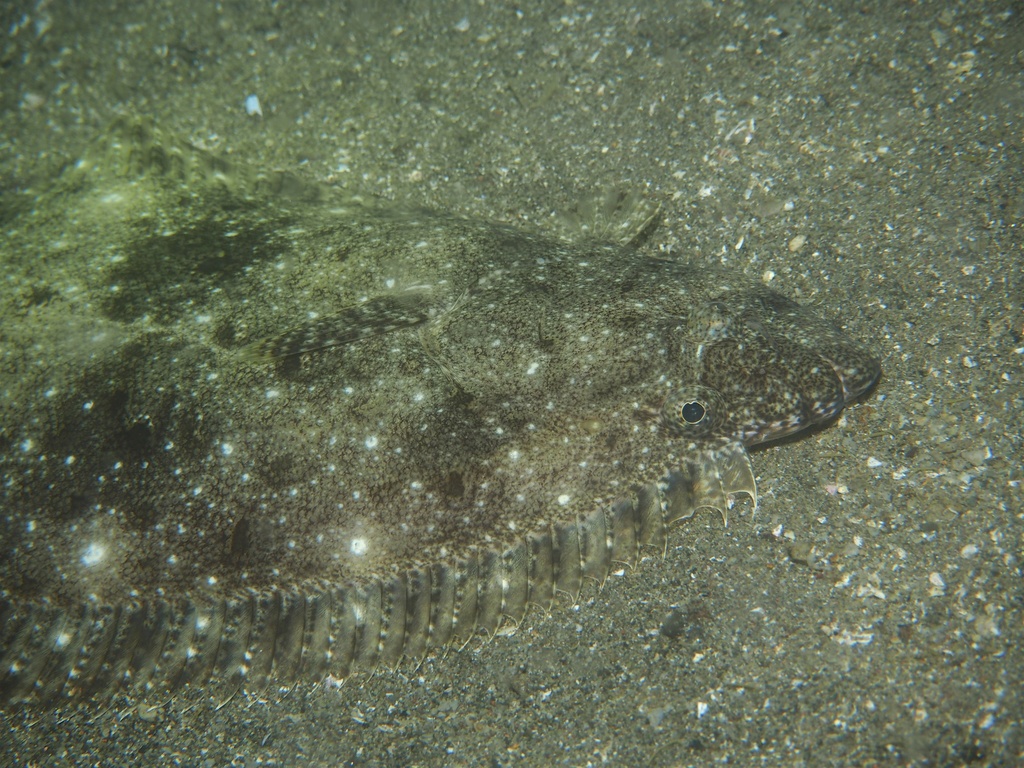
Olive Flounder
Paralichthys olivaceus
The olive flounder (Paralichthys olivaceus), bastard halibut, Japanese flounder or Korean halibut is a temperate marine species of large-tooth flounder native to the North-western Pacific Ocean. It is a high valued fin-fish, known to be excellent for aquaculture due to a rapid growth rate and popularity in Japan and Korea.
From the article Olive flounder on Wikipedia (CC BY-SA), quoted section by section
Description
It reaches a length of 103 cm (41 in) and a weight of 9.1 kg (20 lb). In 2017 its genome and transcriptome was sequenced as a model to study flatfish asymmetry.
Range & habitat
The olive flounder is often found in soft and muddy offshore, coastal areas where the water level goes down to 100 m in depth. The temperature of water in these areas range from 21–24 °C or 69–75 °F. Olive flounder typically eat fish spawn, crustaceans, polychaetes, and small fish.
Wikipedia: “Habitat and diet”
What it does
Olive flounder spawn anytime from January through August in shallow water, roughly about 70 cm in depth. The egg and larvae remain that way for about 24–50 days after hatching. Once they begin their metamorphosis process, they move towards more sandy areas and feed on shrimp. After achieving metamorphosis, the flounder move offshore and begin feeding on bigger fish in order to grow to their adult size. Young olive flounder hatch with a bilaterally symmetrical body plan typical of most fish. Over 24 to 50 days, they undergo metamorphosis: the body flattens, one eye migrates to the opposite side of the head, and the fish settles onto its side, living with both eyes facing upward.
Wikipedia: “Life cycle”
At the table
Olive flounder is widely eaten as food in East Asia, often raw. Hoe (횟감) is the Korean preparation of raw olive flounder (광어), typically sliced thinly and served with gochujang (red chili paste), sesame oil, and vinegar-based sauces. In Japan, raw olive flounder (ヒラメ, hirame) is served as sushi or sashimi, often with ponzu (citrus-soy sauce) and considered a prized white fish for its firm, clean texture. In China, the olive flounder is a popular culinary fish, commonly prepared steamed with ginger and scallions, braised with soybean paste, or cooked as a collagen-rich fish head soup. Raw consumption of olive flounder carries a risk of Kudoa septempunctata poisoning, causing acute vomiting and diarrhea within hours.
Wikipedia: “As food”
In human culture
The olive flounder is the most common flatfish species raised in aquaculture in Korea. In 2022, 46,000 tons of oliver flounder was produced in South Korea, representing 50.5% of the total aquaculture production within the country. Although the aquaculture for the olive flounder started from the late 1980s, its commercial production didn't begin on a major scale until the 1990s in Korea. Olive flounder are also farmed in Japan and China as well.
Wikipedia: “Aquaculture”
Where it lives
Recorded sightings
—
geo-referenced records in GBIF, from museums, herbaria and field observers.
Drag the globe to turn it. Dots are where records exist, not a range map; darker means more records.
In the stacks
Searching the stacks…
Every page naming Paralichthys olivaceus in the Biodiversity Heritage Library →
This page is assembled live from iNaturalist, GBIF, Wikipedia, the Source Library and the Internet Archive. It is not yet part of the hand-edited codex. iNaturalist taxon 361763.