- Animals
- ›Chordates
- ›Vertebrates
- ›Ray-finned Fishes
- ›Spiny-rayed fishes
- ›Blennies, Damselfishes and Allies
- ›Blennies
- ›Combtooth Blennies
- ›Typical Blennies
- ›Plagiotremus
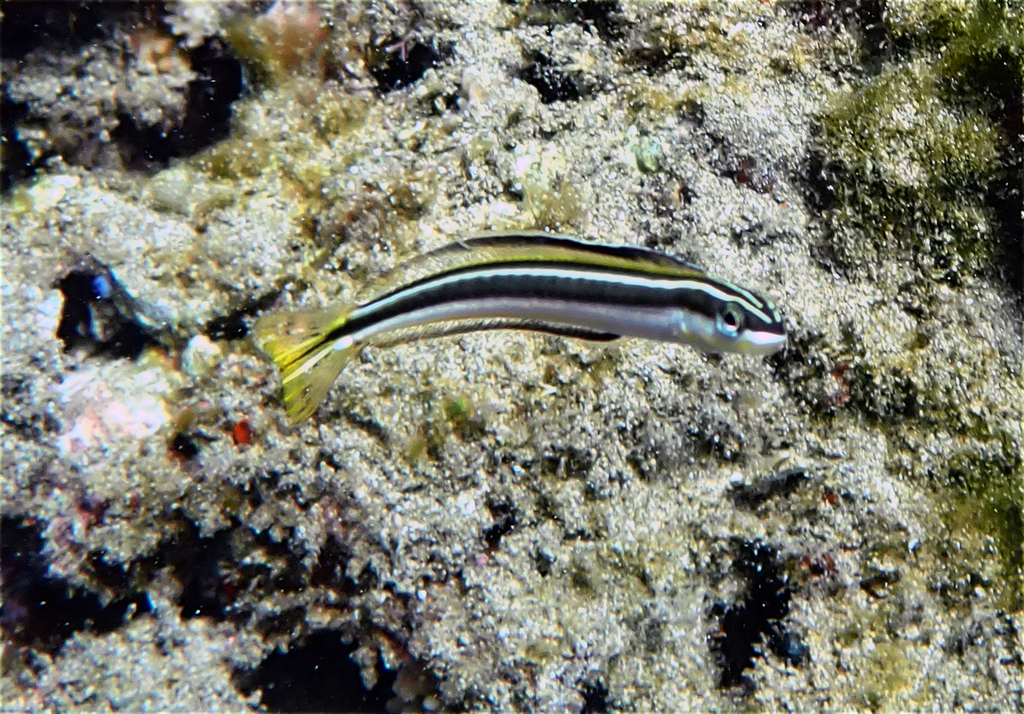
Gosline's Fangblenny
Plagiotremus goslinei
Plagiotremus goslinei, commonly known as the biting blenny, Gosline's fangblenny, the scale-eating blenny, the Ewa fang blenny, the blue-stripe blenny, or the scale-eating fang blenny, is a species of combtooth blenny. The species epithet honours the American ichthyologist William A. Gosline (1915-2002) of the University of Hawaiʻi.
From the article Plagiotremus goslinei on Wikipedia (CC BY-SA), quoted section by section
Description
This species reaches a length of 6.3 cm (2.5 in) SL. The biting blenny is also known as the striped blenny for the bright blue stripes that run down its body. The biting blenny has two large canines on its bottom jaw. This fish's sharp fangs can, when it is eaten by larger fish, hold on to the esophagus to prevent itself from being swallowed. These fangs can also be poisonous, giving the receiver an opioid poison.
Range & habitat
The biting blenny is found in coral reefs in Hawaii and in the eastern central Pacific Ocean.
Wikipedia: “Habitat and distribution”
What it does
The diet of the biting blenny is diverse. It consists of mucus, scales, and skin tissue of larger fish, shrimp, small crustaceans, worms, zooplankton, and fish eggs. The biting blenny sneaks up behind larger fish and takes bites out of their backs and sides.
Wikipedia: “Diet”
Where it lives
Recorded sightings
—
geo-referenced records in GBIF, from museums, herbaria and field observers.
Drag the globe to turn it. Dots are where records exist, not a range map; darker means more records.
In the stacks
Searching the stacks…
Every page naming Plagiotremus goslinei in the Biodiversity Heritage Library →
This page is assembled live from iNaturalist, GBIF, Wikipedia, the Source Library and the Internet Archive. It is not yet part of the hand-edited codex. iNaturalist taxon 363471.