On eBird ↗
Choiseul Pigeon
Live sightings near you, the range map, bar charts of when it is seen, and Macaulay Library photos and recordings.
Choiseul Pigeon
Microgoura meeki
The Choiseul pigeon (Microgoura meeki) is an extinct species of bird in the pigeon and dove family, Columbidae. It was endemic to the island of Choiseul in the Solomon Islands, although there are unsubstantiated reports that it may once have lived on several nearby islands. The last confirmed sighting was in 1904. Other common names were the Solomons crested pigeon, the Solomon Islands crowned-pigeon and the kuvojo.
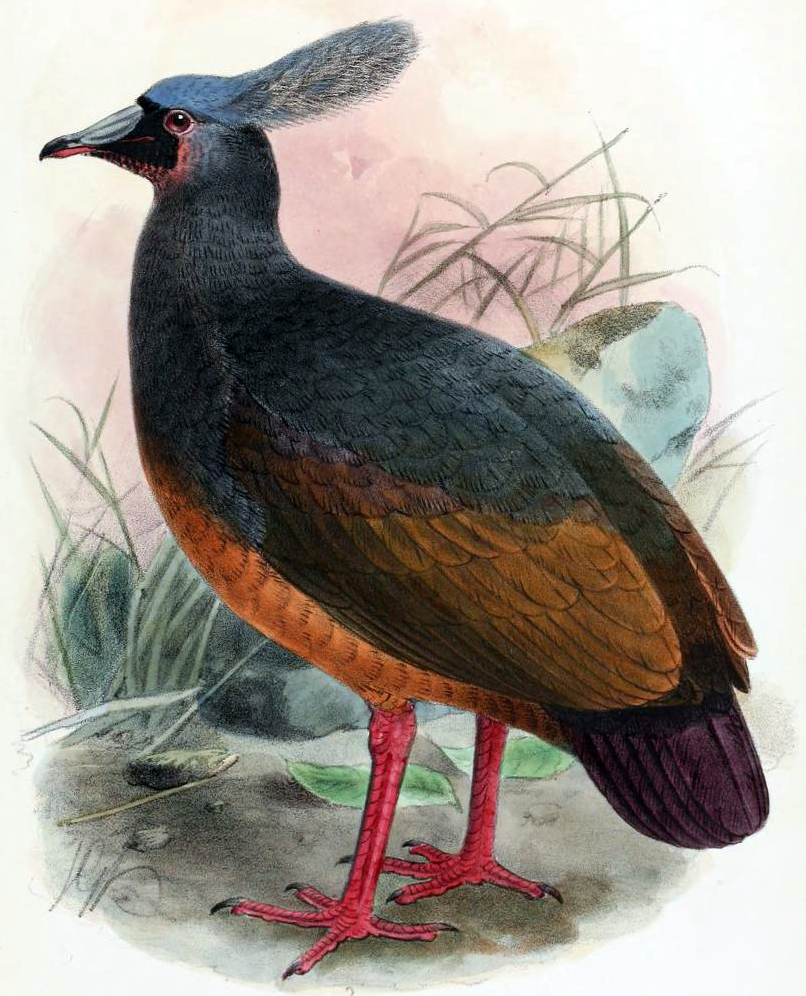
The Choiseul pigeon was monotypic within the genus Microgoura. Its closest living relative is believed to be the thick-billed ground pigeon, and some authors have suggested that the Choiseul pigeon may be a link between that species and the crowned pigeons. There is no available genetic data for the Choiseul pigeon. The adult pigeon was largely blue-grey, with a buffy orange belly and a distinctive slaty-blue crest. It is unknown how this crest was held by the bird in life. The bird's head sported a blue frontal shield surrounded by black feathers and a bicoloured beak. The wings were brown and the short tail was a blackish purple. It was described as having a beautiful rising and falling whistling call.
From the article Choiseul pigeon on Wikipedia (CC BY-SA), quoted section by section
Description
The Choiseul pigeon was about 31 cm (12 in) long. The wing of the male was 195–197 mm (7.7–7.8 in), the tail 100–105 mm (3.9–4.1 in), the culmen 34 mm (1.3 in), and the tarsus was 60 mm (2.4 in). The wing of the female was 180–190 mm (7.1–7.5 in), the tail 100 mm (3.9 in), the culmen 33 mm (1.3 in), and the tarsus was 60 mm (2.4 in). Adult Choiseul pigeons of both sexes were blue-grey overall with a buffy orange belly. The pigeon had a distinctive long, rounded crest that had a hairy texture. This crest, like the crown, was slaty-blue and emerged from the bird's hindcrown. Though many artists have speculated, it is unknown how the pigeon held its crest in life as Meek's notes did not cover this subject. John Gerrard Keulemans (who produced the illustration accompanying Rothschild's original description), depicted the crest as being flat based on Meek's specimens; other artists have presented it as spread and scraggly like that of the crowned pigeons. It has been suggested that the crests of the museum specimens were flattened during preparation. On the bird's forehead was a naked and pale chalky-blue frontal shield. This was surrounded by short, velvety black feathers that extended from the base of the bill to the area just below and in front of the eye, while the area below the eye was a pinkish wash. …
Range & habitat
The Choiseul pigeon was non-migratory and is thought to have lived on the forest floor in lowland forests, including coastal swampy areas that lacked mangroves. The Choiseul pigeon is usually considered to have been endemic to the island of Choiseul in the Solomon Islands off the coast of New Guinea, where the only specimens were collected. The specimens Meek acquired were likely collected near Choiseul Bay in the northern part of the island. The last reports of the species from the indigenous population came from the Kolombangara River. It also reportedly lived on the neighboring islands of Santa Isabel and Malaita, and it is suspected that it may once have lived on Bougainville Island. However, these reports were never confirmed and must be considered anecdotal. It would be considered very unusual if the Choiseul pigeon were truly endemic to Choiseul as the island hosts no other endemic species, and the pigeon was never linked ecologically with another species on the island.
Last sightings. In January 1904 six specimens and an egg were collected by Albert Stewart Meek, a bird collector for Lord Walter Rothschild, near Choiseul Bay on Choiseul. Several local boys told Meek that the pigeon was also present on the nearby islands of Santa Isabel and Malaita. …
Wikipedia: “Distribution and habitat”
What it does
Not much is known about the species' behaviour, as it became extinct before significant field observations could be made. It is likely that the Choiseul pigeon was a largely terrestrial species, feeding and nesting near the forest floor. The indigenous people of the town of Vundutura said that the pigeon would roost in pairs or small groups of three or four in small shrubs close to the ground. They claimed that the species was very tame, allowing local hunters to approach it and pick it up off of its perch by hand. They reported that the species had stones in its gizzard. It laid a single dark, cream-coloured egg in an unlined depression on the ground. The egg was about 43 by 31.3 mm (1.69 by 1.23 in) in size, which is considered small in proportion to the bird.
Wikipedia: “Behaviour and ecology”
Listen
Looking for field recordings…
Where it lives
Recorded sightings
—
geo-referenced records in GBIF, from museums, herbaria and field observers.
Drag the globe to turn it. Dots are where records exist, not a range map; darker means more records.
In the stacks
Searching the stacks…
Every page naming Microgoura meeki in the Biodiversity Heritage Library →
This page is assembled live from iNaturalist, GBIF, Wikipedia, the Source Library and the Internet Archive. It is not yet part of the hand-edited codex. iNaturalist taxon 3663.