On eBird ↗
Peach-fronted Parakeet
Live sightings near you, the range map, bar charts of when it is seen, and Macaulay Library photos and recordings.
Peach-fronted Parakeet
Eupsittula aurea
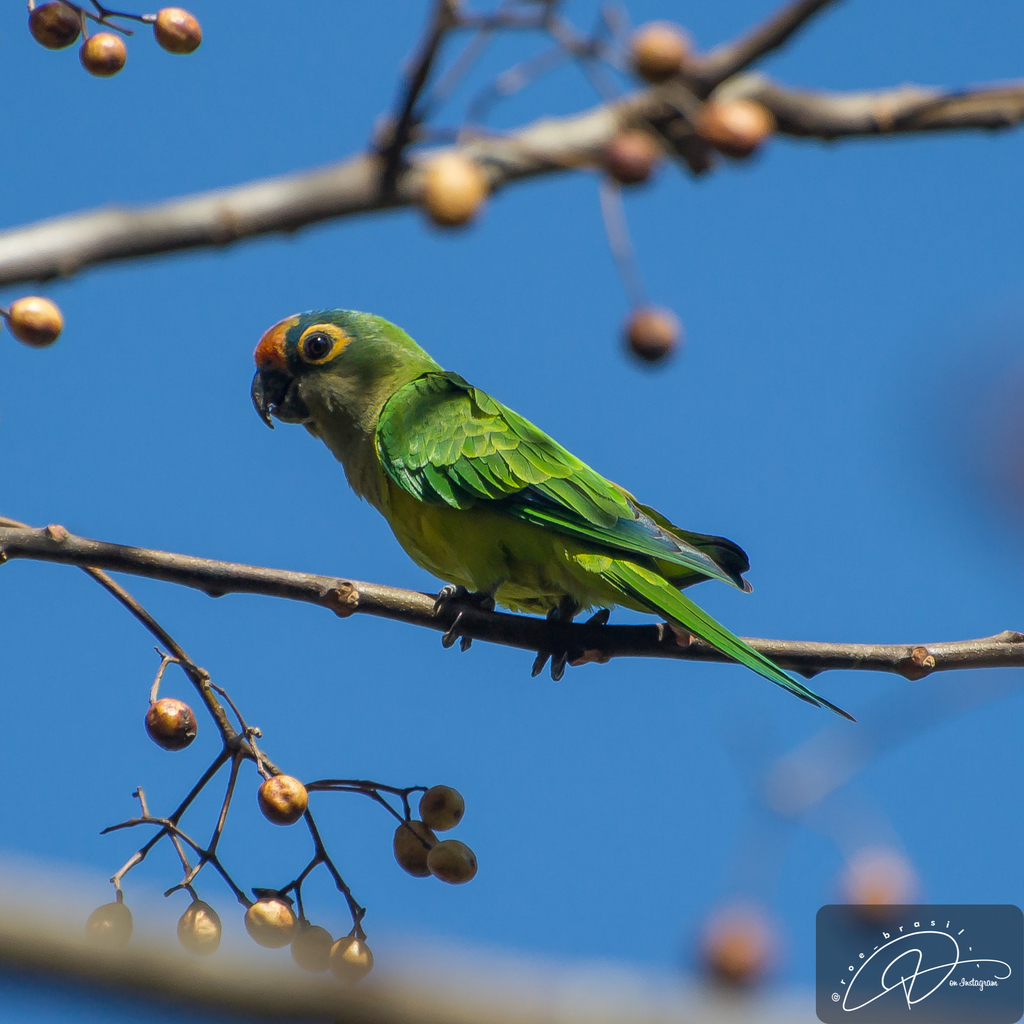
The peach-fronted parakeet (Eupsittula aurea), more commonly known as the peach-fronted conure in aviculture, is a species of parrot in the family Psittacidae. It is widespread and often common in semi-open and open habitats in eastern Brazil, Bolivia, Paraguay, far northern Argentina and southern Suriname (Sipaliwini savanna). Both its common and scientific name is a reference to the orange-yellow forehead, although this is reduced in juveniles.
From the article Peach-fronted parakeet on Wikipedia (CC BY-SA), quoted section by section
Description
The peach-fronted parakeet is 23 to 28 cm (9.1 to 11 in) long and weighs 74 to 94 g (2.6 to 3.3 oz). The sexes are the same. Adults have a peachy orange forehead (the "front") and forecrown; their hindcrown is dull blue. Bare yellow skin surrounds their eye. Their nape, upperparts, and tail are dull green. Their cheeks and throat are pale olive-brown that transitions through their breast and belly to a greenish yellow vent and undertail coverts. Their wings are mostly green on top and yellow green on the bottom, with greenish blue flight feathers. Immature birds are similar to adults but have less orange and blue on their head.
Range & habitat
The peach-fronted parakeet is found from extreme southern Suriname south through most of the eastern half of Brazil to eastern Bolivia, extreme southeastern Peru, central and eastern Paraguay, and slightly into northeastern Argentina. It inhabits a variety of landscapes from semi-open to wooded, including Mauritia palm groves, cerrado, gallery forest, campo rupestre (a savanna-like grassland with shrubs and scattered trees), and urban areas.
Wikipedia: “Distribution and habitat”
What it does
The peach-fronted parakeet does much foraging on the ground. Its primary food is seeds from a wide variety of plants; it also feeds on termites and insect larvae. It feeds in agricultural fields, both before harvest and to glean after harvest.
Wikipedia: “Feeding”
Listen
Looking for field recordings…
Where it lives
Recorded sightings
—
geo-referenced records in GBIF, from museums, herbaria and field observers.
Drag the globe to turn it. Dots are where records exist, not a range map; darker means more records.
In the stacks
Searching the stacks…
Every page naming Eupsittula aurea in the Biodiversity Heritage Library →
This page is assembled live from iNaturalist, GBIF, Wikipedia, the Source Library and the Internet Archive. It is not yet part of the hand-edited codex. iNaturalist taxon 367559.