On eBird ↗
Cactus Parakeet
Live sightings near you, the range map, bar charts of when it is seen, and Macaulay Library photos and recordings.
Cactus Parakeet
Eupsittula cactorum
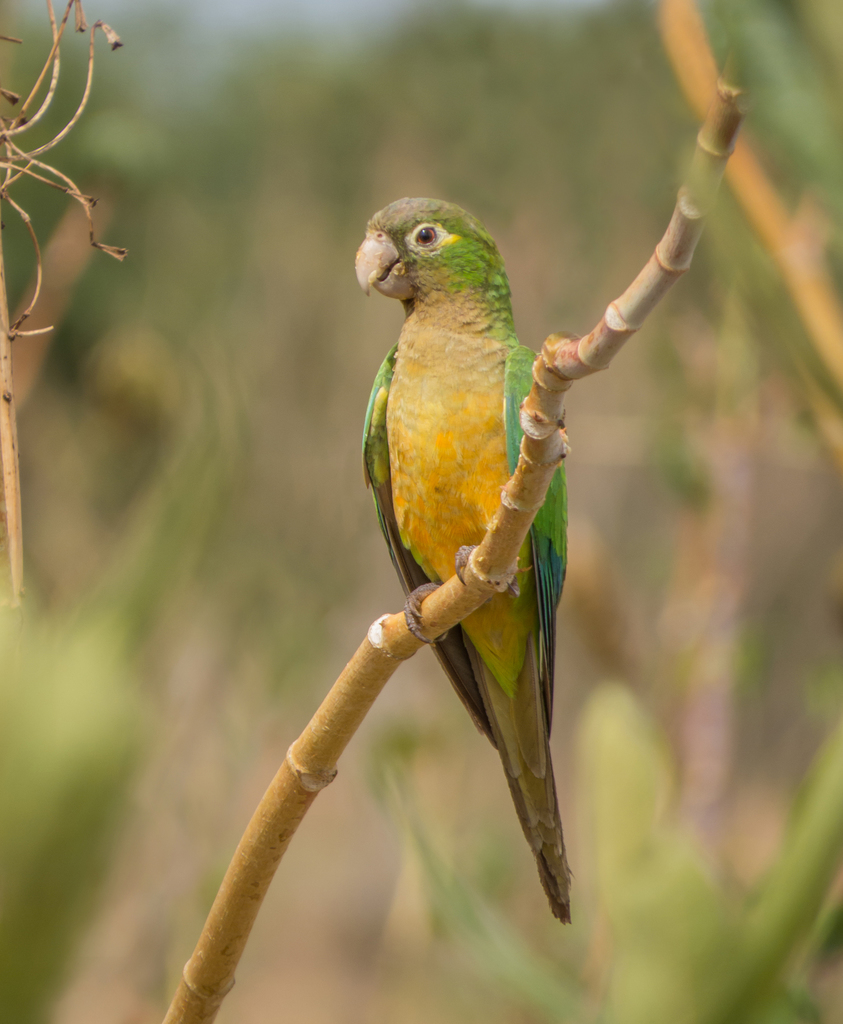
The Caatinga parakeet (Eupsittula cactorum), also called the cactus parakeet and in aviculture the cactus conure, is a species of bird in subfamily Arinae of the family Psittacidae, the African and New World parrots. It is endemic to eastern Brazil.
From the article Caatinga parakeet on Wikipedia (CC BY-SA), quoted section by section
Description
The Caatinga parakeet is about 25 cm (9.8 in) long. The sexes are alike. Adults of the nominate subspecies have a pale brown forecrown, cheeks, throat, sides of the neck, and breast. Bare whitish skin surrounds their eye. Their belly and vent area are yellow-orange. Their nape, ear coverts, upperparts, and tail are green. Their wings are mostly green with bluish flight feathers. Immature birds are similar to adults but have a completely green crown and duller underparts. Subspecies E. c. caixana has the same plumage pattern as the nominate but is overall paler.
Range & habitat
The subspecies E. c. caixana is the more northerly of the two. It is found in northeastern Brazil from Maranhão east to the Atlantic Ocean and south as far as northwestern Bahia. The nominate subspecies is found in east-central Brazil south of the São Francisco River in Bahia and Minas Gerais. The species inhabits pristine and second-growth caatinga, a dry landscape characterized by thorny vegetation, shrubs, and succulents. It also occurs in cerrado and moister woodlands.
Wikipedia: “Distribution and habitat”
What it does
The diet has not been fully investigated. It is known to feed on fruits of figs (Ficus), cactus, and several other plants. It has been reported feeding on flower buds. It also feeds on crops like rice, maize and sorghum.
Wikipedia: “Feeding”
Listen
Looking for field recordings…
Where it lives
Recorded sightings
—
geo-referenced records in GBIF, from museums, herbaria and field observers.
Drag the globe to turn it. Dots are where records exist, not a range map; darker means more records.
In the stacks
Searching the stacks…
Every page naming Eupsittula cactorum in the Biodiversity Heritage Library →
This page is assembled live from iNaturalist, GBIF, Wikipedia, the Source Library and the Internet Archive. It is not yet part of the hand-edited codex. iNaturalist taxon 367561.