On eBird ↗
Mitred Parakeet
Live sightings near you, the range map, bar charts of when it is seen, and Macaulay Library photos and recordings.
Mitred Parakeet
Psittacara mitratus
The mitred parakeet (Psittacara mitratus), also known as the mitred conure in aviculture, is a species of bird in subfamily Arinae of the family Psittacidae, the African and New World parrots. It is native to Argentina, Bolivia, and Peru. It has been introduced to Uruguay and is established there. There are also substantial populations in the US states of California and Florida and smaller numbers in Hawaii.
From the article Mitred parakeet on Wikipedia (CC BY-SA), quoted section by section
Description
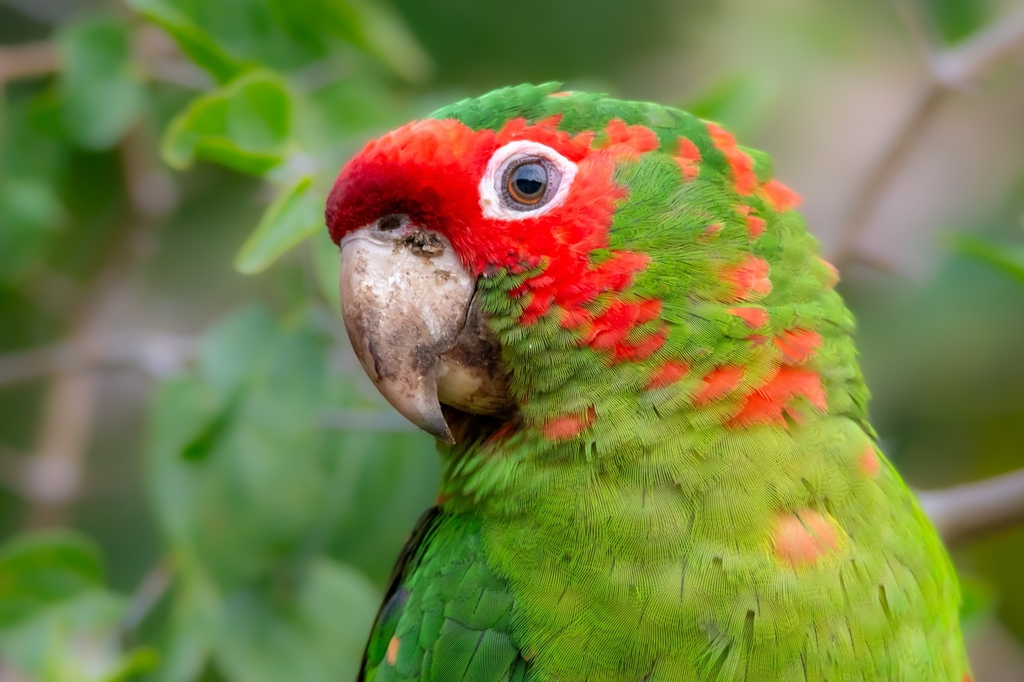
The mitred parakeet is 31 to 38 cm (12 to 15 in) long and weighs 219 to 275 g (7.7 to 9.7 oz). The sexes are alike. Adults of all subspecies are mostly green with a purplish forehead and a variable amount and pattern of red on the face. All subspecies have a red forecrown and red in front of their eye. The red usually extends past the eye and down the cheeks, and is often just flecks on the ear coverts. Subspecies P. m. chlorogenys has less red around and below the eye than the others, often a blue tinge on the crown, and some red on the thighs. Some individuals of all subspecies have a small amount of red at the bend of the wing. Their eye is surrounded by bare white skin and their bill is horn colored. Juveniles have little or no red. The differences in plumage coloration noted in the field and in specimens are possibly due to erroneous age assignments, and might also be clinal.
Range & habitat
The nominate subspecies P. m. mitratus of the mitred parakeet is found from the departments of Ayacucho and Cuzco in Peru south through Bolivia into northwestern Argentina as far as Córdoba Province. Subspecies P. m. chlorogenys is found on the eastern slope of the Peruvian Andes between Amazonas and Junín departments. P. m. tucumanus is found in the Argentinian provinces of Córdoba and Tucumán. The mitred parakeet has been introduced to Uruguay and is established there. Populations in California, Florida, and Hawaii are apparently derived from escaped or released cage birds. California's official list does not include the species but the other two states' lists do. In their native range mitred parakeets inhabit a variety of landscapes, most of them forested. These include both evergreen and deciduous montane forest, cloudforest, secondary forest, and semi-humid to humid scrub areas in otherwise arid zones. Subspecies P. m. chlorogenys ranges from 1,200 to 2,900 m (3,900 to 9,500 ft) in elevation. The other two subspecies occur in the wider elevational range of 1,000 to 3,400 m (3,300 to 11,200 ft) with one reported sighting at 4,000 m (13,000 ft) in Peru. The introduced populations in California and Florida mostly occur in suburban and urban areas while those in Hawaii occur in both populated and unpopulated areas.
Wikipedia: “Distribution and habitat”
What it does
The mitred parakeet's diet in its native range has not been fully described but is known to include berries and other fruits, seeds, nuts, and maize. In California the species has been observed feeding on fruits and flowers. In south Florida it has been documented feeding on 34 species of plants, both native and introduced.
Wikipedia: “Feeding”
In human culture
The subspecies seen in American aviculture is Psittacara m. mitrata (though this is labelled with some uncertainty considering the recent developments in the taxonomy). Popular as pets, the mitred parakeets are considered outgoing and playful. They are even used as "watch birds", given their loud, piercing alarm call. Like most parrots, they tend to be devoted to their human owners. They have been known to grow attached to groups rather than individuals. They make great pets for people who will devote their time and money and will understand the birds natural behaviors; screaming, biting, splashing, etc.
== References ==
Wikipedia: “Aviculture”
Listen
Looking for field recordings…
Where it lives
Recorded sightings
—
geo-referenced records in GBIF, from museums, herbaria and field observers.
Drag the globe to turn it. Dots are where records exist, not a range map; darker means more records.
In the stacks
Searching the stacks…
Every page naming Psittacara mitratus in the Biodiversity Heritage Library →
This page is assembled live from iNaturalist, GBIF, Wikipedia, the Source Library and the Internet Archive. It is not yet part of the hand-edited codex. iNaturalist taxon 367571.