On eBird ↗
Black Honeyeater
Live sightings near you, the range map, bar charts of when it is seen, and Macaulay Library photos and recordings.
Black Honeyeater
Sugomel nigrum
The black honeyeater (Sugomel nigrum) is a species of bird in the honeyeater family Meliphagidae and the sole species in the genus Sugomel. The black honeyeater exhibits sexual dimorphism, with the male being black and white while the female is a speckled grey-brown; immature birds look like the female. The species is endemic to Australia, and ranges widely across the arid areas of the continent, through open woodland and shrubland, particularly in areas where the emu bush and related species occur.
A nectar feeder, the black honeyeater has a long curved bill to reach the base of tubular flowers such as those of the emu bush. It also takes insects in the air, and regularly eats ash left behind at campfires. Cup-shaped nests are built in the forks of small trees or shrubs. The male engages in a soaring song flight in the mating season, but contributes little to nest-building or incubating the clutch of two or three eggs. Both sexes feed and care for the young. While the population appears to be decreasing, the black honeyeater is sufficiently numerous and widespread and hence is considered to be of least concern on the International Union for Conservation of Nature (IUCN)'s Red List of Endangered species.
From the article Black honeyeater on Wikipedia (CC BY-SA), quoted section by section
Description
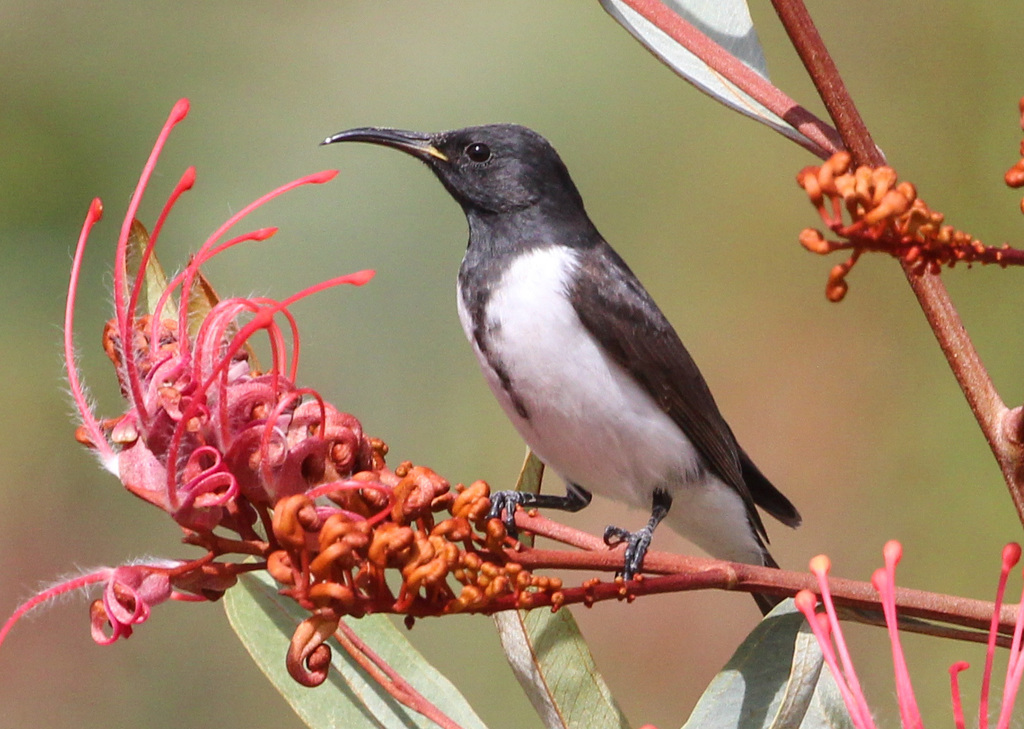
The black honeyeater has a long, slender, down-curved bill, a small rounded head and slender neck set on a plump body, and a short, slightly cleft tail. It is between 10 and 13 cm (3.9 and 5.1 in) long, with an average wingspan of around 19 cm (7.5 in) and a weight of 9.5 g (0.34 oz). It has relatively long, pointed wings for a honeyeater, and very long wings for such a small bird, the development of which has been attributed to its feeding behaviour of flying between shrubs and hovering over flowers. The species is strongly sexually dimorphic. Adult males are black and white, with a black head, neck, wings and upperparts, and a black stripe running down from the centre of the chest to the abdomen, and with a white belly, flanks and under-tail coverts. The female's crown, ear coverts and upper parts are buff brown, scalloped paler, with a pale eyebrow, and the chest is speckled grey-brown grading into a dull white belly. In both male and female the iris is dark brown and the bill and legs blackish brown. Immature birds are similar to the adult female; however, the upper breast and throat tend to be more uniform grey-brown and the base of the bill is paler; they are not distinguishable from adult females at a distance. The black honeyeater is quiet when not breeding, but calls before and during the nesting season, often early in the morning. …
Range & habitat
The black honeyeater is a bird of the dry inland of Australia, being generally widespread though scattered in western Queensland and New South Wales to the South Australian border, and occasionally recorded in the Mallee and Wimmera regions of Victoria. In South Australia, it occurs in the south-east and it is widespread in the central and northern regions of Western Australia, with some rare sightings in the south near Kalgoorlie. In the Northern Territory, it is widespread around Alice Springs, with some vagrants to the Top End. It is dependent on the presence of the berrigan emu bush (Eremophila longifolia) and related species. As a result, the black honeyeater is found in open woodlands and shrublands of arid and semi-arid regions, as well as in mulga or mallee woodlands, and it is also found in spinifex savanna where flowering shrubs such as grevilleas and paperbarks occur. It has been noted that the black honeyeater is able to locate emu bushes, even when clumps consist of only two or three and are separated by many kilometres of country, which suggests the importance of this plant–bird association. The black honeyeater is considered to be migratory rather than strictly nomadic, with regular seasonal movements related to flowering of food plants, especially the emu bush. …
Wikipedia: “Distribution and habitat”
What it does
The black honeyeater is usually encountered alone or in pairs, though up to 50 may gather at stands of plants in flower.
Breeding. The breeding season is from July to December (mostly between August and November), or opportunistically after rain. There is apparently some variation based upon location, with birds in Western Australia nesting earlier, whilst those in Queensland breed as late as March. Black honeyeater populations concentrate for breeding wherever the right plants are in flower and there is an abundance of insects, both essential for feeding the young. At the beginning of the mating season, males can be seen soaring in "song flights", which consist of a series of zigzagging movements, high into the air, accompanied by constant calling. The birds appear to stiffen themselves, with wings pointed downward, as they rise, while uttering a two-note call. Black honeyeaters gather into loose groups of up to fifty birds during the breeding season, with only several pairs within the group breeding. The males agonistically defend a small breeding territory against members of their own species as well as other honeyeaters. Both members of the pair seem to be involved in selecting the nest site. The nest is usually low on a dead limb or in a fork of a small tree or shrub, though sometimes fallen timber is chosen as the nest site. …
Wikipedia: “Behaviour”
Listen
Looking for field recordings…
Where it lives
Recorded sightings
—
geo-referenced records in GBIF, from museums, herbaria and field observers.
Drag the globe to turn it. Dots are where records exist, not a range map; darker means more records.
In the stacks
Searching the stacks…
Every page naming Sugomel nigrum in the Biodiversity Heritage Library →
This page is assembled live from iNaturalist, GBIF, Wikipedia, the Source Library and the Internet Archive. It is not yet part of the hand-edited codex. iNaturalist taxon 367631.