On eBird ↗
Long-tailed Silky-flycatcher
Live sightings near you, the range map, bar charts of when it is seen, and Macaulay Library photos and recordings.
Long-tailed Silky-flycatcher
Ptiliogonys caudatus
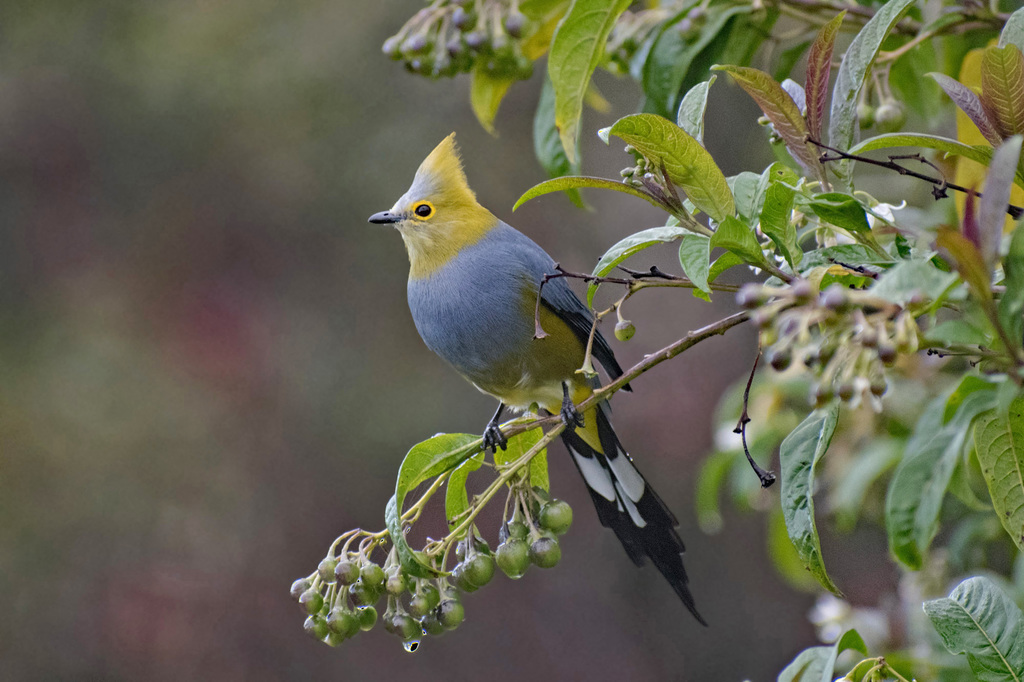
The long-tailed silky-flycatcher, (Ptiliogonys caudatus), is a passerine bird which occurs only in the mountains of Costa Rica and western Panama, usually from 1,850 m altitude to the timberline. It is a thrush-sized species weighing about 37 g. The silky-flycatchers are related to waxwings, and like that group have soft silky plumage.
From the article Long-tailed silky-flycatcher on Wikipedia (CC BY-SA), quoted section by section
Description
The long-tailed silky-flycatcher is 20 to 24.4 cm (7.9 to 9.6 in) long and weighs about 37 g (1.3 oz). It is a slender bird with a prominent crest and a long tail whose central pair of feathers extend beyond the others. Adult males have a gray forehead and crown and a thin yellow eye-ring. The rest of their face, their crest, and their neck are yellowish olive-green. Their back, rump, uppertail coverts and upperwing coverts are bluish gray. Their flight feathers and tail are black with most tail feathers having a large white patch in their middle. Their throat is grayish olive-green and their breast and upper belly a slightly paler olive-green than their back. Their lower belly, sides, and flanks are yellowish olive-green and their undertail coverts bright yellow. Adult females are overall duller than males and have a somewhat shorter tail. Their head, neck, and crest are a paler yellowish olive-green than the male's. Their back, rump, uppertail coverts, upperwing coverts, breast, and upper belly are olivaceous gray. Their lower belly is yellowish white, their flanks greenish yellow, and their undertail coverts yellow. Both sexes have a dark iris, a black bill, and black legs and feet. Juveniles are generally light grayish brown. They have a whitish eye-ring, brownish uppertail coverts, paler underparts than adults, pale yellow undertail coverts, and brownish bill and feet.
Range & habitat
The long-tailed silky-flycatcher is found in the Cordillera Central in central Costa Rica and the Cordillera de Talamanca which extends from south-central Costa Rica into western Panama. The ranges are separated from each other by deep river valleys in which the silky-flycatcher is not found. It inhabits somewhat open landscapes in the subtropical and temperate zones. These include the edges of primary forest, secondary forest, pastures with scattered trees, and gardens. Sources differ on the species' elevational range. Two state it as 1,800 to 3,000 m (5,900 to 9,800 ft) and a third as 1,600 m (5,200 ft) to timberline.
Wikipedia: “Distribution and habitat”
What it does
The long-tailed silky-flycatcher feeds on insects and small fruits. It feeds on fruit at any level of its habitat by plucking while perched. It takes insects in mid-air from a perch high in a tree, often gathering several in one sortie.
Wikipedia: “Feeding”
Listen
Looking for field recordings…
Where it lives
Recorded sightings
—
geo-referenced records in GBIF, from museums, herbaria and field observers.
Drag the globe to turn it. Dots are where records exist, not a range map; darker means more records.
In the stacks
Searching the stacks…
Every page naming Ptiliogonys caudatus in the Biodiversity Heritage Library →
This page is assembled live from iNaturalist, GBIF, Wikipedia, the Source Library and the Internet Archive. It is not yet part of the hand-edited codex. iNaturalist taxon 367680.