On eBird ↗
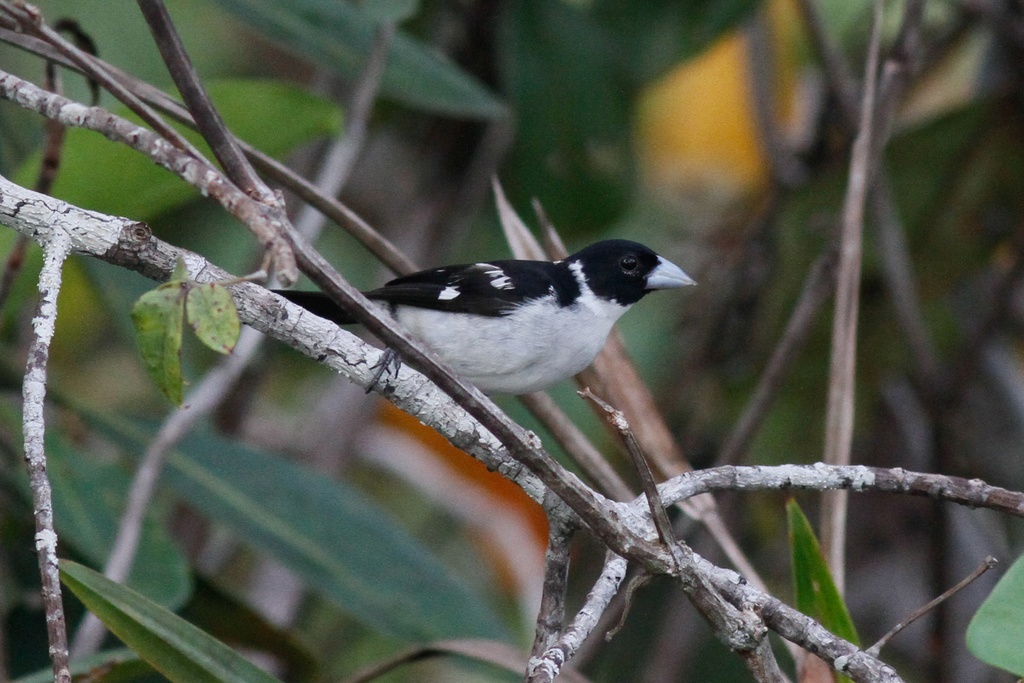
White-naped Seedeater
Live sightings near you, the range map, bar charts of when it is seen, and Macaulay Library photos and recordings.
White-naped Seedeater
Sporophila fringilloides
The white-naped seedeater (Sporophila fringilloides) is a species of bird in the family Thraupidae. Sometimes classified in the bunting and American sparrow family Emberizidae, more recent studies have shown it to belong in the Thraupidae.
From the article White-naped seedeater on Wikipedia (CC BY-SA), quoted section by section
Description
The white-naped seedeater is 13 to 13.5 cm (5.1 to 5.3 in) long; three males weighed an average of 12.7 g (0.45 oz) and 10 females 13.1 g (0.46 oz). It is slim, with a longish tail, and has a large, sharp, triangular bill. The species is sexually dimorphic. Adult males have a black head with a white collar below the nape. Their upperparts are mostly black with a white rump. Their wings are mostly black with white median coverts, white tips on the greater coverts, and white bases on the primaries. The white median coverts show as a bold wing bar and the greater covert tips as a smaller one; the white of the primaries is seldom visisble. Their tail is black. Their throat is black and the rest of their underparts mostly white with a small black wedge on the side of the breast, pale grayish sides, and pale grayish flanks with faint blackish blotches. Adult females have a dull brown head, upperparts, wings, and tail. Their throat, breast, and flanks are brownish, their belly whitish, and their undertail coverts buffy. Juveniles resemble adult females. Both sexes have a brown or dark brown iris. Males have an ivory to light blue bill and gray or dark gray legs; females have a gray bill and grayish black or gray-brown legs.
Range & habitat
The white-naped seedeater's primary range extends from Guaviare, Vaupes, and Guainia departments in southeastern Colombia east into south-central Amazonas state in southern Venezuela and very slightly into northwestern Brazil's Amazonas state. There are also scattered records further east in Brazil. A record in southern Guyana was announced in 2005. The white-naped seedeater is primarily bird of forest on nutrient-poor white sand though it also is found along the edges of forest on richer soils and in grassy savanna. It favors landscapes with much large-leafed herbaceous plants and terrestrial arums. In elevation it reaches 250 m (800 ft) in Colombia and Brazil and 200 m (700 ft) in Venezuela.
Wikipedia: “Distribution and habitat”
What it does
The white-naped seedeater apparently feeds primarily on seeds, though insects and mistletoe (Loranthaceae) berries are also part of its diet. It typically forages singly or in pairs and rarely with other species. It has been observed foraging up to about 4 m (13 ft) above the ground.
Wikipedia: “Feeding”
Listen
Looking for field recordings…
Where it lives
Recorded sightings
—
geo-referenced records in GBIF, from museums, herbaria and field observers.
Drag the globe to turn it. Dots are where records exist, not a range map; darker means more records.
In the stacks
Searching the stacks…
Every page naming Sporophila fringilloides in the Biodiversity Heritage Library →
This page is assembled live from iNaturalist, GBIF, Wikipedia, the Source Library and the Internet Archive. It is not yet part of the hand-edited codex. iNaturalist taxon 367687.