On eBird ↗
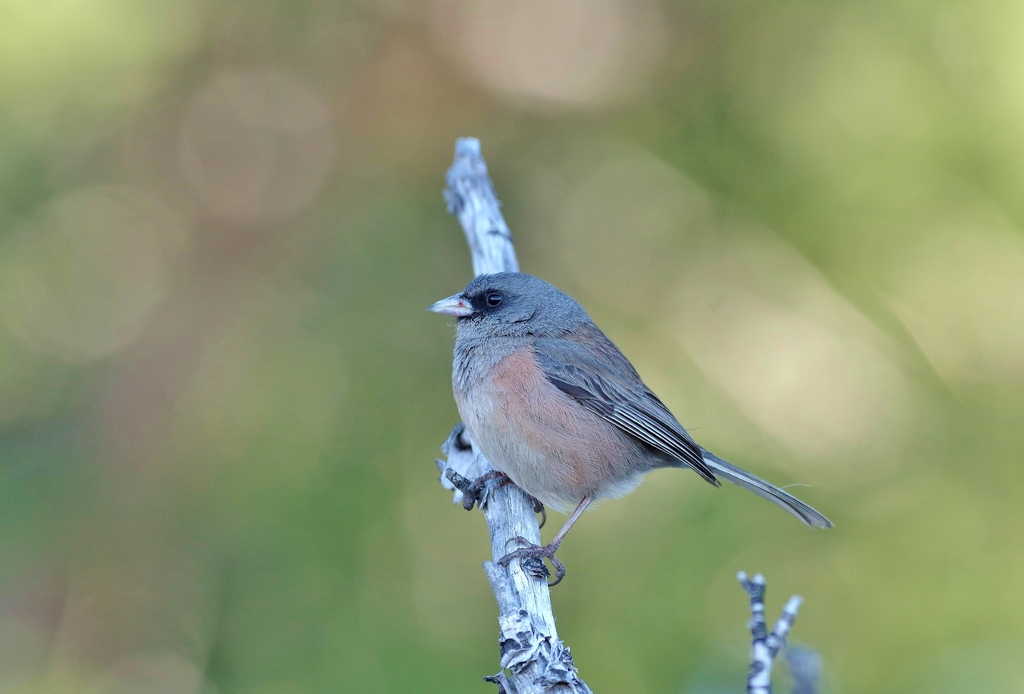
Guadalupe Junco
Live sightings near you, the range map, bar charts of when it is seen, and Macaulay Library photos and recordings.
Guadalupe Junco
Junco insularis
The Guadalupe junco (Junco insularis) is a small bird in the New World sparrow family that is endemic to Guadalupe Island off the western coast of Baja California, Mexico. Many taxonomic authorities classified it in 2008 as a subspecies of the dark-eyed junco (Junco hyemalis). In 2016, it was re-classified as a full species.
From the article Guadalupe junco on Wikipedia (CC BY-SA), quoted section by section
Description
The Guadalupe junco has a dull grayish head with a gray bill and brownish upperparts. Its wings and tail are blackish, though the tail has white edges. Its underparts are white with a rufous fringe at the bottom of the wings. It makes a high, sharp sik and a long series of chipping notes. This bird is today found mainly in the Guadalupe cypress (Cupressus guadalupensis) groves on Guadalupe Island, with a few birds in the remaining Monterey pine (Pinus radiata) stands. Around 1900, it was known to utilize almost any habitat for breeding. It ranged over the whole island for feeding then, and indeed still does theoretically, but actually only a handful of flocks exist, mostly in the northern part of the island. A testimony to the adaptability of this species is the fact that, today, a few birds breed at the seashore in non-native tree tobacco (Nicotiana glauca) shrubs, since this is dense enough to provide some protection from feral cats. The breeding season is from February to June. Three to four eggs are laid in a bulky cup nest of dried grass stems, which is either in a depression in the ground or in the lower branches of a tree. The eggs are greenish-white with reddish-brown spots. If food is plentiful, the birds apparently breed twice a year.
Wikipedia: “Description and ecology”
Listen
Looking for field recordings…
Where it lives
Recorded sightings
—
geo-referenced records in GBIF, from museums, herbaria and field observers.
Drag the globe to turn it. Dots are where records exist, not a range map; darker means more records.
In the stacks
Searching the stacks…
Every page naming Junco insularis in the Biodiversity Heritage Library →
This page is assembled live from iNaturalist, GBIF, Wikipedia, the Source Library and the Internet Archive. It is not yet part of the hand-edited codex. iNaturalist taxon 367689.