On eBird ↗
Tooth-billed Pigeon
Live sightings near you, the range map, bar charts of when it is seen, and Macaulay Library photos and recordings.
Tooth-billed Pigeon
Didunculus strigirostris
The tooth-billed pigeon (Didunculus strigirostris), also known as the manumea, is a large pigeon found only in Samoa. It is the only living species of genus Didunculus. A related extinct species, the Tongan tooth-billed pigeon (Didunculus placopedetes), is only known from subfossil remains in several archeological sites in Tonga. The tooth-billed pigeon is the national bird of Samoa and featured on the 20 tālā bills and the 50 sene pieces of the 2008/2011 series.
From the article Tooth-billed pigeon on Wikipedia (CC BY-SA), quoted section by section
Description
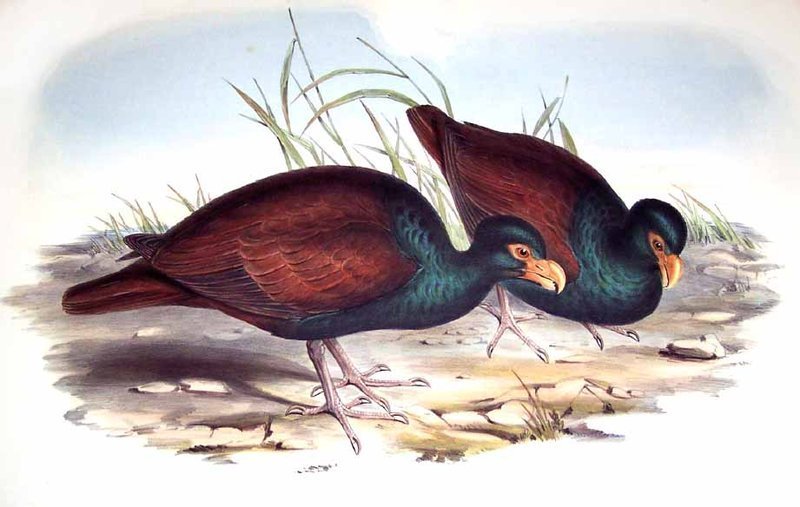
The tooth-billed pigeon is a medium-sized, approximately 31 centimetres (12 in) long, dark pigeon with reddish feet and red bare skin around the eye. The underparts, head and neck are greyish with a slight blue-green iridescence, and the tail, wings-coverts and tertials are rufous chestnut, while the remaining remiges are blackish. It has a large, curved, and hooked bright red bill, with tooth-like projections on the lower mandible which let them act as seed dispensers. The sexes are similar in appearance, but the juvenile is duller, with a browner head, and a black bill with pale orange at the base. Behaviourally, it is unusual – perhaps unique among members of Columbiformes in drinking by scooping water up in its bill, in the manner of the great majority of bird species, rather than sucking it up using the tongue as a straw.
Range & habitat
The tooth-billed pigeon is confined to undisturbed forests of both the islands of Samoa in the Pacific. It is only found on three islands, Savai'i, Upolu, and Nu'utele. It lives away from sea level on it's main food source, the fruits of 2 species of Dysoxylum, a tree in the mahogany family, though baby chicks are unable to do so.
Wikipedia: “Distribution and habitat”
Listen
Looking for field recordings…
Where it lives
Recorded sightings
—
geo-referenced records in GBIF, from museums, herbaria and field observers.
Drag the globe to turn it. Dots are where records exist, not a range map; darker means more records.
In the stacks
Searching the stacks…
Every page naming Didunculus strigirostris in the Biodiversity Heritage Library →
This page is assembled live from iNaturalist, GBIF, Wikipedia, the Source Library and the Internet Archive. It is not yet part of the hand-edited codex. iNaturalist taxon 3685.