- Animals
- ›Chordates
- ›Vertebrates
- ›Ray-finned Fishes
- ›Spiny-rayed fishes
- ›Jacks, Flounders, Barracudas, and Allies
- ›Flatfishes
- ›Large-tooth Flounders
- ›Pseudorhombus
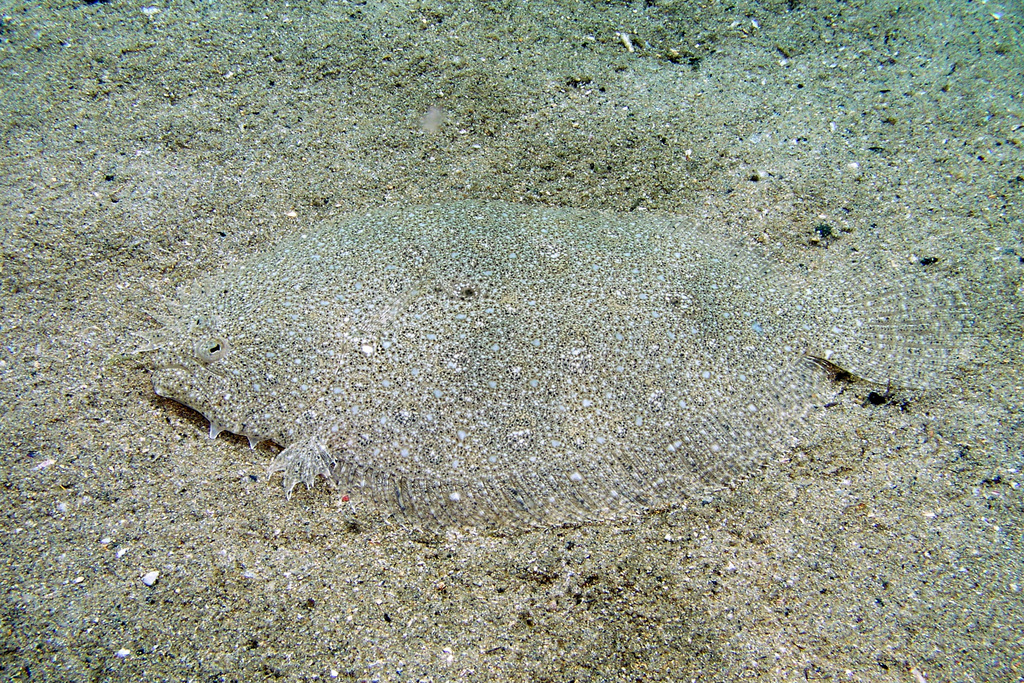
Largetooth Flounder
Pseudorhombus arsius
Pseudorhombus arsius, the largetooth flounder, is a species of left-eyed flatfish. As an adult, the dark side of its body, where its eyes are located, is on the left side. It belongs to the family Paralichthyidae. As Rhombus polyspilos, it was named as the type species of the genus Pseudorhombus. It is an Indo-Pacific species and is caught by both recreational and commercial fisheries.
From the article Pseudorhombus arsius on Wikipedia (CC BY-SA), quoted section by section
Description
Pseudorhombus arsius has an oval-shaped body which has a depth which is 1.8 to 2.3 times its standard length. The head has a slight notch in front of its upper eye. The eyes are on the left side and have a diameter which is a fifth of the length of the head and the snout has a length equal to or slightly greater than the diameter of the eye. The dorsal fin starts in front of its upper eye and of the nostrils on blind side. The mouth forms a deep cleft with the maxilla normally almost half the length of the head. The jaws and teeth are nearly equally developed on both jaws. The upper jaw reaches to below the posterior edge of the lower eye. There are several pairs of moderately large caniform teeth in the anterior parts of both jaws, which are of unequal size and arranged in a single row. These number 5 to 8 in the lower jaw on the eyed side, and 6 to 13 lateral teeth in lower jaw of blind side which are more robust and more widely spaced than those of upper jaw. The gill rakers are pointed, longer than they are broad. It has simple fin-rays which number 71–84 in the dorsal fin, 53–62 in the anal fin and 11–13 in the pectoral fin. The lateral line curves above the pectoral fin has 69-81 scales and there are 36 vertebrae. In the dorsal fin, the longest rays are found in the posterior third and only the rearmost three or four rays are branched, as at the last five anal fin rays. …
Range & habitat
Pseudorhombus arsius is found in the tropical and temperate waters from the Persian Gulf and the eastern coast of Africa as far south as Algoa Bay and possibly even Knysna to Fiji in the western Pacific, to southern Japan in the north and as far south as the northern coast of Australia. It may extend as far south as the Bass Strait.
Wikipedia: “Distribution”
Where it lives
Recorded sightings
—
geo-referenced records in GBIF, from museums, herbaria and field observers.
Drag the globe to turn it. Dots are where records exist, not a range map; darker means more records.
In the stacks
Searching the stacks…
Every page naming Pseudorhombus arsius in the Biodiversity Heritage Library →
This page is assembled live from iNaturalist, GBIF, Wikipedia, the Source Library and the Internet Archive. It is not yet part of the hand-edited codex. iNaturalist taxon 368886.