On eBird ↗
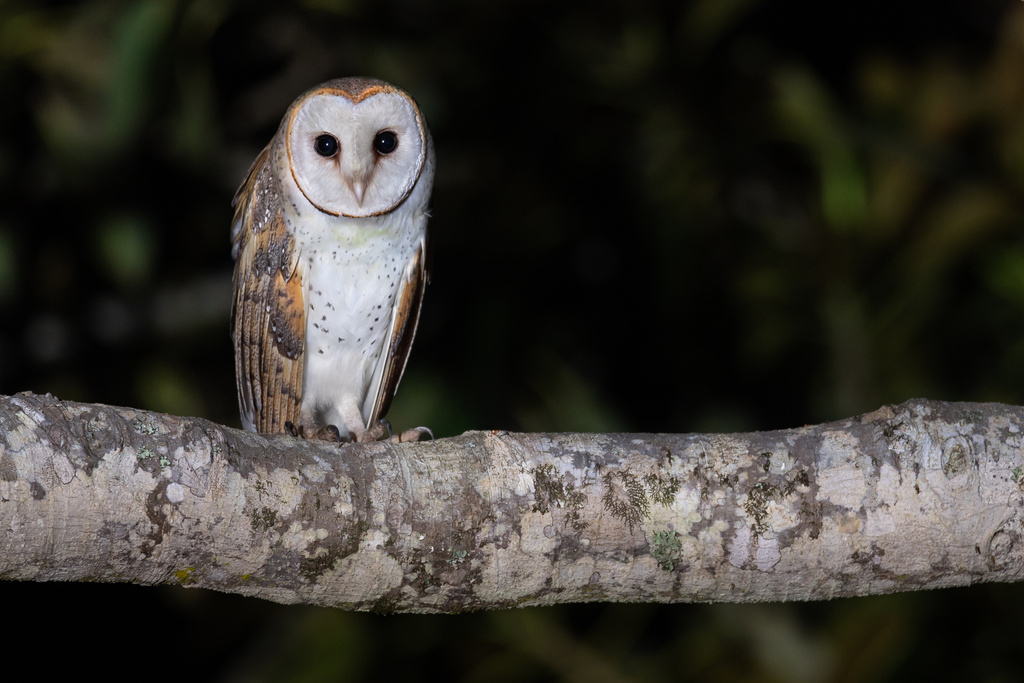
Eastern Barn Owl
Live sightings near you, the range map, bar charts of when it is seen, and Macaulay Library photos and recordings.
Eastern Barn Owl
Tyto javanica
The Eastern barn owl (Tyto javanica) is usually considered a subspecies group and together with the American barn owl group, the western barn owl group, and sometimes the Andaman masked owl make up the genus Tyto. The cosmopolitan barn owl is recognized by most taxonomic authorities. A few (including the International Ornithologists' Union) separate them into distinct species, as is done here. The eastern barn owl is native to southeastern Asia, New Zealand, and Australasia.
The eastern barn owl is nocturnal over most of its range, but in some Pacific islands, it also hunts by day. They specialise in hunting animals on the ground, and nearly all of their food consists of small mammals which they locate by sound, their hearing being very acute. They mate for life unless one of the pair is killed, after which a new pair bond may be formed. Breeding takes place at varying times of year according to locality, with a clutch, averaging about four eggs, being laid in a nest in a tree hollow, old building or fissure in a cliff. The female does all the incubation, and she and the young chicks are reliant on the male for food. When large numbers of small prey are readily available, barn owl populations can expand rapidly.
From the article Eastern barn owl on Wikipedia (CC BY-SA), quoted section by section
Range & habitat
The eastern barn owl occurs on the Indian subcontinent, Southeast Asia, Australia, and many Pacific Islands. In general it is considered to be sedentary, and indeed many individuals, having taken up residence in a particular location, remain there even when better foraging areas nearby become vacant. In Australia there is some migration as the birds move towards the northern coast in the dry season and southward in the wet, and also nomadic movements in association with rodent plagues. Occasionally, some of these birds turn up on Norfolk Island, Lord Howe Island or New Zealand, showing that crossing the ocean is not beyond their capabilities. In 2008, eastern barn owls were recorded for the first time breeding in New Zealand.
Wikipedia: “Distribution”
What it does
Like most owls, the barn owl is nocturnal, relying on its acute sense of hearing when hunting in complete darkness. It often becomes active shortly before dusk and can sometimes be seen during the day when relocating from one roosting site to another. On various Pacific Islands and perhaps elsewhere, it sometimes hunts by day. This practice may depend on whether the owl is mobbed by other birds if it emerges in daylight. The barn owl is a bird of open country such as farmland or grassland with some interspersed woodland, usually at altitudes below 2,000 metres (6,600 ft) but occasionally as high as 3,000 metres (9,800 ft) in the tropics. This owl prefers to hunt along the edges of woods or in rough grass strips adjoining pasture. It has an effortless wavering flight as it quarters the ground, alert to the sounds made by potential prey. Like most owls, the barn owl flies silently; tiny serrations on the leading edges of its flight feathers and a hairlike fringe to the trailing edges help to break up the flow of air over the wings, thereby reducing turbulence and the noise that accompanies it. Hairlike extensions to the barbules of its feathers, which give the plumage a soft feel, also minimise noise produced during wingbeats. Items consumed can be ascertained from identifying the prey fragments in the pellets of indigestible matter that the bird regurgitates. …
Wikipedia: “Behaviour and ecology”
Listen
Looking for field recordings…
Where it lives
Recorded sightings
—
geo-referenced records in GBIF, from museums, herbaria and field observers.
Drag the globe to turn it. Dots are where records exist, not a range map; darker means more records.
In the stacks
Searching the stacks…
Every page naming Tyto javanica in the Biodiversity Heritage Library →
This page is assembled live from iNaturalist, GBIF, Wikipedia, the Source Library and the Internet Archive. It is not yet part of the hand-edited codex. iNaturalist taxon 370399.