- Animals
- ›Chordates
- ›Vertebrates
- ›Reptiles
- ›Snakes and Lizards
- ›Lizards
- ›Skinks and allies
- ›Skinks
- ›Sphenomorphine Skinks
- ›Ctenotus
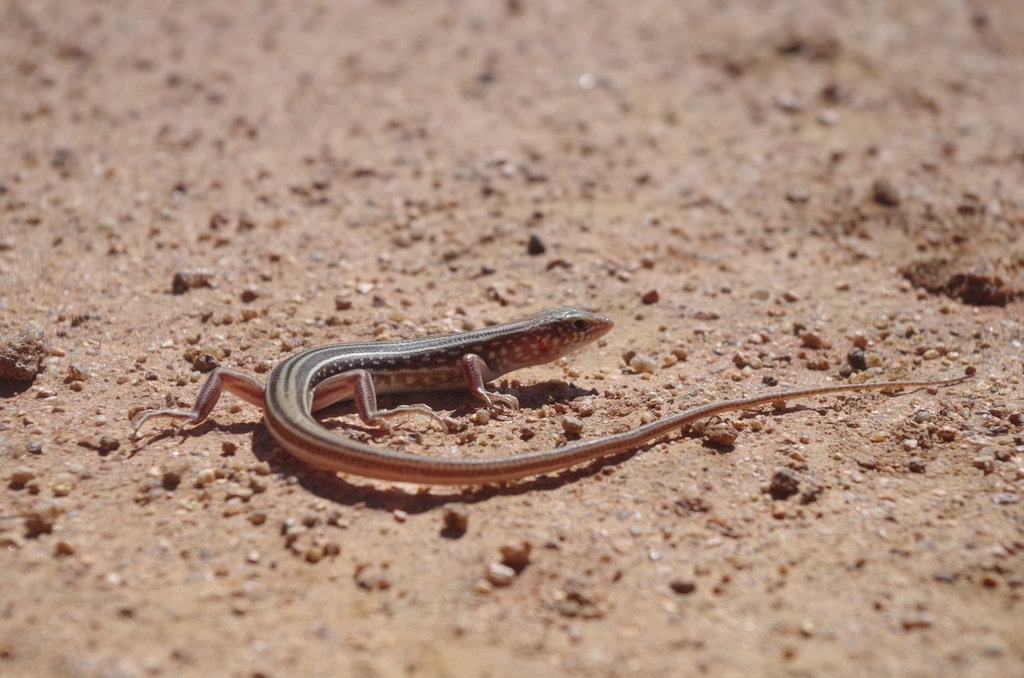
Common Desert Ctenotus
Ctenotus leonhardii
Ctenotus leonhardii, known by the common names Leonhardi's ctenotus, Leonhardi's skink, and the common desert ctenotus, is a species of lizard in the subfamily Sphenomorphinae of the family Scincidae. The species is found in a range of arid and semi-arid regions throughout mainland Australia. Named after German anthropologist Moritz von Leonhardi in 1919, it belongs to the genus Ctenotus, one of the largest genera of lizards in Australia.
From the article Ctenotus leonhardii on Wikipedia (CC BY-SA), quoted section by section
Description
Leonhardi's ctenotus is a small, slender terrestrial skink. This species is typically brown to ochre-brown above, sometimes with a dark brown stripe running down the vertebral row of dorsal scales. There are pale stripes running from the eyes down to the tail on either side, often with a dark brown edge above. Below this stripe is a darker, sometimes black lateral stripe with a complex pattern of white spots over the top. From the groin there is a pale cream stripe running towards the flanks, with a series of white spots near the arms and a continuing pale lateral stripe down the length of the tail. Like all other Ctenotus species, Leonhardi's ctenotus has four limbs, five digits on each limb, and smooth scales, with a distinctive row of small scales near the ear. Leonhardi's ctenotus adults can grow to a maximum snout-to-vent length (SVL) of 7.9 cm (3.1 in), weighing on average 9.14 g (0.322 oz). Males and females grow to a similar size, unlike many other Ctenotus species which demonstrate sexual dimorphism. Leonhardi's ctenotus is one of the slower growing Ctenotus species, reaching maturity at 18 months. Juveniles grow at a rate of 0.22 mm (0.0087 in) per day from hatching and commonly live for 5 years, though the oldest recorded specimen was 7 years old.
Range & habitat
Leonhardi's ctenotus is found in the arid and semi-arid regions of central Western Australia, the lower half of the Northern Territory, northern South Australia, south-west Queensland and north-west New South Wales. It is a common species in these regions, often seen basking in the sun in the morning in open areas.
Wikipedia: “Distribution”
What it does
Leonhardi's ctenotus has been found in a range of arid habitat types including open grasslands, sandplain deserts dominated by spinifex, and semi-arid shrublands. It is particularly abundant in acacia and chenopod-dominated shrublands and prefers habitats with grassy groundcover. Spinifex tussocks provide protection from predators, harsh environmental conditions and an abundant supply of insects. Within chenopod-dominated ecosystems, this species has been found to be significantly associated with high densities of Maireana species. It is a burrowing skink and shelters in burrows with at least two entrances. Like many other lizards, Leonhardii's ctenotus is able to survive in harsh desert environments due to the use of ectothermy which allows metabolic inactivity to occur in harsh conditions (i.e. aestivation). However, unlike some other lizard species Leonhardi's ctenotus is diurnal and active during the hottest hours of the day As a result, it has the highest active body temperature recorded for any skink species. The home range of Leonhardi's ctenotus ranges from 20-60 square meters (215–646 square feet), similar to the home range size for other Ctenotus species. Leonhardi's ctenotus is carnivorous, with a generalist insectivore diet. It is an active forager, foraging within the open spaces between grasses and other groundcover plants for prey. …
Wikipedia: “Habitat and ecology”
In human culture
Leonhardi's ctenotus was named after German anthropologist Moritz von Leonhardi by herpetologist Richard Sternfeld in 1919. The species is in the Scincidae family (skinks), belonging to the genus Ctenotus. In the past this genus was included within the genus Sphenomorphus, before being raised to generic status in 1964. Ctenotus species are commonly called "comb-eared skinks" due to the shape of the small scales near the ear. Ctenotus is one of the largest genera of lizards in Australia, containing nearly 100 species. It is one of the most abundant genera of lizards in arid and semi-arid Australia, and one of the most diverse genera of terrestrial vertebrates globally. Ctenotus is further divided into a number of species groups that are based on morphological similarity and which include the Ctenotus leonhardii group, to which Leonhardi's ctenotus belongs.
Wikipedia: “Etymology and taxonomy”
Where it lives
Recorded sightings
—
geo-referenced records in GBIF, from museums, herbaria and field observers.
Drag the globe to turn it. Dots are where records exist, not a range map; darker means more records.
In the stacks
Searching the stacks…
Every page naming Ctenotus leonhardii in the Biodiversity Heritage Library →
This page is assembled live from iNaturalist, GBIF, Wikipedia, the Source Library and the Internet Archive. It is not yet part of the hand-edited codex. iNaturalist taxon 37085.