- Animals
- ›Chordates
- ›Vertebrates
- ›Ray-finned Fishes
- ›Spiny-rayed fishes
- ›Perches, Scorpionfishes, Sticklebacks, and Allies
- ›Scorpionfishes and Allies
- ›Stonefishes
- ›Australian Prowfishes
- ›Pataecus
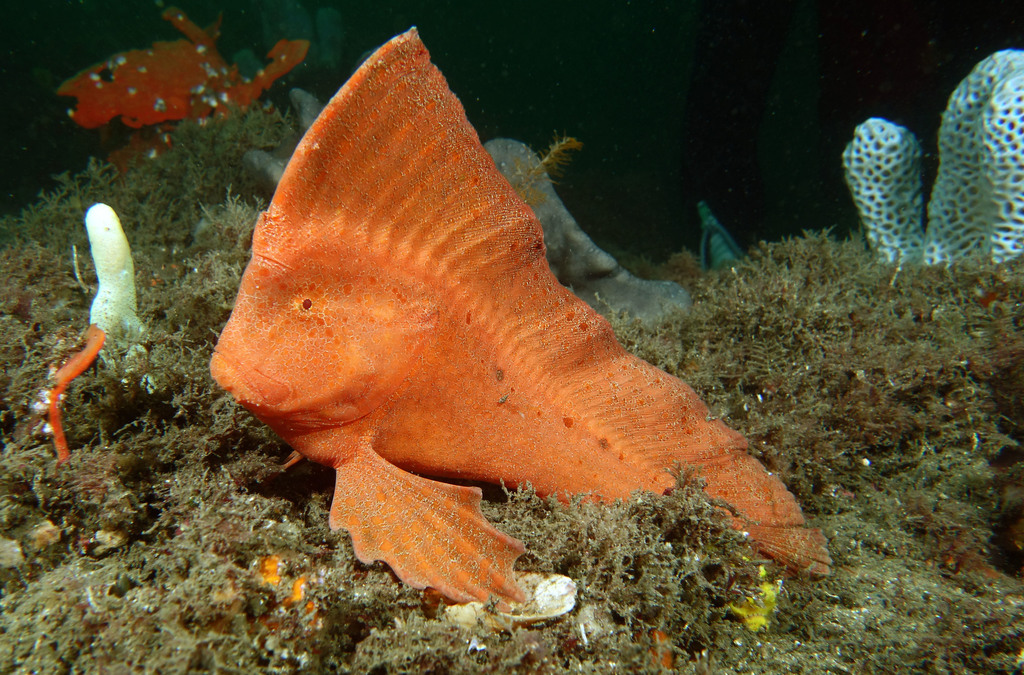
Red Indianfish
Pataecus fronto
The Red Indian fish (Pataecus fronto), also known as the red forehead fish, is a species of marine ray-finned fish, an Australian prowfish belonging to the subfamily Pataecinae. It is endemic to the coastal waters of western and southern Australia where it occurs at depths of from 5 to 80 metres (16 to 262 ft). This species is the only known member of its genus.
From the article Red Indian fish on Wikipedia (CC BY-SA), quoted section by section
Description
The Red Indian fish has an elongated, highly compressed body which is deepest towards the head, wedge-shaped with the thinnest part being the caudal peduncle. The relatively small eyes are placed high on the head and the mouth is oblique with tiny teeth on the jaws. The upper part of the operculum has two diagonal low ridges and the head is not spined. The skin is smooth and lacks scales. The long dorsal fin starts on the head in front of the eyes with a short spine but the longest spines are towards the front and they reduce in size towards the tail. The dorsal fin contains between 22 and 25 spines and 14 to 17 soft rays, the anal fin has between 9 and 11 spines and 4 to 7 soft rays. The dorsal fin is joined to the rounded caudal fin. The large pectoral fins are located low on the body and there are no pelvic fins. This species reaches a maximum total length of 35 cm (14 in). The colours may be scarlet, brick red or orange. They are infrequently pale or show black or white spots, sometimes both, mostly on the dorsal part of the body.
Range & habitat
The Red Indian fish is endemic to the waters off southern Australia where it is found from Maroochydore in southern Queensland to Barragga Bay in southern New South Wales on the east coast and then from, Gulf St Vincent in South Australia to Shark Bay in Western Australia on the southern and western coasts. This demersal fish is only infrequently recorded in South Australia, suggesting that it may prefer deeper reefs there. It lives within communities of sponges on coastal reefs and estuaries as deep as 80 m (260 ft). In NSW it is often seen at shallow depths by scuba divers. It is mostly seen inside bays or harbours and almost always only on the northern side of the inlet. Even more interestingly, when seen, it is normally on the northern side of rocks or sponges. It is rare to see on the southern side of inlets or even rocks. Very little is known about red indianfish from their birth till they reach almost adult size. Few, if any, photos exist of very small specimens.
Wikipedia: “Distribution and habitat”
In human culture
The Red Indian fish's common name derives from the long, high dorsal fin beginning on the head which resembles the headdress of a Native American chief as seen in popular Western films.
== References ==
Wikipedia: “Etymology of common name”
Where it lives
Recorded sightings
—
geo-referenced records in GBIF, from museums, herbaria and field observers.
Drag the globe to turn it. Dots are where records exist, not a range map; darker means more records.
In the stacks
Searching the stacks…
Every page naming Pataecus fronto in the Biodiversity Heritage Library →
This page is assembled live from iNaturalist, GBIF, Wikipedia, the Source Library and the Internet Archive. It is not yet part of the hand-edited codex. iNaturalist taxon 371888.