- Animals
- ›Chordates
- ›Vertebrates
- ›Reptiles
- ›Snakes and Lizards
- ›Lizards
- ›Skinks and allies
- ›Skinks
- ›Social skinks
- ›Corucia
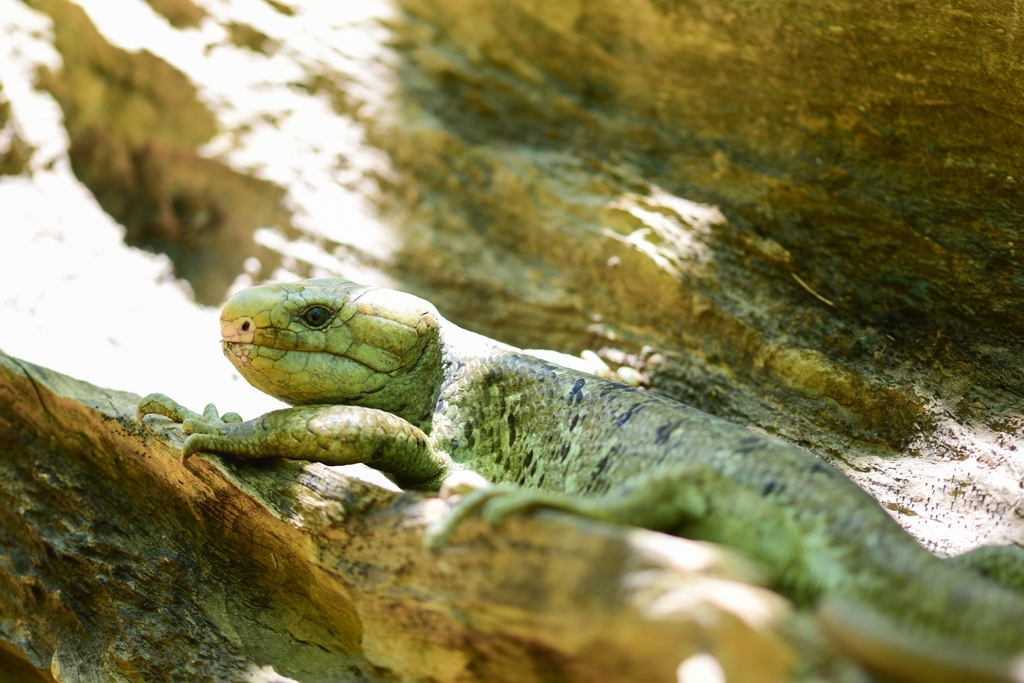
Solomon Islands Skink
Corucia zebrata
The Solomon Islands skink (Corucia zebrata), also known as prehensile-tailed skink, monkey-tailed skink, giant skink, zebra skink, and monkey skink, is an arboreal species of skink endemic to the Solomon Islands archipelago. It is the largest known extant species of skink.
The Solomon Islands skink is completely herbivorous, eating many different fruits and vegetables including the pothos plant. It is one of the few species of reptile known to function within a social group or circulus. Both male and female specimens are known to be territorial and often hostile towards members not a part of their family group.
From the article Solomon Islands skink on Wikipedia (CC BY-SA), quoted section by section
Range & habitat
The Solomon Islands skink is native to Papua New Guinea, and the Solomon Islands archipelago, a group of islands in the south-west Pacific Ocean. The common subspecies (C. z. zebrata) is found on the islands of Choiseul, New Georgia, Santa Isabel, Guadalcanal, Nggela, Malaita, Makira, Ugi and Owaraha. The northern subspecies (C. z. alfredschmidti) is known from the islands of Bougainville and Buka and the Shortland Islands. Bougainville and Buka are geographically part of the Solomons Archipelago, though politically part of Papua New Guinea. Both subspecies of the Solomon Islands skink are strictly arboreal, usually inhabiting the upper canopy of forested areas throughout its range. The adults commonly establish a territory within the canopy of one tree. It commonly occurs in the strangler fig tree (Ficus sp.), provided the epiphytic growth of its several food plants are present. It occurs in trees in semi-cleared areas and cultivated food gardens, again provided its food plants occur there.
Wikipedia: “Distribution and habitat”
What it does
Solomon Islands skinks are herbivores, feeding on the leaves, flowers, fruit, and growing shoots of several different species of plants. This includes the somewhat toxic (due to high concentrations of calcium oxalate) Epipremnum pinnatum (cf. E. aureum) plant, which the lizard eats without ill effect. Juvenile skinks often eat feces from adults in order to acquire the essential microflora to digest their food. Newborn skinks have been observed consuming their placental sac after birth and will not feed on other food for the first two days. A study done in 2000 showed that this species still exhibits a feed response based on chemical cues from insects. It is believed that this is an ancestral trait that these skinks have retained, though it is not used in the wild.
Wikipedia: “Diet”
In human culture
The Solomon Islands skink was first described by John Edward Gray in 1855 as Corucia zebrata. The generic name Corucia derives from the Latin word coruscus meaning "shimmering". This is in reference to Gray's description of "a play of colors effect from the body scales". Its specific name zebrata is a Latinized form of the word zebra, in reference to the animal's zebra-like stripes. Some of its common names (prehensile-tailed skink, monkey-tailed skink, monkey skink) refer to its fully prehensile tail which the species uses as a fifth limb for climbing. Although appearances of Solomon Island skinks vary from island to island, only one subspecies, from the western islands of the Solomons Archipelago, was described by Dr. Gunther Köhler in 1996 as C. z. alfredschmidti, the trinomial name of which is in honor of German amateur herpetologist Alfred A. Schmidt. The closest living relatives of C. zebrata are the blue-tongued skinks of the genus Tiliqua and skinks of the genus Egernia of Australia, New Guinea, and Indonesia, all of which are also assigned to the subfamily Lygosominae.
Wikipedia: “Taxonomy and etymology”
Where it lives
Recorded sightings
—
geo-referenced records in GBIF, from museums, herbaria and field observers.
Drag the globe to turn it. Dots are where records exist, not a range map; darker means more records.
In the stacks
Searching the stacks…
Every page naming Corucia zebrata in the Biodiversity Heritage Library →
This page is assembled live from iNaturalist, GBIF, Wikipedia, the Source Library and the Internet Archive. It is not yet part of the hand-edited codex. iNaturalist taxon 37194.