- Animals
- ›Chordates
- ›Vertebrates
- ›Reptiles
- ›Snakes and Lizards
- ›Lizards
- ›Skinks and allies
- ›Skinks
- ›Typical skinks
- ›Chalcides
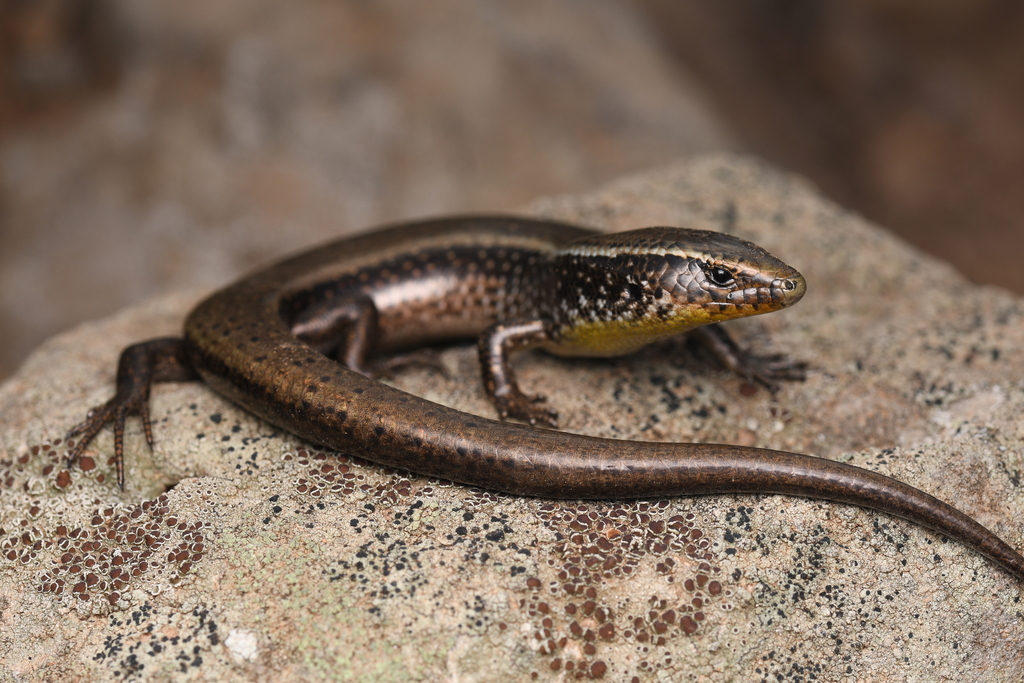
Gran Canaria Skink
Chalcides sexlineatus
The Gran Canaria skink (Chalcides sexlineatus) is a species of skink in the Scincidae family which is endemic to Gran Canaria. Its natural habitats are temperate forests, temperate shrubland, Mediterranean-type shrubby vegetation, temperate grassland, rocky areas, sandy shores, pastureland, and plantations. The adults measure 16 – 18 cm out of which the tail forms 50%. Their legs are tiny, slim, and have five fingers. They live solitarily and only seek a partner during the mating season. They...
From the article Gran Canaria skink on Wikipedia (CC BY-SA), quoted section by section
Description
The Gran Canaria skink has a flattened body and wide head, with strong legs that are longer in the north subspecies. The south subspecies has one phrenocular scale, while the north usually has two. The average total body length is around 150mm (6 inches) including the tail, with females being a few millimeters longer on average. The species is slightly smaller in the south. In the northeast, C. s. sexlineatus notably has a bright blue tail and light bluish belly. It has a black dorsolaetral band, separated from the side by a whitish or yellowish line. On the back there are four yellowish brown lines. In the southwest, C. s. bistriatus has a brown tail and white to yellowish belly. The back is brown with white spots arranged in a line down the body. On each side of the back there is a narrow light band. Intermediate populations between the north and south have a green tail.
Range & habitat
It is abundant in nearly all habitats throughout Gran Canaria, from coastal areas, temperate forest and grassland, rocky peaks, and agricultural areas, though it is rarer in pine forests and the drier areas of the south. They are ovoviviparous. Breeding occurs in July and August, and they give birth to 2–7 starting in September. The skinks are elusive and may be difficult to sight. It feeds mainly on insect larvae and other small invertebrates.
Wikipedia: “Habitat and ecology”
Where it lives
Recorded sightings
—
geo-referenced records in GBIF, from museums, herbaria and field observers.
Drag the globe to turn it. Dots are where records exist, not a range map; darker means more records.
In the stacks
Searching the stacks…
Every page naming Chalcides sexlineatus in the Biodiversity Heritage Library →
This page is assembled live from iNaturalist, GBIF, Wikipedia, the Source Library and the Internet Archive. It is not yet part of the hand-edited codex. iNaturalist taxon 37214.