- Animals
- ›Chordates
- ›Vertebrates
- ›Ray-finned Fishes
- ›Spiny-rayed fishes
- ›Perches, Scorpionfishes, Sticklebacks, and Allies
- ›Sculpins and Allies
- ›Lumpfishes
- ›Spiny Lumpsuckers
- ›Eumicrotremus
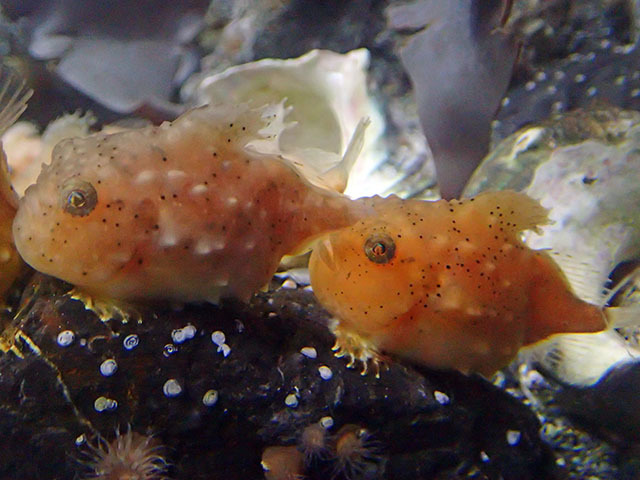
spotted lumpsucker
Eumicrotremus pacificus
Eumicrotremus pacificus, commonly known as the spotted lumpsucker or the balloon lumpfish, is a species of lumpfish (family Cyclopteridae) native to the northwestern Pacific Ocean. It occurs in the Sea of Okhotsk, the Sea of Japan, the East China Sea, and the waters off Hokkaido and the Kuril Islands.
E. pacificus may be confused with the closely related Eumicrotremus orbis, which has an overlapping distribution. However, E. pacificus is typically larger, reaching up to 20 cm (7.9 in) in total length. It is generally yellow to orange in colour with small dark spots, and its tubercles are usually smaller and less pronounced than those of E. orbis, giving it a less spiny appearance.
From the article Eumicrotremus pacificus on Wikipedia (CC BY-SA), quoted section by section
Description
The spotted lumpsucker (Eumicrotremus pacificus) is a species of fish in the family Cyclopteridae. E. pacificus is often confused with the Pacific spiny lumpsucker (E. orbis) due to their similar spiny appearance and overlapping distribution in the Pacific Ocean. Like other species within the family, spotted lumpsuckers possess a suction disc located on the underside of the body. This disc is a highly modified pair of pelvic fins and is a distinguishing anatomical feature of the Cyclopteridae. The spotted lumpsucker has a globiform (rounded) body with an external bony armor. It has a ventral mouth and lacks a swim bladder. Most adult E. pacificus individuals are yellow to orange in colour, with small brown to black dots distributed across the body. Juvenile E. pacificus have been observed to exhibit darker head and body coloration, gradually developing the yellow and orange tones as they mature. In addition to its vibrant coloration, E. pacificus possesses bony tubercles that form part of its body armor. These tubercles grow from plaques distributed across the body. The plaques are less pronounced than those of the Pacific spiny lumpsucker (E. orbis). The individual spines are set into circular bases within the bony plaques. …
Range & habitat
The spotted lumpsucker (Eumicrotremus pacificus) is found in the northern regions of the Pacific Ocean, primarily along coastal and tidal areas. Its recorded range includes the East China Sea, the Sea of Okhotsk, the Sea of Japan, and the waters surrounding Hokkaido and the Kuril Islands. There are no known data indicating a preference for either warm or cold water temperatures. Research on the specific habitats occupied by E. pacificus within these regions is limited. However, other members of the family Cyclopteridae are commonly found among rocks, stones, seagrass, algae, and other solid substrates to which they can attach. Due to their limited swimming ability, spotted lumpsuckers are believed to inhabit a range of depths, including shallow coastal waters, deeper marine areas, and intertidal zones.
Wikipedia: “Distribution and habitat”
Where it lives
Recorded sightings
—
geo-referenced records in GBIF, from museums, herbaria and field observers.
Drag the globe to turn it. Dots are where records exist, not a range map; darker means more records.
In the stacks
Searching the stacks…
Every page naming Eumicrotremus pacificus in the Biodiversity Heritage Library →
This page is assembled live from iNaturalist, GBIF, Wikipedia, the Source Library and the Internet Archive. It is not yet part of the hand-edited codex. iNaturalist taxon 372198.