- Animals
- ›Chordates
- ›Vertebrates
- ›Ray-finned Fishes
- ›Salmons, Pikes and Mudminnows
- ›Salmons, Trouts, and Whitefishes
- ›Salmons, Trouts, and Whitefishes
- ›Graylings
- ›Thymallus
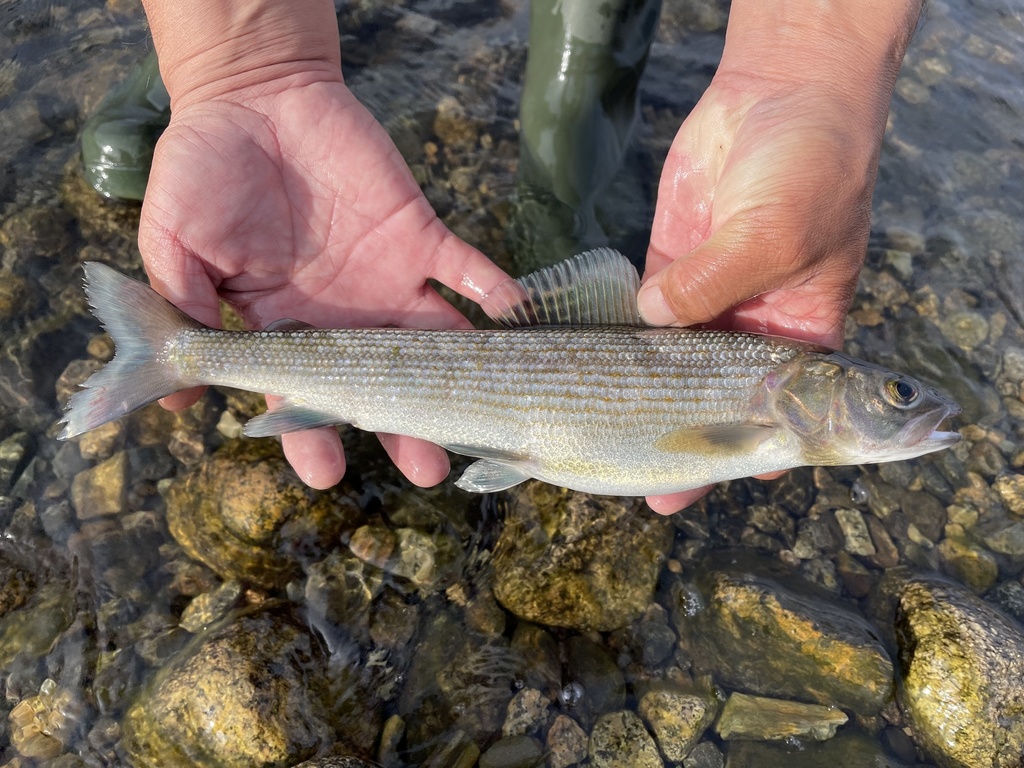
Mongolian Grayling
Thymallus brevirostris
The Mongolian grayling (Thymallus brevirostris) is a freshwater species of fish of the genus Thymallus endemic to the landlocked rivers in Mongolia, Inner Mongolia Province of China and nearby parts of Russian far east. It is considered to be the largest grayling species in the world, and hence viewed as an auspicious sign by local tribes.
From the article Mongolian grayling on Wikipedia (CC BY-SA), quoted section by section
Description
Mongolian grayling grow to a recorded maximum length of 65 cm (26 inches). The dorsal side is blackish, and the abdominal side is light. Black spots are uniformly present on both sides of the body. In adults, their upper jaw extends at least below the posterior edge of the eye. The Mongolian grayling is considered by researchers to be a relic from the Tertiary period.
Range & habitat
The Mongolian grayling is native to the landlocked lake region of Mongolia and the nearby Russian and Chinese areas, such as Khovd River, Issyk-Kul Lake and other rivers and lakes of the Altai Mountains, with Arctic graylings and their hybrids often found together. It is mostly found in the Central Asian basin of western Mongolia and the border region with Kazakhstan, as well as the Tuva Republic in southern Siberia.
Wikipedia: “Distribution”
What it does
The Mongolian grayling is omnivorous and lives predatorily at certain times of the year. During the summer months, it inhabits mountain rivers and lakes at all depths. In autumn and winter, it forms large shoals in front of the estuaries in lakes before spawning. It can only reproduce in cold, oxygen-rich water below temperatures of 20°C.
== References ==
Wikipedia: “Life cycle”
Where it lives
Recorded sightings
—
geo-referenced records in GBIF, from museums, herbaria and field observers.
Drag the globe to turn it. Dots are where records exist, not a range map; darker means more records.
In the stacks
Searching the stacks…
Every page naming Thymallus brevirostris in the Biodiversity Heritage Library →
This page is assembled live from iNaturalist, GBIF, Wikipedia, the Source Library and the Internet Archive. It is not yet part of the hand-edited codex. iNaturalist taxon 372260.