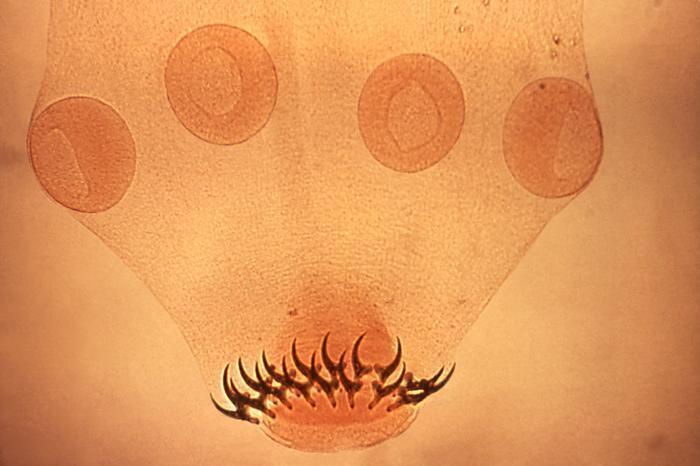
Pork Tapeworm
Taenia solium
Taenia solium, the pork tapeworm, belongs to the cyclophyllid cestode family Taeniidae. It is found throughout the world and is most common in countries where pork is eaten. It is a tapeworm that uses humans (Homo sapiens) as its definitive host and pigs and boars (family Suidae) as the intermediate or secondary hosts. It is transmitted to pigs through human feces that contain the parasite eggs and contaminate their fodder. Pigs ingest the eggs, which develop into larvae, then into oncospheres, and ultimately into infective tapeworm cysts, called cysticerci. Humans acquire the cysts through consumption of uncooked or undercooked pork and the cysts grow into adult worms in the small intestine.
There are two forms of human infection. One is "primary hosting", called taeniasis, and is due to eating undercooked pork that contains the cysts, resulting in adult worms in the intestines. This form generally is without symptoms; the infected person does not know they have tapeworms. This form is easily treated with anthelmintic medications which eliminate the tapeworm. The other form, "secondary hosting", called cysticercosis, is due to eating food, or drinking water, contaminated with faeces from someone infected by the adult worms, thus ingesting the tapeworm eggs, instead of the cysts. The eggs go on to develop cysts primarily in the muscles, and usually with no symptoms. However, some people have obvious symptoms, the most harmful and chronic form of which is when the cysts form in the brain. Treatment of this form is more difficult but possible.
From the article Taenia solium on Wikipedia (CC BY-SA), quoted section by section
Description
Adult T. solium is a triploblastic acoelomate, having no body cavity. It is normally 2 to 3 metres (6.6 to 9.8 ft) in length, but can become much larger, sometimes over 8 metres (26 ft) long. It is white in colour and flattened into a ribbon-like body. The anterior end is a knob-like attachment organ (sometimes mistakenly referred to as a "head") called a scolex, 1 mm in diameter. The scolex bears four radially arranged suckers that surround the rostellum. These are the organs of adhesive attachment to the intestinal wall of the host. The rostellum is armed with two rows of proteinaceous spiny hooks. Its 22 to 32 rostellar hooks can be differentiated into short (130 μm) and long (180 μm) types. After a short neck is the elongated body, the strobila. The entire body is covered by a covering called a tegument, which is an absorptive layer consisting of a mat of minute specialised microvilli called microtriches. The strobila is divided into segments called proglottids, 800 to 900 in number. Body growth starts from the neck region, so the oldest proglottids are at the posterior end. Thus, the three distinct proglottids are immature proglottids towards the neck, mature proglottids in the middle, and gravid proglottids at the posterior end. …
What it does
The life cycle of T. solium is indirect as it passes through pigs and boars, commonly Sus domesticus due to their association with people, as intermediate hosts, into humans, as definitive hosts. In humans the infection can be relatively short or long lasting, and in the latter case if reaching the brain can last for life. From humans, the eggs are released in the environment where they await ingestion by another host. In the secondary host, the eggs develop into oncospheres which bore through the intestinal wall and migrate to other parts of the body where the cysticerci form. The cysticerci can survive for several years in the animal.
Definitive host. Humans are colonised by the larval stage, the cysticercus, from undercooked pork or other meat. Each microscopic cysticercus is oval in shape, containing an inverted scolex (specifically "protoscolex"), which everts once the organism is inside the small intestine. This process of evagination is stimulated by bile juice and digestive enzymes (of the host). Then, the protoscolex lodges in the host's upper intestine by using its crowned hooks and four suckers to enter the intestinal mucosa. Then, the scolex is fixed into the intestine by having the suckers attached to the villi and hooks extended. It grows in size using nutrients from the surroundings. Its strobila lengthens as new proglottids are formed at the foot of the neck. …
Wikipedia: “Life cycle”
Where it lives
Recorded sightings
—
geo-referenced records in GBIF, from museums, herbaria and field observers.
Drag the globe to turn it. Dots are where records exist, not a range map; darker means more records.
In the stacks
Searching the stacks…
Every page naming Taenia solium in the Biodiversity Heritage Library →
This page is assembled live from iNaturalist, GBIF, Wikipedia, the Source Library and the Internet Archive. It is not yet part of the hand-edited codex. iNaturalist taxon 372430.