- Animals
- ›Chordates
- ›Vertebrates
- ›Reptiles
- ›Snakes and Lizards
- ›Lizards
- ›Skinks and allies
- ›Skinks
- ›Mabuyas
- ›Trachylepis
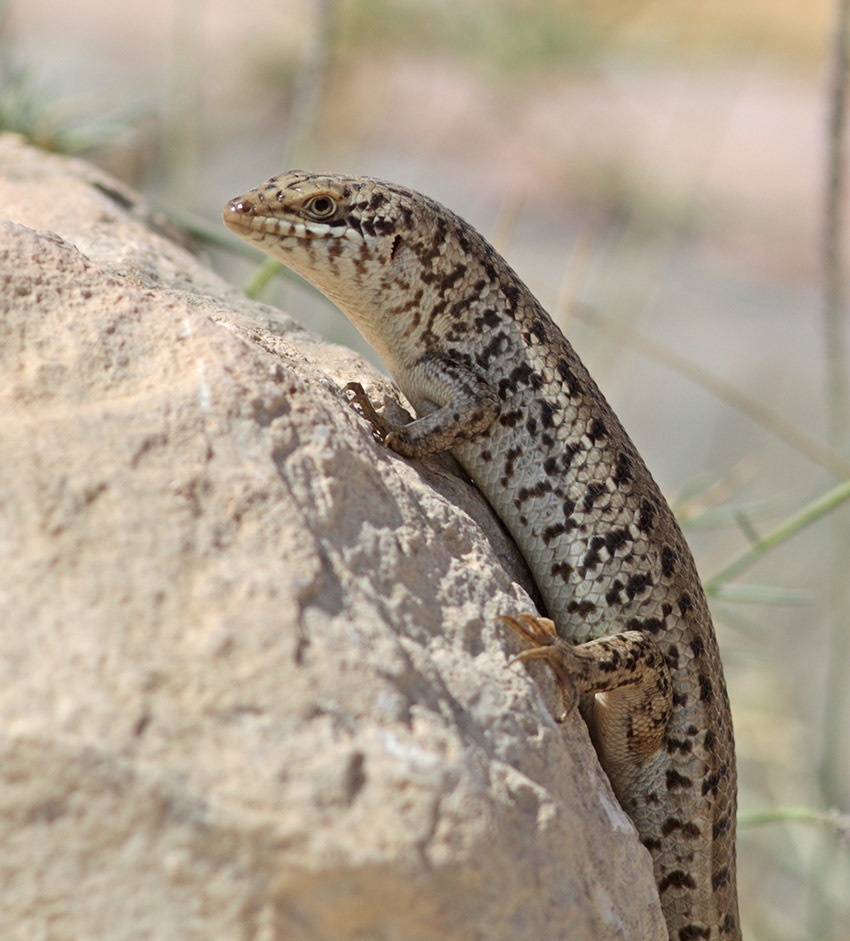
Sudan Mabuya
Trachylepis brevicollis
Trachylepis brevicollis, the short-necked skink or Sudan mabuya, is a species of skink in the family Scincidae. It is distributed across northeastern and eastern Africa and the southern Arabian Peninsula.
From the article Trachylepis brevicollis on Wikipedia (CC BY-SA), quoted section by section
Description
Trachylepis brevicollis is a relatively large and robust skink, reaching a snout–vent length of approximately 140 mm. The body is cylindrical with well-developed limbs. Dorsal and lateral scales are strongly keeled, often with double keels, giving the skin a rough texture. The neck is not particularly short, but the head is short and broad with five supralabial scales anterior to the eye, and the first supraocular scale contacts the frontal scale. The eye is large with a round pupil. The tail is about half the skink's total length and is stout at its base. Adult size may reach up to 32 cm, however the average length is 18-26 cm. Hatchlings are between 7-9 cm in length. Coloration is variable. Juveniles typically exhibit bold dark and light patterning, while adults tend to be more uniformly brown or grey. In some populations, particularly in Arabia, adult males may show orange or reddish coloration along the flanks and sides of the body.
Range & habitat
The species occurs in Sudan, South Sudan, Eritrea, Ethiopia, Somalia, Kenya, Uganda, Tanzania, Yemen, Saudi Arabia, and Oman from sea level to about 1500m. Trachylepis brevicollis inhabits open and semi-arid environments, including savanna, scrubland, rocky terrain, agricultural areas, and disturbed habitats. It is often found on the ground or among low vegetation and human-modified landscapes.
Wikipedia: “Distribution and habitat”
What it does
This species is diurnal and primarily terrestrial. Individuals are commonly observed basking in sunlight and actively foraging during the day. Like other members of the genus, it is presumed to be insectivorous, feeding mainly on small invertebrates, although detailed dietary studies are lacking.
Wikipedia: “Ecology and behavior”
In human culture
The species was originally described by Wiegmann in 1837 as Euprepes brevicollis. It was later placed in the genus Mabuya before being transferred to the genus Trachylepis following taxonomic revision of African mabuyine skinks. The specific epithet brevicollis is derived from Latin, meaning “short-necked”, referring to the species’ relatively stout neck.
Wikipedia: “Taxonomy and etymology”
Where it lives
Recorded sightings
—
geo-referenced records in GBIF, from museums, herbaria and field observers.
Drag the globe to turn it. Dots are where records exist, not a range map; darker means more records.
In the stacks
Searching the stacks…
Every page naming Trachylepis brevicollis in the Biodiversity Heritage Library →
This page is assembled live from iNaturalist, GBIF, Wikipedia, the Source Library and the Internet Archive. It is not yet part of the hand-edited codex. iNaturalist taxon 37439.