- Animals
- ›Chordates
- ›Vertebrates
- ›Birds
- ›Pelicans, Herons, Ibises, and Allies
- ›Ibises and Spoonbills
- ›Bostrychia
On eBird ↗
Olive Ibis
Live sightings near you, the range map, bar charts of when it is seen, and Macaulay Library photos and recordings.
Olive Ibis
Bostrychia olivacea
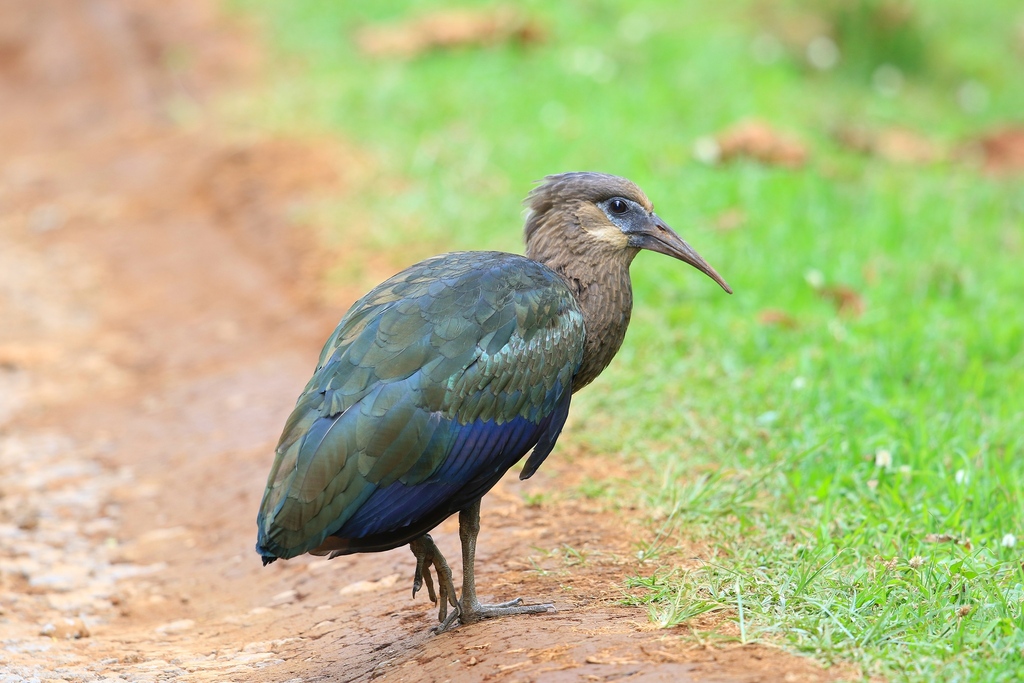
The olive ibis (Bostrychia olivacea) is a species of ibis native to dense tropical forests in central Africa. Between 65 and 75 cm in length, it is a small ibis with olive plumage displaying an iridescent sheen. Four subspecies are recognized.
From the article Olive ibis on Wikipedia (CC BY-SA), quoted section by section
Description
This relatively small ibis measures 65–75 cm in length, depending on subspecies. Recorded wing lengths in the various subspecies are 330–334 mm in olivacea, 309–355 mm in cupreipennis, 343–372 mm in akeleyorum, and 328 mm and 313 mm in males and females respectively of rothschildi. The culmen in olivacea measures 95–96 mm. Single male specimens of the subspecies akeleyorum, cupreipennis and rothschildi have reported culmen lengths of 108 mm, 85 mm and 95 mm respectively; with the corresponding lengths on females being 102 mm, 94 mm and 90 mm respectively. B. o. cupreipennis and rothschildi are roughly equal in size, olivacea is slightly larger, and akleyorum is the largest of all subspecies and also has the longest bill. The number of available specimens of this species is however considered too small to confirm whether this pattern of size variation among the subspecies holds generally. The adult plumage is dusky brown with green and bronze iridescent tinges. The head and neck are also brown, and pale stripes extend underneath the eye. The face around the orbital and loral regions is bluish black and the bill is coral red. The tail coverts and tail are dark blue. The back and rump are dusky greenish bronze. The secondary flight feathers and wing coverts stand out from the plumage through their pinkish green tinge. …
Wikipedia: “Appearance”
Range & habitat
This species is patchily distributed in dense forests from the West to East coast of tropical Africa. The countries in which it natively occurs are Cameroon, the RCongo, DRCongo, Côte d'Ivoire, Gabon, Ghana, Kenya, Liberia, Nigeria, Sierra Leone and Tanzania, besides Príncipe and São Tomé islands. Alongside its dense forest habitat, it has also been recorded in regenerating forest in Gabon and cliff holes. The different subspecies inhabit different geographical regions in Africa. Bostrychia olivacea olivacea and B. o. cupreipennis occur in the west. The former is found in Upper Guinea in countries such as Sierra Leone, Liberia and Cote d'Ivoire; and the latter found in Lower Guinea in countries slightly further south such as Cameroon, Gabon, RCongo and DRCongo. B. o. cupreipennis is also found more toward central Africa than olivacea, which is more common on the western coast. B. o. rothschildi lives on Príncipe island and São Tomé. B. o. akleyorum occurs in the montane forests of eastern Africa at altitudes of 1,800-12,000 m above sea level. It is found in the eastern DRCongo, on Mount Kenya and in the Aberdares of Kenya, Kilimanjaro in Tanzania, on Mount Meru and on Mount Elgon; but is apparently absent from lowland forests in east Africa such as the Kakamega tropical rainforest in Kenya. However, its call was once reportedly heard in the Bwamba lowlands of Uganda. …
Wikipedia: “Distribution and habitat”
What it does
The olive ibis feeds on insects such as beetles, grubs and snails. It also reportedly feeds on myriapods, forest floor vegetation and snakes. It feeds singly, in pairs or in flocks usually comprising 5-12 individuals in densely forested areas along small stretches of fast flowing water, but also in mangroves, marshes, swamps and backwaters as well as larger rivers such as St. Paul's River in Liberia and Camma River in Gabon. Observations from the Hagenia forests of Kenya suggest that this ibis may preferentially forage on the forest floor with little or no undergrowth. The olive ibis preferentially roosts in tops of large dead trees at night such as silk-cotton and probably uses the same ones daily. It apparently uses the same routes daily to fly between roosting and feeding grounds. When landing on a tree branch from flight, the ibis does not do so at right angles, but along the length of the branch and runs a short distance along the branch after landing.
Wikipedia: “Feeding and roosting”
Listen
Looking for field recordings…
Where it lives
Recorded sightings
—
geo-referenced records in GBIF, from museums, herbaria and field observers.
Drag the globe to turn it. Dots are where records exist, not a range map; darker means more records.
In the stacks
Searching the stacks…
Every page naming Bostrychia olivacea in the Biodiversity Heritage Library →
This page is assembled live from iNaturalist, GBIF, Wikipedia, the Source Library and the Internet Archive. It is not yet part of the hand-edited codex. iNaturalist taxon 3744.