- Animals
- ›Chordates
- ›Vertebrates
- ›Reptiles
- ›Snakes and Lizards
- ›Lizards
- ›Skinks and allies
- ›Skinks
- ›Typical skinks
- ›Chalcides
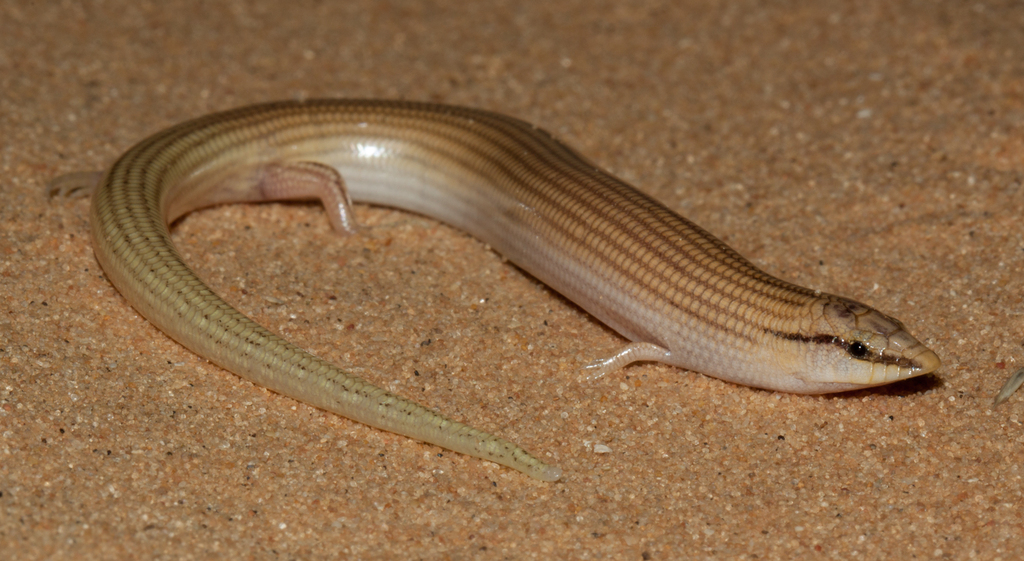
Wedge-snouted Skink
Chalcides sepsoides
The wedge-snouted skink (Chalcides sepsoides) is a common and widespread species of skink in the Scincidae family. It is found in Egypt, Israel, Jordan, Libya, and the Palestinian territories. Its natural habitats are subtropical or tropical dry shrubland, subtropical or tropical dry lowland grassland, freshwater springs, hot deserts, and sandy shores. S. sepsoides is a viviparous species, and it is nocturnal during the summer and diurnal during the winter.
From the article Chalcides sepsoides on Wikipedia (CC BY-SA), quoted section by section
Range & habitat
C. sepsoides occurs in sandy areas and dunes, including open steppe and bushland with sandy soil. It is nocturnal during the summer and diurnal during the winter. It is a common species that can be locally threatened by habitat loss, overgrazing, and commercial collection, although none of these threats are considered to be very serious, and the species population is stable.
Wikipedia: “Habitat and conservation”
What it does
S. sepsoides is a viviparous species. C. sepsoides is subarenaceous, and it moves very efficiently by "swimming" under the sand. In fact, it is rarely seen about the ground, and a common method of capturing specimens is to dig through sand dunes near the bases of bushes; this is because its main escape tactic is to dive into the sand. Its limbs are greatly reduced as an adaptation to this fossorial movement. As a result, it is often considered to be a sand specialist.
Wikipedia: “Ecology”
Where it lives
Recorded sightings
—
geo-referenced records in GBIF, from museums, herbaria and field observers.
Drag the globe to turn it. Dots are where records exist, not a range map; darker means more records.
In the stacks
Searching the stacks…
Every page naming Chalcides sepsoides in the Biodiversity Heritage Library →
This page is assembled live from iNaturalist, GBIF, Wikipedia, the Source Library and the Internet Archive. It is not yet part of the hand-edited codex. iNaturalist taxon 37477.