- Animals
- ›Chordates
- ›Vertebrates
- ›Birds
- ›Pelicans, Herons, Ibises, and Allies
- ›Ibises and Spoonbills
- ›Cercibis
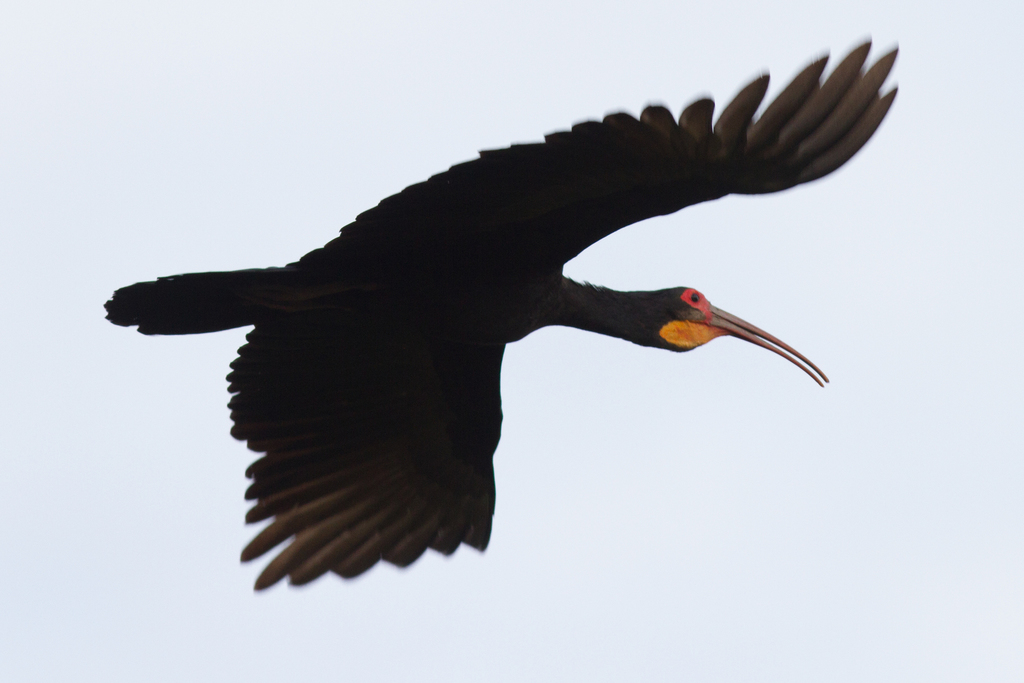
On eBird ↗
Sharp-tailed Ibis
Live sightings near you, the range map, bar charts of when it is seen, and Macaulay Library photos and recordings.
Sharp-tailed Ibis
Cercibis oxycerca
The sharp-tailed ibis (Cercibis oxycerca) is a species of ibis native to open wet savannas in parts of northern South America.
From the article Sharp-tailed ibis on Wikipedia (CC BY-SA), quoted section by section
Description
This large ibis measures 75–86 cm in length, with males being slightly larger than females. In adult males, the flat wing measures 390–415mm lengthways, and the culmen measures 156–168mm from the base of the bill. In adult females, the wing is 376–413mm long and the culmen 144–197mm. The species is distinguished by its notably long tail, the longest among all extant ibis species; measuring 250–301mm in males and 256–272mm in females. The tail projects beyond the tips of the folded wings when the ibis stands; and beyond the trailing legs in flight. The plumage is predominantly black with greenish glossing; and with purplish tinges on the upper back, hindneck, wings and tail. The forehead and cheek region are occasionally greyish brown. Juveniles appear similar to adults, but their plumage lacks a metallic sheen. The bill, legs, toes, and bare facial skin are orangey-red; the throat is yellowish-orange, and a feathered grey strip extends below the eye from the lower mandible. An inconspicuous fuzzy crest extends down the back of its head and upper neck. The iris is greyish red, but is sometimes scarlet red, which may be associated with breeding. Nothing is however known of changes in soft part colourations as part of courtship. …
Range & habitat
The sharp-tailed ibis inhabits wet lowland savannas and riverbanks of northern South America east of the Andes, at less than 300-500m above sea level. It is native to Venezuela, eastern Colombia, southwestern Guyana, Brazil and Suriname. In Venezuela, it is typically found along or near the Orinoco and Apure rivers. In the llanos of eastern Colombia, it is found along the Casanare and Cravo Sur rivers, as well as the Colombian stretch of the Apure. In Brazil, it often occurs to the northwest of the Amazon and frequents the grasslands near to the Rio Negro and Rio Branco. However, it is also present to the west near Rio Guanco and to the south in northwest Mato Grosso. This ibis also sometimes uses gallery forests in which to roost and breed. This ibis is patchily distributed throughout its global range and despite a relatively large total population; it is generally uncommon on a local scale and is considered to be the least numerous ibis species in the Venezuelan llanos. It is however more abundant there during the rainy season. It does not associate with other wading bird species, often distancing itself from its heterospecifics. It is primarily found in male-female pairs and in small intraspecific groups comprising three to five individuals. Despite this ibis's territoriality, individuals very rarely forage alone. …
Wikipedia: “Distribution and habitat”
What it does
Like the sympatric glossy ibis, the sharp-tailed ibis largely feeds terrestrially or semi-terrestrially; either on open land or in short grass. It typically forages in moist soil, shallow mud and along marshy edges of lagoons and rice fields. However, it also occasionally forages in shallow water at depths of 3 cm or less. It is less aquatic in its feeding habits than many other South American Ibises. Throughout the sharp-tailed ibis's range, only the buff-necked ibis forages on drier, higher-altitude ground. More rarely, the sharp-tailed ibis has been observed to forage in gallery forests during the wet season. The species primarily feeds tactilely. Its typical foraging method consists in walking quickly over moist soil and through shallow mud or water; probing deeply into the moist underlying substrate for prey at intervals. It is relatively flexible in microhabitat use, foraging either on open ground or in short grass. Several individuals have been observed with dried mud along the length of their bills. Its foraging highly resembles that of the glossy ibis and buffnecked ibis. Despite the largely overlapping niches, the sharp-tailed ibis may be more active during the morning than other sympatric ibises; hence suggesting temporal niche partitioning. …
Wikipedia: “Food and feeding”
Listen
Looking for field recordings…
Where it lives
Recorded sightings
—
geo-referenced records in GBIF, from museums, herbaria and field observers.
Drag the globe to turn it. Dots are where records exist, not a range map; darker means more records.
In the stacks
Searching the stacks…
Every page naming Cercibis oxycerca in the Biodiversity Heritage Library →
This page is assembled live from iNaturalist, GBIF, Wikipedia, the Source Library and the Internet Archive. It is not yet part of the hand-edited codex. iNaturalist taxon 3772.