On eBird ↗
Blue-footed Booby
Live sightings near you, the range map, bar charts of when it is seen, and Macaulay Library photos and recordings.
Blue-footed Booby
Sula nebouxii
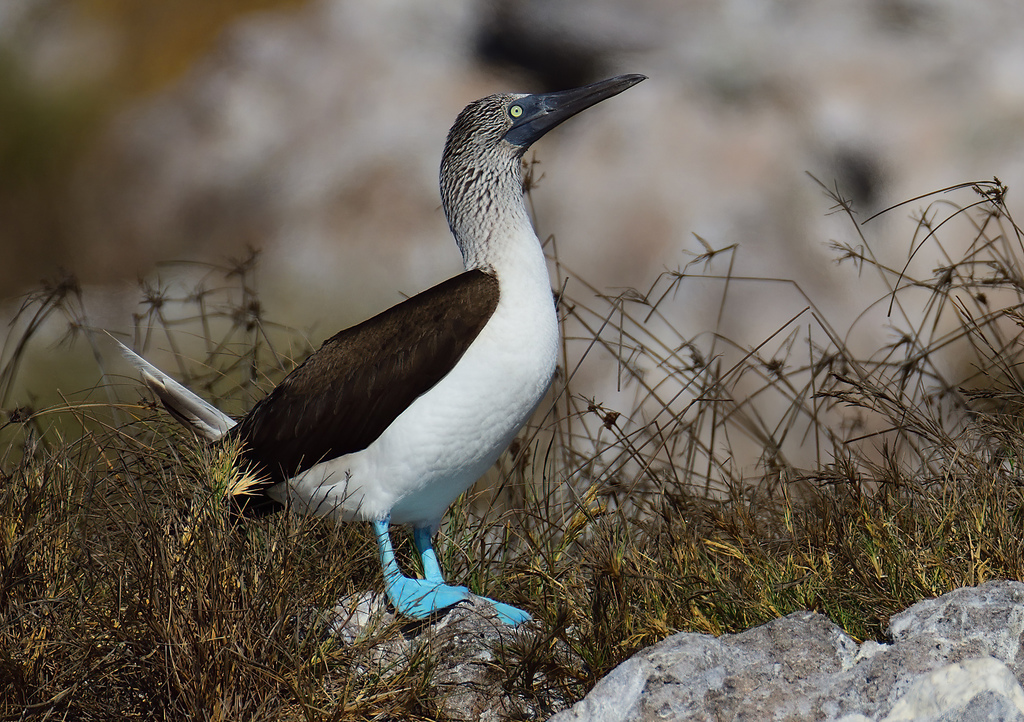
The blue-footed booby (Sula nebouxii) is a species of marine bird in the family Sulidae. The species is native to subtropical and tropical regions of the eastern Pacific Ocean. It is one of six species of the genus Sula, commonly known as boobies. It is easily recognizable by its distinctive bright blue feet, which is a sexually selected trait and a product of its diet. The male displays its feet in an elaborate mating ritual by lifting them up and down while strutting before the female. Females are slightly larger than males and can measure up to 90 cm (35 in) long with a wingspan up to 1.5 m (5 ft).
The natural breeding habitats of the blue-footed booby are the tropical and subtropical islands of the Pacific Ocean. It can be found from the Gulf of California south along the western coasts of Central and South America to Peru. About half of all breeding pairs nest on the Galápagos Islands. Its diet mainly consists of fish, which it obtains by diving and sometimes swimming underwater in search of its prey. It sometimes hunts alone, but usually hunts in groups.
From the article Blue-footed booby on Wikipedia (CC BY-SA), quoted section by section
Description
The blue-footed booby is on average 81 cm (32 in) long and weighs 1.5 kg (3+1⁄4 lb), with the female being slightly larger than the male. Its wings are long, pointed, and brown in color. The neck and head of the blue-footed booby are light brown with white streaks, while the belly and underside exhibit pure white plumage. Its eyes are placed on either side of its bill and oriented towards the front, enabling excellent binocular vision. Its eyes are a distinctive yellow, with the male having more yellow in its irises than the female. Blue-footed booby chicks have black beaks and feet and are clad in a layer of soft white down. The subspecies S. n. excisa that breeds on the Galápagos Islands is larger than the nominate subspecies and has lighter plumage especially around the neck and head. The Peruvian booby is similar in appearance, but has grey feet, whiter head and neck, and white spots on its wing coverts. The ranges of the two species overlap in the waters of northern Peru and southern Ecuador. Since the blue-footed booby preys on fish by diving headlong into the water, its nostrils are permanently closed, and it has to breathe through the corners of its mouth. Its most notable characteristic is its blue-colored feet, which can range in color from a pale turquoise to a deep aquamarine. Males and younger birds have lighter feet than females. …
Range & habitat
The blue-footed booby is distributed among the continental coasts of the eastern Pacific Ocean from California to the Galápagos Islands south into Peru. It is strictly a marine bird. Its only need for land is to breed and rear young, which it does along the rocky coasts of the eastern Pacific. A booby may use and defend two or three nesting sites, which consist of bare black lava in small divots in the ground, until they develop a preference for one a few weeks before the eggs are laid. These nests are created as parts of large colonies. While nesting, the female turns to face the sun throughout the day, so the nest is surrounded by excrement.
Natal dispersal. Females start breeding when they are 1 to 6 years old, while males start breeding when they are 2 to 6 years old. Very limited natal dispersal occurs, meaning that young pairs do not move far from their original natal nests for their own first reproduction, leading to the congregation of hundreds of boobies in dense colonies. The benefit of limited dispersal is that by staying close to their parents' nesting sites, the boobies are more likely to have a high-quality nest. Since their parents had successfully raised chicks to reproductive age, their nest site must have been effective, either by providing cover from predation and parasitism, or by its suitability for taking off and landing. …
Wikipedia: “Distribution and habitat”
What it does
The blue-footed booby is a specialized fish eater, feeding on small schooling fish such as sardines, anchovies, mackerel, and flying fish. It will also take squid and offal. The blue-footed booby hunts by diving into the ocean after prey, sometimes from a great height, and can also swim underwater in pursuit of its prey. It can hunt singly, in pairs, or in larger flocks. Boobies travel in parties of about 12 to areas of water with large schools of small fish. When the lead bird sees a fish shoal in the water, it signals to the rest of the group and they all dive in unison, pointing their bodies down like arrows. Plunge diving can be done from heights of 10–30.5 m (33–100 ft) and even up to 100 m (330 ft). These birds hit the water around 97 km/h (60 mph; 27 m/s) and can go to depths of 25 m (80 ft) below the water surface. Their skulls contain special air sacs that protect the brain from enormous pressure. Prey are usually eaten while the birds are still under water. Individuals prefer to eat on their own instead of with their hunting group, usually in the early morning or late afternoon. Males and females fish differently, which may contribute to why blue-foots, unlike other boobies, raise more than one young. The male is smaller and has a proportionally larger tail, which enables the male to fish in shallow areas and deep waters. The female is larger and can carry more food. …
Wikipedia: “Hunting and feeding”
Listen
Looking for field recordings…
Where it lives
Recorded sightings
—
geo-referenced records in GBIF, from museums, herbaria and field observers.
Drag the globe to turn it. Dots are where records exist, not a range map; darker means more records.
In the stacks
Searching the stacks…
Every page naming Sula nebouxii in the Biodiversity Heritage Library →
This page is assembled live from iNaturalist, GBIF, Wikipedia, the Source Library and the Internet Archive. It is not yet part of the hand-edited codex. iNaturalist taxon 3786.