On eBird ↗
Masked Booby
Live sightings near you, the range map, bar charts of when it is seen, and Macaulay Library photos and recordings.
Masked Booby
Sula dactylatra
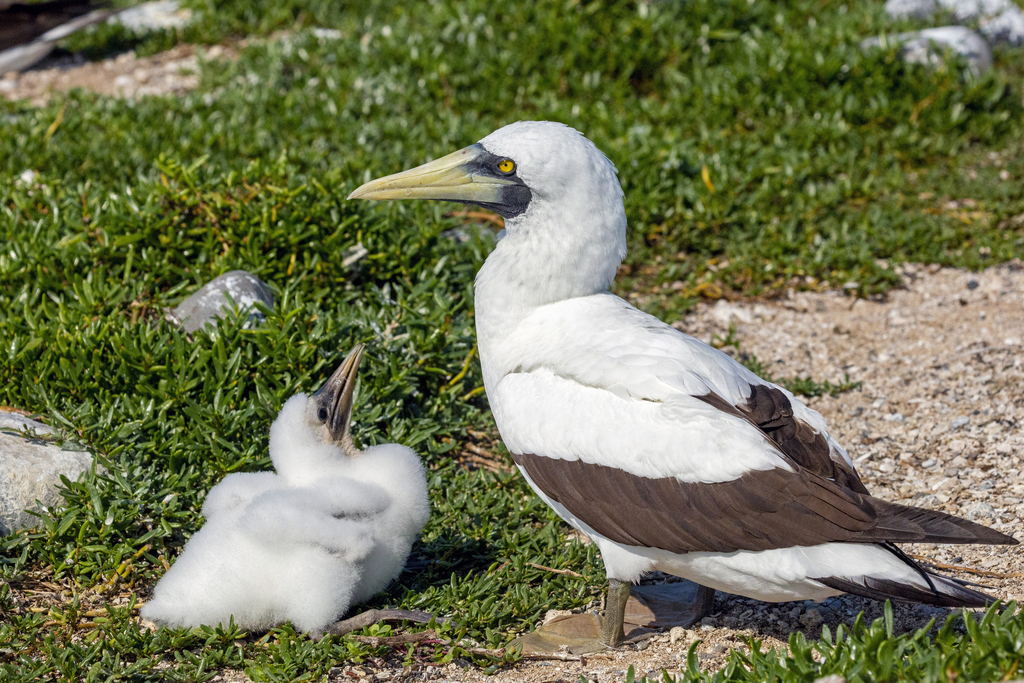
The masked booby (Sula dactylatra), also called the masked gannet or the blue-faced booby, is a large seabird of the booby and gannet family, Sulidae. First described by the French naturalist René-Primevère Lesson in 1831, the masked booby is one of six species of booby in the genus Sula. It has a typical sulid body shape, with a long pointed yellowish bill, long neck, aerodynamic body, long slender wings and pointed tail. The adult is bright white with black wings, a black tail and a dark face mask; at 75–85 cm (30–33 in) long, it is the largest species of booby. The sexes have similar plumage. This species ranges across tropical oceans, except in the eastern Atlantic and eastern Pacific. In the latter, it is replaced by the Nazca booby (Sula granti), which was formerly regarded as a subspecies of masked booby.
Nesting takes place in colonies, generally on islands and atolls far from the mainland and close to deep water required for foraging. Territorial when breeding, the masked booby performs agonistic displays to defend its nest. Potential and mated pairs engage in courtship and greeting displays. The female lays two chalky white eggs in a shallow depression on flat ground away from vegetation. The chicks are born featherless, but are soon covered in white down. The second chick born generally does not survive and is killed by its elder sibling. These birds are spectacular plunge divers, plunging into the ocean at high speed in search of prey—mainly flying fish.
From the article Masked booby on Wikipedia (CC BY-SA), quoted section by section
Description
The largest species of booby, the masked booby ranges from 75 to 85 cm (30 to 33 in) long, with a 160–170 cm (63–67 in) wingspan and 1.2–2.2 kg (2.6–4.9 lb) weight. It has a typical sulid body shape, with a long pointed bill, long neck, aerodynamic body, long slender wings and pointed tail. The adult is bright white with dark wings and a dark tail. The sexes have similar plumage with no seasonal variation, but females are on average slightly heavier and larger than males. The bare skin around the face, throat and lores is described either as black or blue-black. It contrasts with the white plumage and gives a mask-like appearance. Conical in shape, the bill is longer than the head and tapers to a slightly downcurved tip. Backward-pointing serrations line the mandibles. The primaries, secondaries, humerals and rectrices are brown-black. The inner webs of the secondaries are white at the base. The underwing is white except for the brown-black flight-feathers that are not covered by the white coverts. The legs are yellow-orange or olive. The iris is yellow. The juvenile is a streaked or mottled grey-brown on the head and upperparts, with a whitish neck collar. The wings are dark brown and underparts are white. Its bill is yellowish, face is blue-grey and iris a dark brown. …
Range & habitat
The masked booby is found across tropical oceans between the 30th parallel north and 30th parallel south. In the Indian Ocean it ranges from the coastlines of the Arabian Peninsula and East Africa across to Sumatra and Western Australia, though it is not found off the coast of the Indian subcontinent. Off the Western Australian coastline it is found as far south as the Dampier Archipelago. In the Pacific, it ranges from Brisbane eastwards. It is found in the Caribbean and Atlantic Ocean south to Ascension Island. In the eastern Pacific off the coast of Colombia and Ecuador, the masked booby is replaced by the Nazca booby. A vagrant was rescued in 2015 in Newport, Oregon. In the Atlantic, Caribbean birds occasionally wander north to warm southern Gulf Stream waters off the eastern seaboard of the United States, with single records from Island Beach in New Jersey and New York. There are summer records from Delaware Bay, and Worcester County, Maryland, as well as waters off the coast of Spain. During the monsoon season (midyear), the masked booby is an occasional vagrant along the western coast of India, with records from Kerala, Karnataka, and Maharashtra states. It is a vagrant to the Caroline Islands north of New Guinea.
Breeding colonies. Breeding colonies are located on remote islands, atolls and cays. Lord Howe Island is the southernmost colony. …
Wikipedia: “Distribution and habitat”
What it does
The masked booby generally flies at least 7 m (23 ft) in height, and at speeds of up to 70 km/h (43 mph). It alternates between gliding and active flying with strong periodic wingbeats. It is often encountered alone, or in a small group when returning to its colony. Regarding the masked booby's longevity, a bird tagged at Nepean Island (off Norfolk Island) in September 1979 was recovered and released after being caught in fishing gear 24 years and 9.9 months later some 713 km (443 mi) away off the Isle of Pines, New Caledonia in July 2004. The longest distance travelled is 3,152 km (1,959 mi); a bird tagged at Raine Island in the Great Barrier Reef in December 1981 was picked up and released at Phillip Island (off Norfolk Island) in December 1986.
Breeding and courtship. The masked booby begins breeding by around four or five years of age, though can occasionally do so at three years old. Adults form monogamous relationships with many pairs remaining together over multiple breeding seasons. Highly territorial when nesting, single males and mated pairs engage in agonistic displays to mark their ground against neighbours and interlopers. The male advertises his territory to females by flight circuiting—making a short flight and holding his wings in a 'V' shape and making a call as he lands. …
Wikipedia: “Behaviour”
Listen
Looking for field recordings…
Where it lives
Recorded sightings
—
geo-referenced records in GBIF, from museums, herbaria and field observers.
Drag the globe to turn it. Dots are where records exist, not a range map; darker means more records.
In the stacks
Searching the stacks…
Every page naming Sula dactylatra in the Biodiversity Heritage Library →
This page is assembled live from iNaturalist, GBIF, Wikipedia, the Source Library and the Internet Archive. It is not yet part of the hand-edited codex. iNaturalist taxon 3788.