- Animals
- ›Chordates
- ›Vertebrates
- ›Reptiles
- ›Snakes and Lizards
- ›Lizards
- ›Skinks and allies
- ›Skinks
- ›Mabuyas
- ›Eutropis
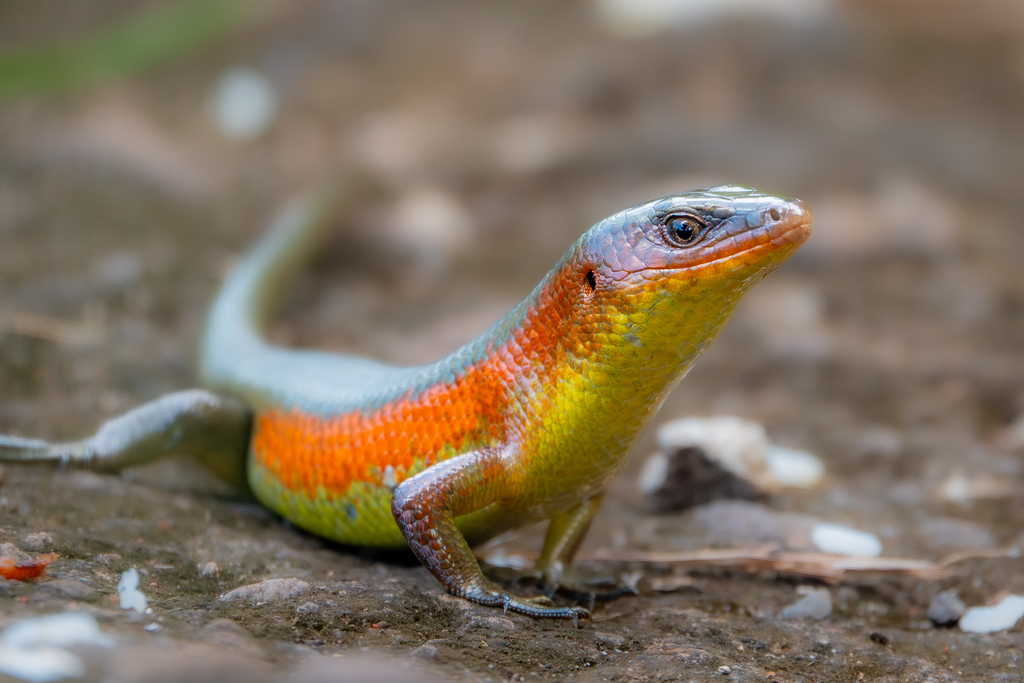
Common Sun Skink
Eutropis multifasciata
Eutropis multifasciata, commonly known as the East Indian brown mabuya, many-lined sun skink, many-striped skink, common sun skink or (ambiguously) as golden skink, is a species of skink that inhabits an extensive range from India and southern China to southern Indonesia.
From the article Eutropis multifasciata on Wikipedia (CC BY-SA), quoted section by section
Description
See Snake scales for terminology.
Eutropis multifasciata is a species of skink that often shows prominent coloured dorsal bands. They have a number of other distinctive features that allows this species to be distinguished from other species, particularly in the detail of the arrangement of their scales. Their snout is moderate to obtuse, and their lower eyelid is scaly. The nostril is positioned behind the vertical line of the suture between the rostral and first labial scale, and it has a postnasal scale. The anterior loreal scale is no deeper than the second, and is in contact with the first labial scale. The supranasal scales are largely in contact behind the rostral. The frontonasal scale is broader than it is long, and the prefrontal scales consistently form a median suture. The frontal scale is as long as or shorter than the frontoparietals and interparietal together, and makes contact with the second (and occasionally the first) supraocular. There are four supraoculars, the second of which is largest, and six supraciliaries, the first of which is largest. There are distinct fronto-parietal scales, larger than the interparietal, completely separating the parietals. There are a pair of nuchals and four labials anterior to the subocular, which is large and not narrower below. The ear-opening is roundish or oval and is as large as a lateral scale, or a little smaller. …
Range & habitat
The species is widely present in southern Asia and occurs from India (Assam and the Nicobar islands) and southern China throughout continental Southeast Asia to southern Indonesia, with scattered records from New Guinea. It has been introduced to Australia and the USA.
Taiwan. Eutropis multifasciata was first observed in Taiwan in 1992, in the southern Kaohsiung area. It has since spread northward and established populations in the central-western and south-western lowlands. The species has successfully adapted to Taiwan's agricultural areas, open forests, and human-disturbed areas. Its high fecundity (reproductive ability) has enabled it to compete with other species for resources. This is likely the cause of the decline in the populations of indigenous lizard species that occupy the same habitats as Eutropis multifasciata. Since this species has a poor cold tolerance, its elevational distribution in Taiwan is restricted below 500 meters. However, it is expected that in response to rising temperatures associated with climate change, this species will benefit from increased maximum activity time. As a result, distribution of this species is expected to expand from lowland areas to higher elevations, especially if the landscape becomes more open.
Wikipedia: “Distribution”
Where it lives
Recorded sightings
—
geo-referenced records in GBIF, from museums, herbaria and field observers.
Drag the globe to turn it. Dots are where records exist, not a range map; darker means more records.
In the stacks
Searching the stacks…
Every page naming Eutropis multifasciata in the Biodiversity Heritage Library →
This page is assembled live from iNaturalist, GBIF, Wikipedia, the Source Library and the Internet Archive. It is not yet part of the hand-edited codex. iNaturalist taxon 38008.