On eBird ↗
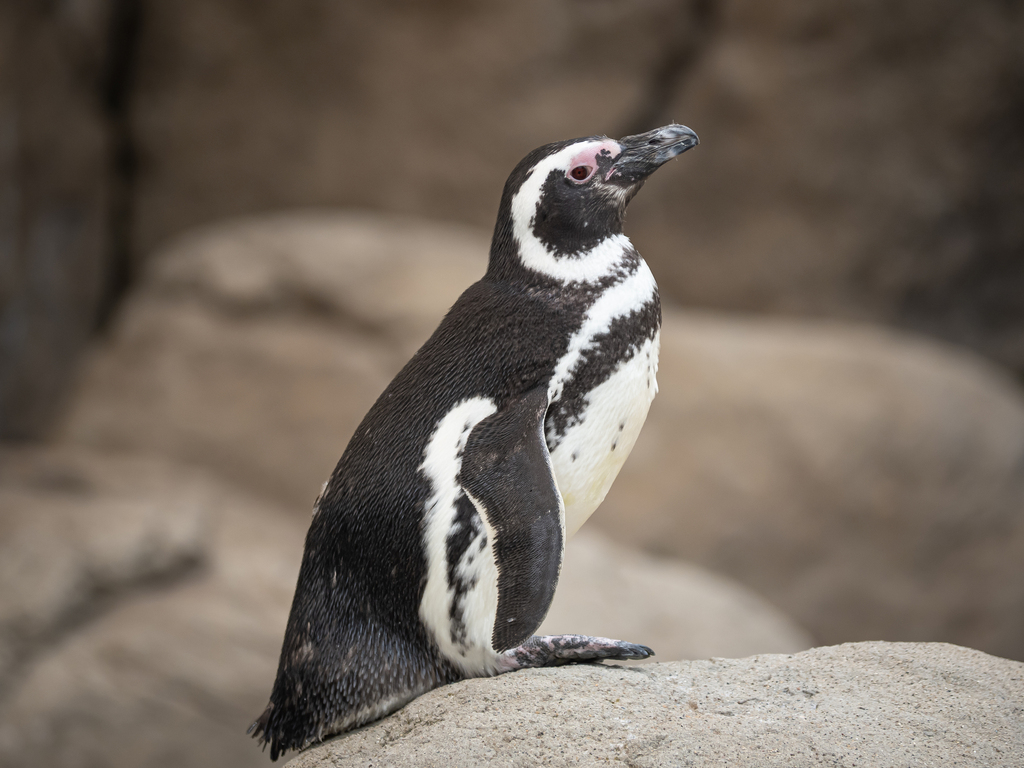
Magellanic Penguin
Live sightings near you, the range map, bar charts of when it is seen, and Macaulay Library photos and recordings.
Magellanic Penguin
Spheniscus magellanicus
The Magellanic penguin (Spheniscus magellanicus) is a South American penguin, breeding in coastal Patagonia, including Argentina, Chile, and the Falkland Islands, with some migrating to Brazil and Uruguay, where they are occasionally seen as far north as Espírito Santo. Vagrants have been found in El Salvador, the Avian Island in Antarctica, Australia, and New Zealand. It is the most numerous of the Spheniscus banded penguins. Its nearest relatives are the African penguin, the Humboldt penguin, and the Galápagos penguins. The Magellanic penguin was named after Portuguese explorer Ferdinand Magellan, who spotted the birds in 1520. The species is listed as being of Least Concern by the IUCN.
From the article Magellanic penguin on Wikipedia (CC BY-SA), quoted section by section
Description
Magellanic penguins are medium-sized penguins which grow to be 61–76 cm (24–30 in) tall and weigh between 2.7 and 6.5 kg (6.0 and 14.3 lb). The males are larger than the females, and the weight of both drops while the parents raise their young. Adults have black backs and white abdomens. There are two black bands between the head and the breast, with the lower band shaped in an inverted horseshoe. The head is black with a broad white border that runs from behind the eye, around the black ear-coverts and chin, and joins at the throat. Chicks and younger penguins have grey-blue backs, with a more faded grey-blue colour on their chest. Magellanic penguins can live up to 25 years in the wild, but as much as 30 years in captivity. Captain Eo, a male Magellanic penguin at the San Francisco Zoo, died in 2022 at the age of 40. Young birds usually have a blotched pattern on their feet, which fades as they grow up into adulthood. By the time these birds reach about ten years of age, their feet usually become all black. Like other species of penguins, the Magellanic penguin has very rigid wings used to swim under water.
What it does
Magellanic penguins feed in the water, preying primarily on small pelagic fish (Argentine anchoita, silversides, Argentine hake, Falkland sprat, Southern blue whiting, rockcod), hagfish, cuttlefish, squid (Patagonian longfin squid, Gonatus antarcticus, shortfin squid), krill, and squat lobsters, and ingest sea water with their prey. Their salt-excreting gland rids the salt from their bodies. Adult penguins can regularly dive to depths of 20 to 50 m (66 to 164 ft) deep in order to forage for prey. During the breeding season males and females have similar foraging and diving patterns as well as diet composition, however bone tissue analysis suggests that diets diverge post-season when limitations imposed by chick rearing are removed. Magellanic penguins do not experience a severe shortage of food like the Galapagos penguins, because they have a consistent food supply being located on the Atlantic coast of South America. The presence of the large continental shelf in the Atlantic Ocean lets Magellanic penguins forage far from their breeding colony. Jellyfish including species in the genera Chrysaora and Cyanea were found to be actively sought-out food items, while they previously had been thought to be only accidentally ingested. Similar preferences were found in the Adélie penguin, yellow-eyed penguin and little penguin.
Wikipedia: “Diet”
In human culture
In 2016, videos of a Magellanic penguin who had befriended a Brazilian fisherman went viral. The fisherman had found the penguin close to death and covered in oil, and had nursed it back to health. In 2024, a movie of the story, My Penguin Friend, was released. The Penguin Lessons is a 2024 comedy-drama film that centers on a Magellanic penguin rescued from an oil slick.
Wikipedia: “In popular culture”
Listen
Looking for field recordings…
Where it lives
Recorded sightings
—
geo-referenced records in GBIF, from museums, herbaria and field observers.
Drag the globe to turn it. Dots are where records exist, not a range map; darker means more records.
In the stacks
Searching the stacks…
Every page naming Spheniscus magellanicus in the Biodiversity Heritage Library →
This page is assembled live from iNaturalist, GBIF, Wikipedia, the Source Library and the Internet Archive. It is not yet part of the hand-edited codex. iNaturalist taxon 3812.