On eBird ↗
Fiordland Penguin
Live sightings near you, the range map, bar charts of when it is seen, and Macaulay Library photos and recordings.
Fiordland Penguin
Eudyptes pachyrhynchus
The Fiordland penguin (Eudyptes pachyrhynchus), also known as the Fiordland crested penguin (in Māori, tawaki), is a crested penguin species endemic to New Zealand. It currently breeds along the south-western coasts of New Zealand's South Island as well as on Stewart Island/Rakiura and its outlying islands. Because it originally ranged beyond Fiordland, it is sometimes referred to as the New Zealand crested penguin. It is occasionally found in Australia.
From the article Fiordland penguin on Wikipedia (CC BY-SA), quoted section by section
Description
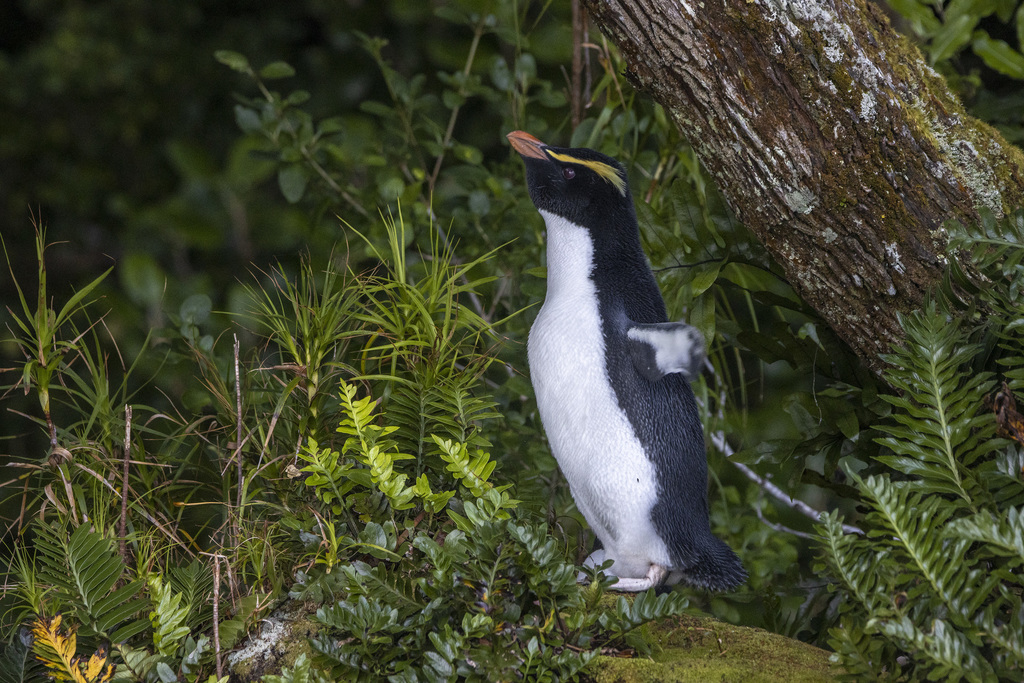
This species is a medium-sized, yellow-crested, black-and-white penguin, growing to approximately 55 cm (22 in) long and weighing on average 3.5 kg (7.7 lb), with a weight range of 2 to 5 kg (4.4 to 11.0 lb). The face possesses white markings and the front is white while the head and body are black. Its broad, yellow crest begins at the base of the beak and extends over the eye, dropping down the neck. It can be distinguished from the similar erect-crested penguin (Eudyptes sclateri) and Snares penguin (Eudyptes robustus) in having no bare skin around the base of its bill. Female Fiordland penguins lay a clutch of two eggs where the first-laid egg is much smaller than the second egg, generally hatches later, and shows higher mortality, demonstrating a brood reduction system that is unique from other avian groups. The Fiordland crested penguin has a much higher breeding success than most other Eudyptes species except for the southern rockhopper penguin, even at sites with introduced and/or native predators.
Range & habitat
This penguin nests in colonies among tree roots and rocks in dense temperate coastal forest. It breeds along the shores in the West Coast of the South Island, south of about Bruce Bay and the Open Bay Islands, around Fiordland and Foveaux Strait, and on Stewart Island/Rakiura and its outlying islands. Fossils of this species have been found as far north as the northern end of the South Island, and they probably once nested in the North Island as well. Their range drastically reduced by hunting in Polynesian times, and they are now only found in the least-populated part of New Zealand. The species was also present in Australia.
Wikipedia: “Distribution and habitat”
What it does
The main prey species reported are cephalopods (85%, mainly arrow squid, Nototodarus sloanii), followed by crustaceans (13%, primarily krill, Nyctiphanes australis) and fish (2%, mainly red cod and Blue grenadier (hoki)). However, the importance of cephalopods might be exaggerated. Prey taken seems to vary between Codfish Island and northern Fiordland.
Wikipedia: “Diet”
Listen
Looking for field recordings…
Where it lives
Recorded sightings
—
geo-referenced records in GBIF, from museums, herbaria and field observers.
Drag the globe to turn it. Dots are where records exist, not a range map; darker means more records.
In the stacks
Searching the stacks…
Every page naming Eudyptes pachyrhynchus in the Biodiversity Heritage Library →
This page is assembled live from iNaturalist, GBIF, Wikipedia, the Source Library and the Internet Archive. It is not yet part of the hand-edited codex. iNaturalist taxon 3823.