- Animals
- ›Chordates
- ›Vertebrates
- ›Reptiles
- ›Snakes and Lizards
- ›Lizards
- ›Wall lizards, amphisbaenians, and allies
- ›Whiptails and Tegus
- ›Whiptails and Ameivas
- ›Cnemidophorus
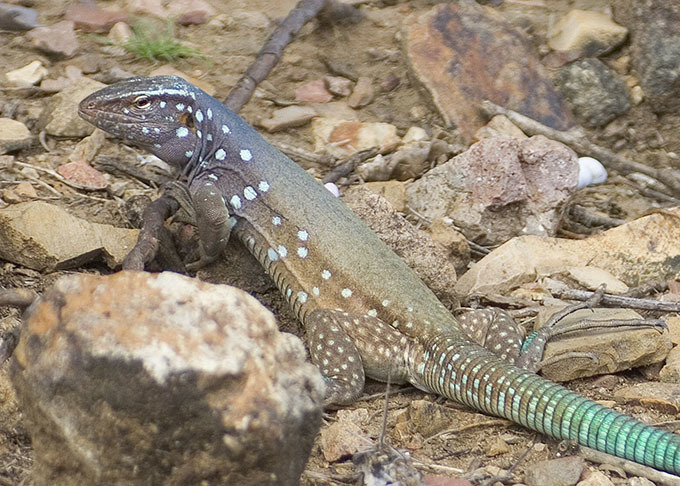
Bonaire Whiptail
Cnemidophorus ruthveni
Cnemidophorus ruthveni, the Bonaire whiptail, is a species of lizard belonging to the family Teiidae, which includes the whiptails and related species. This lizard is endemic to Bonaire. It was formerly considered a subspecies of Cnemidophorus murinus, commonly known as Laurenti's whiptail, but that name is now restricted to the form found on the island of Curacao.
From the article Cnemidophorus ruthveni on Wikipedia (CC BY-SA), quoted section by section
Description
Cnemidophorus ruthveni is a large member of its genus with a maximum snout-vent length in excess of 151 mm (5.9 in) in males. The males have a dark grey to blackish head, neck and the front part of the back that becomes browner and paler towards the rear. The sides of the head and the body are marked with large white or light blue spots and the sides of the tail and the feet are blue. The females are uniformly brown in colour and may have some faint stripes or spots.
Range & habitat
Cnemidophorus ruthveni is endemic to the special municipality of the Caribbean Netherlands, Bonaire. Here it occurs on the main island and on Klein Bonaire. It is found in arid woodland and scrub. It can often be found around habitation taking advantage of additional food sources, such as poultry feed.
== References ==
Wikipedia: “Distribution and habitat”
In human culture
Cnemidophorus ruthveni is classified within the genus Cnemidophorus, this name is New Latin and derives from the Greek knēmidophoros, meaning "wearer of greaves". The specific name honours Alexander G. Ruthven, an American herpetologist to recognise his contributions to herpetology in America.
Wikipedia: “Etymology”
Where it lives
Recorded sightings
—
geo-referenced records in GBIF, from museums, herbaria and field observers.
Drag the globe to turn it. Dots are where records exist, not a range map; darker means more records.
In the stacks
Searching the stacks…
Every page naming Cnemidophorus ruthveni in the Biodiversity Heritage Library →
This page is assembled live from iNaturalist, GBIF, Wikipedia, the Source Library and the Internet Archive. It is not yet part of the hand-edited codex. iNaturalist taxon 38720.