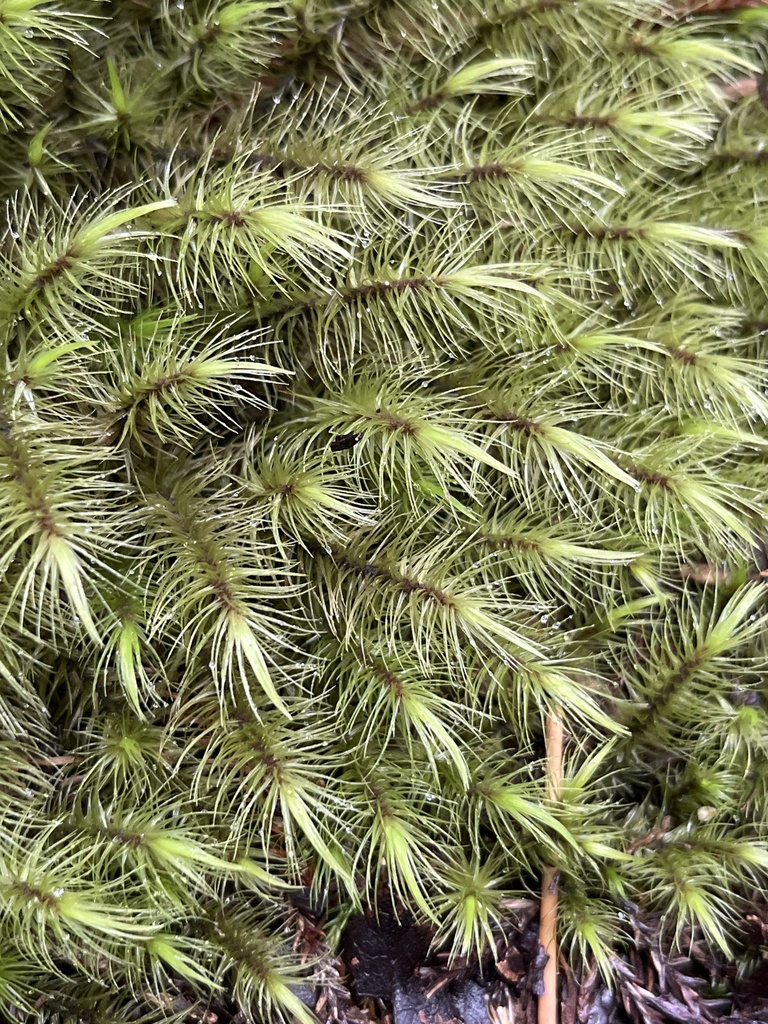
Dicranoloma billardierei
Dicranoloma billardierei is a species of bryophyte in the genus Dicranoloma. This moss is extremely common in wet rainforest habitats. In the field, Dicranoloma billardierei, is often confused with Dicranoloma robustum and Dicranoloma fasciatum. However, the short and obtuse nature of the leaves make this moss normally very distinctive.
From the article Dicranoloma billardierei on Wikipedia (CC BY-SA), quoted section by section
Description
Dicranoloma billardierei is a lustrous green or gold brown coloured plant that mostly forms cushions up to 80 cm (31 in) in diameter. The stems are branched by innovation and forking. The cross section has 3 to 4 layers of cortical cells and a central stand, with rhizoids in the leaf axils. The leaves are often twisted at the apex, falcate or erect spreading when fresh. The leaves are serrate or entire above and entire below with planes at margins. The mid laminal cells are elongate and irregular with elongate cells extending to apex. The border is well defined and extends from alar group to serrations. The cells that the base of the leaf are usually longer. The costa is narrow and wide in the middle of the leaf with the abaxial surface bearing short spines. There is normally one setae per perichaetium, the capsules are exserted and strongly curved. The operculum is curved and the calyptra is cucullate and smooth. Dicranoloma billarderi is very similar to Dicranoloma robustum but can be distinguished by the more untidy look of the leaves as well as the leaves generally being smaller. Dicranoloma billardierei is almost always paler and less yellow then Dicranoloma robustum. The cushions and stems, which are much branched and visible within the leaves, stems are often prostrate and the short leaves make this moss very distinctive. …
Range & habitat
Dicranoloma billardierei lives in epiphytic and terrestrial environments. Generally growing on logs, stumps, exposed roots, soil or on rock. In terrestrial environments it is often found in well drained sites in a variety of forest and shrub types. It occurs in mixed broad leaf or southern beech forest on the forest floor and in New Zealand is often found within manuka scrub environments. This moss often forms a mosaic with Dicranoloma robustum and is found any from sea level up to approximately 1,250 m (4,100 ft).
Wikipedia: “Habitat and distribution”
What it does
Dicranoloma billardierei normally consists of a main stem with multiple lateral branches and commonly at each apex a perichaetium was present. This perichaetium is a cluster of leaves surrounding the sex organs of the moss and forming an enveloping sheath. Archegonial, the female sex organs in plants, development began later then the male sex organ of plants, the antheridia. Maturation in archegonia takes around three months compared to antheridia which is about six to seven months. Maturation in antheridia means the sex organs are full size as the leaves surrounding the organs are ‘bulging’. Once fertilization of an archegonium occurs any further development is inhibited. As the haploid gamete fuse, the male gamete from the antheridium fertilizes the female, which results in a diploid spore forming plant forming known as sporophyte. The internal of fertilization is between two and three months for Dicranoloma billardierei. These sporophytes increase their seta length and capsule size from march to July. By early spring the sporophytes have reached the operculum intact stage and sporophytes begin to rapidly develop. Once spore dispersal completes, the seta is the only evidence left of the sporophyte as the capsules disperse. Sporophyte maturation in Dicranoloma billardierei takes approximately twenty months. …
Wikipedia: “Reproduction”
Where it lives
Recorded sightings
—
geo-referenced records in GBIF, from museums, herbaria and field observers.
Drag the globe to turn it. Dots are where records exist, not a range map; darker means more records.
In the stacks
Searching the stacks…
Every page naming Dicranoloma billardierei in the Biodiversity Heritage Library →
This page is assembled live from iNaturalist, GBIF, Wikipedia, the Source Library and the Internet Archive. It is not yet part of the hand-edited codex. iNaturalist taxon 401386.