- Animals
- ›Chordates
- ›Vertebrates
- ›Mammals
- ›Therians
- ›Marsupials
- ›Carnivorous Marsupials
- ›Dasyurids
- ›Quolls, Devils, and Allies
- ›Dasyurus
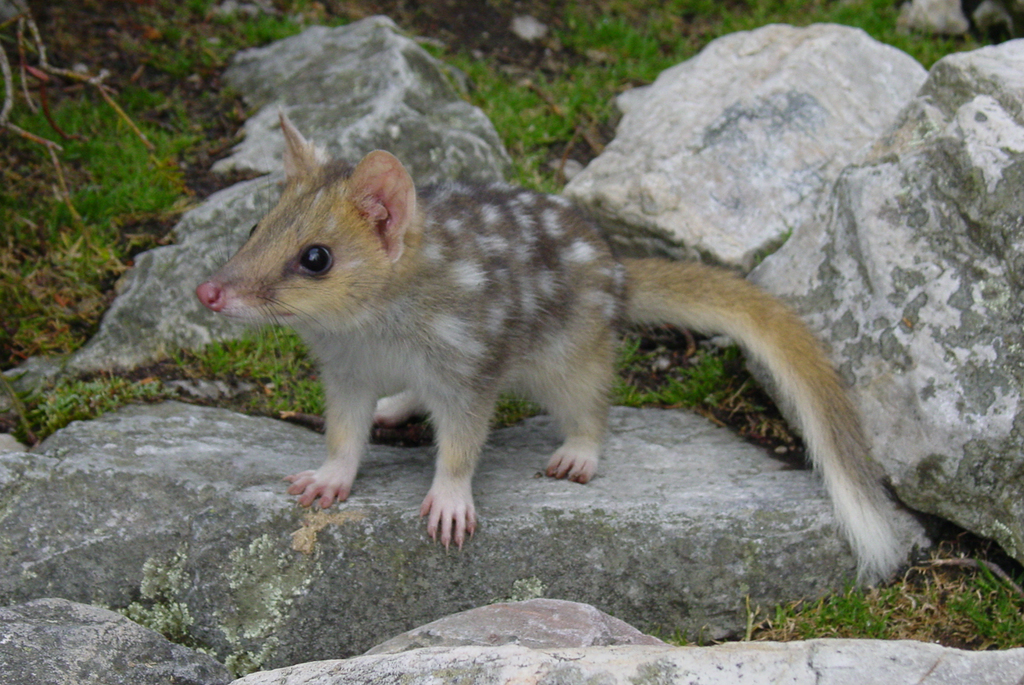
Eastern Quoll
Dasyurus viverrinus
The eastern quoll (Dasyurus viverrinus), formerly known as the eastern native cat, is a medium-sized carnivorous dasyurid marsupial native to Australia. They are widespread and even locally common in Tasmania. They have been considered extinct on the mainland since the 1960s, however have been reintroduced back into fenced sanctuaries in 2016, and more recently into the wild in March 2018. It is one of six extant species of quolls.
From the article Eastern quoll on Wikipedia (CC BY-SA), quoted section by section
Description
Eastern quolls are about the size of a small domestic cat, with adult males measuring 53 to 66 cm (21 to 26 in) in total length, including the 20 to 28 cm (7.9 to 11.0 in) tail, and having an average weight of 1.1 kg (2.4 lb). Females are significantly smaller, measuring 48 to 58 cm (19 to 23 in), including a 17 to 24 cm (6.7 to 9.4 in) tail, and weighing around 0.7 kg (1.5 lb). They have a tapering snout, short legs, and erect ears. They can be distinguished from all other species of quolls by the presence of only four toes, rather than five, on the hind feet, lacking the hallux. They have a thick, light fawn or near-black coat covered by white spots, with off-white underparts stretching from the chin to the underside of the tail. Both fawn and black individuals can be born in the same litter, although in surviving populations, the former are about three times more common than the latter. The spots are 5 to 20 mm (0.20 to 0.79 in) in diameter and are found across the upper body and flanks, from the top of the head to the rump, but unlike some other species of quolls, do not extend onto the tail. Females possess a relatively shallow, fur-lined pouch formed by lateral folds of skin. …
Range & habitat
The eastern quoll was formerly found across much of southeastern mainland Australia, from the eastern coasts of South Australia, through most of Victoria, to the mid-north coast of New South Wales. The species was formerly abundant around Adelaide, particularly the Adelaide Hills, with a 1923 newspaper article noting its rapid decline and presumed extinction in the area during the preceding ten years. It likely became functionally extinct across its entire mainland range by the early 1960s, but remains widespread but patchy in Tasmania and Bruny Island. Within Tasmania, eastern quolls inhabit rainforest, heathland, alpine areas, and scrub below 1,500 m (4,900 ft). They prefer dry grassland and forest mosaics, bounded by agricultural land, particularly where pasture grubs are common.
Wikipedia: “Distribution and habitat”
What it does
Eastern quolls are solitary predators, hunting at night for their prey of insects, small mammals, birds, and reptiles. They have been known to scavenge food from the much larger Tasmanian devil. Although the majority of their diet consists of meat, they also eat some vegetable matter, including fruit during the summer, and grass year-round. Eastern quolls are prey for Tasmanian devils and masked owls. Eastern quolls are nocturnal, and spend the day resting in dens, although they may also use natural rock crevices or hollow tree trunks. The dens often consist of no more than a simple, blind-ending tunnel, but are sometimes more complex, including one or more nesting chambers lined with grass. Each individual uses a number of dens, usually no more than five, which it alternates between on different days. Eastern quolls are solitary and tend to avoid one another, but can form loose "neighbourhoods". Home ranges are typically around 35 ha (86 acres) for females, and 44 ha (110 acres) for males, with the latter increasing dramatically during the breeding season. Territories are scent marked, although scats are distributed randomly, rather than placed at specific latrines. Adults also ward off intruders by hissing and making coughing sounds and also make a sharp shriek that may be an alarm call. …
Wikipedia: “Behaviour”
Listen
Looking for field recordings…
Where it lives
Recorded sightings
—
geo-referenced records in GBIF, from museums, herbaria and field observers.
Drag the globe to turn it. Dots are where records exist, not a range map; darker means more records.
In the stacks
Searching the stacks…
Every page naming Dasyurus viverrinus in the Biodiversity Heritage Library →
This page is assembled live from iNaturalist, GBIF, Wikipedia, the Source Library and the Internet Archive. It is not yet part of the hand-edited codex. iNaturalist taxon 40167.