- Animals
- ›Chordates
- ›Vertebrates
- ›Mammals
- ›Therians
- ›Marsupials
- ›Carnivorous Marsupials
- ›Dasyurids
- ›Quolls, Devils, and Allies
- ›Dasyurus
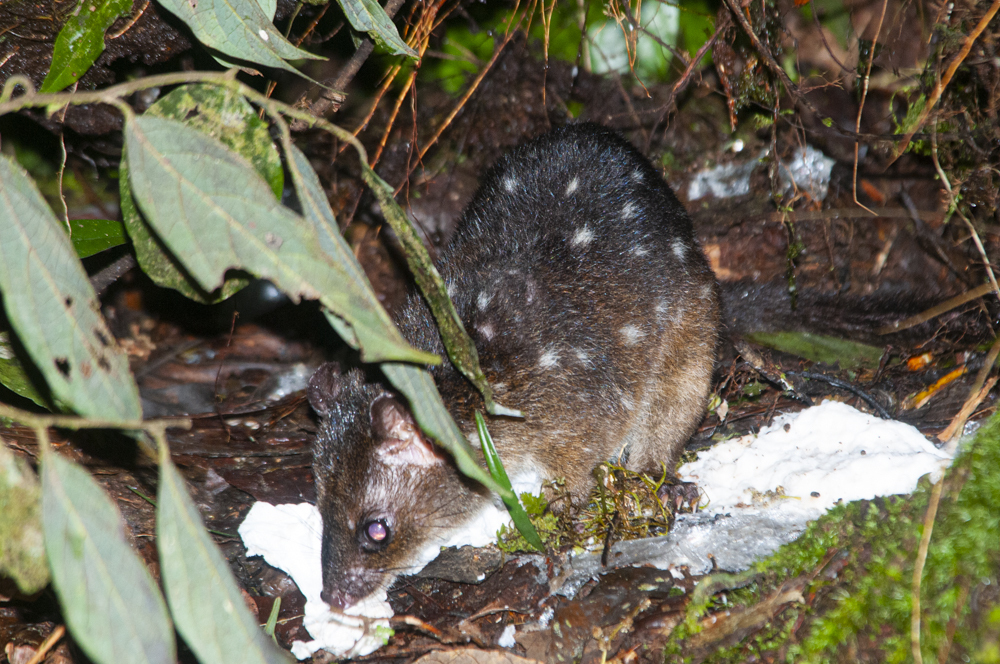
New Guinean Quoll
Dasyurus albopunctatus
The New Guinean quoll (Dasyurus albopunctatus), also known as the New Guinea quoll or New Guinea native cat, is a carnivorous marsupial mammal native to New Guinea. It is the second-largest surviving marsupial carnivore of New Guinea. It is known as suatg in the Kalam language of Papua New Guinea.
From the article New Guinean quoll on Wikipedia (CC BY-SA), quoted section by section
Description
The New Guinean quoll is small, usually weighing just over 1 lb (0.45 kg). Its body is brown and the back spotted with white; the spots do not extend onto the lightly haired tail. It resembles a cat-like opossum; the quolls are also referred to as "native cats" and occasionally "marsupial cats" or "tiger cats". Its feet have transversely striated pads, which is likely to be an adaptation for grip and is indicative of a life spent in the trees. It lives throughout the forests of New Guinea at elevations up to 11,000 ft (3300 m) but usually closer to 3,000 ft (900 m). The population appears to be centered in the highlands of New Guinea.
What it does
Quolls feed on a large range of prey, including birds, rats, other marsupials, small reptiles, and insects. They are reported to feed on prey larger than themselves. They are good climbers, but also spend time on the forest floor. Although nocturnal, they spend the daylight hours basking in the sun. They nest in rocky banks, hollow logs, or small caves. In captivity, the longest recorded survival is three years, but their lifespan in the wild is unknown.
Wikipedia: “Behaviour and diet”
Listen
Looking for field recordings…
Where it lives
Recorded sightings
—
geo-referenced records in GBIF, from museums, herbaria and field observers.
Drag the globe to turn it. Dots are where records exist, not a range map; darker means more records.
In the stacks
Searching the stacks…
Every page naming Dasyurus albopunctatus in the Biodiversity Heritage Library →
This page is assembled live from iNaturalist, GBIF, Wikipedia, the Source Library and the Internet Archive. It is not yet part of the hand-edited codex. iNaturalist taxon 40168.