- Animals
- ›Chordates
- ›Vertebrates
- ›Mammals
- ›Therians
- ›Marsupials
- ›Carnivorous Marsupials
- ›Dasyurids
- ›Quolls, Devils, and Allies
- ›Pseudantechinus
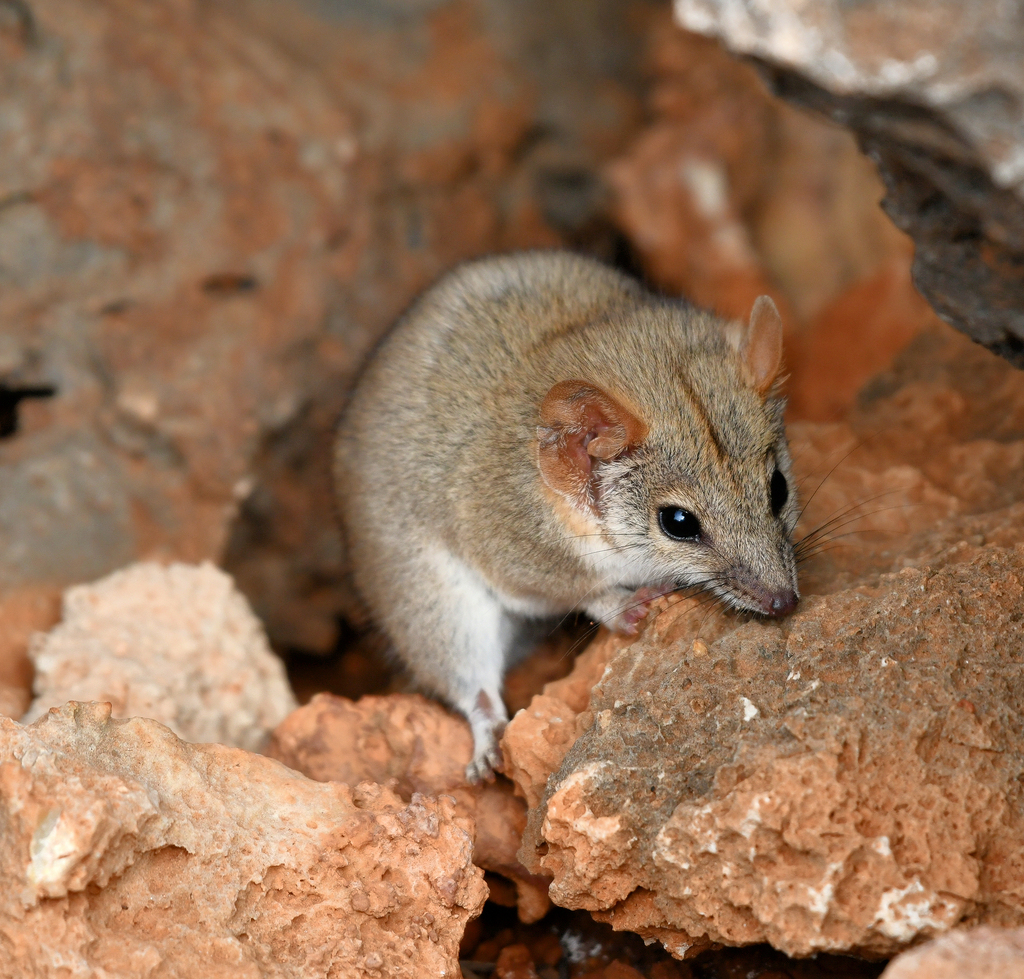
Fat-tailed Pseudantechinus
Pseudantechinus macdonnellensis
The fat-tailed false antechinus (Pseudantechinus macdonnellensis), also called the fat-tailed pseudantechinus and red-eared antechinus, is a member of the order Dasyuromorphia. It is an inhabitant of western and central Australia. Its species name, macdonnellensis, refers to the MacDonnell Ranges near Alice Springs, where it was first discovered.
From the article Fat-tailed false antechinus on Wikipedia (CC BY-SA), quoted section by section
Description
The fat-tailed false antechinus is a medium-sized dasyurid marsupial that ranges from 18–33 g (0.63–1.16 oz), and has a life span of about seven years.is 9.5-10.5 cm long with a 7.5-8.5 cm tail; it weighs 20-45g. It has a carrot-shaped tail swollen with fat which serves as a food reserve. Its fur is grey-brown. It has litters of up to six young, born in July–September (slightly later further west in the range). It is an insectivorous and nocturnal species.
Range & habitat
The P. macdonellensis is commonly found in the rocky environments of Central Australia. In addition it is found throughout South Australia, the Northern Territory and Western Australia. An outlying population in more coastal areas of Western Australia has been reclassified as a new species, Rory Cooper's false antechinus (P. roryi). The species inhabits rocky slopes and plains.
Wikipedia: “Habitat”
What it does
The P. macdonellensis is generally an insectivore whose diet consists of beetles, grasshoppers, and termites. A characteristic specific to this kind of species is its ability to store fat in its tail when food is plentiful.
Wikipedia: “Diet”
Listen
Looking for field recordings…
Where it lives
Recorded sightings
—
geo-referenced records in GBIF, from museums, herbaria and field observers.
Drag the globe to turn it. Dots are where records exist, not a range map; darker means more records.
In the stacks
This page is assembled live from iNaturalist, GBIF, Wikipedia, the Source Library and the Internet Archive. It is not yet part of the hand-edited codex. iNaturalist taxon 40228.