- Animals
- ›Chordates
- ›Vertebrates
- ›Mammals
- ›Therians
- ›Placental Mammals
- ›Ungulates, Carnivorans, and Allies
- ›Bats
- ›Yangochiroptera
- ›Vespertilionoid Bats
- ›Evening Bats
- ›Mouse-eared Bats
- ›Myotis
- ›Chrysopteron
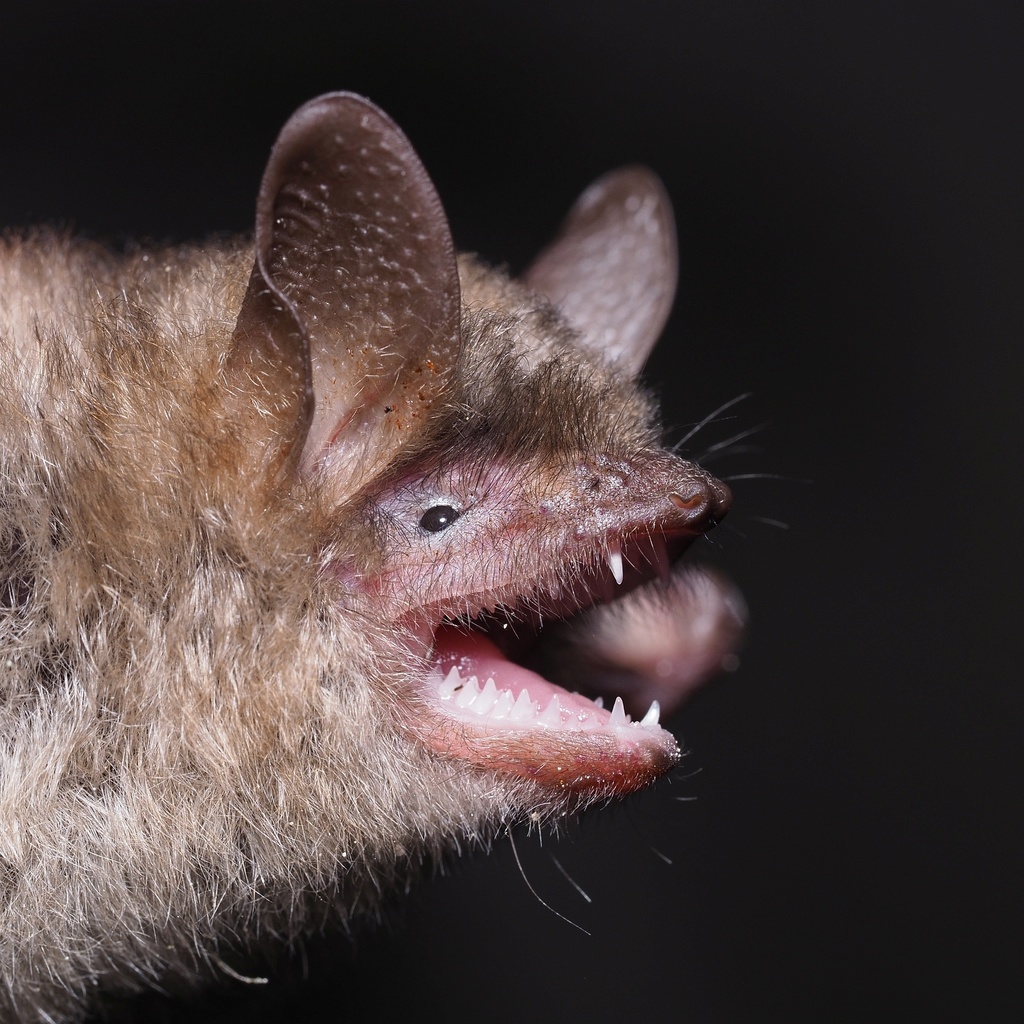
Geoffroy's Bat
Myotis emarginatus
Geoffroy's bat (Myotis emarginatus), also known as the notch-eared bat, is a species of vesper bat.
From the article Geoffroy's bat on Wikipedia (CC BY-SA), quoted section by section
Description
M. emarginatus is a medium-sized bat with long and woolly fur. The dorsal side of the torso is rust-brown to fox-red and the ventral side is a poorly delineated pale yellowish-brown. The young animals are almost fully grey. The face is light brown. The ears are brown and they have an almost right-angled notch at the outer edge and many scattered, wart-like growths on the auricle. The tip of the tragus does not reach the notch on the edge of the ear. The wings are brown and broad. The edge of the tail membrane is supported by a straight calcar and part of it has short, straight and soft hairs.
Range & habitat
Geoffroy's bat can be found in Afghanistan, Albania, Algeria, Andorra, Armenia, Austria, Azerbaijan, Belgium, Bosnia and Herzegovina, Bulgaria, Croatia, Cyprus, Czech Republic, France, Georgia, Germany, Greece, Hungary, Iran, Israel, Italy, Jordan, Kazakhstan, Kyrgyzstan, Lebanon, Luxembourg, Montenegro, Morocco, Netherlands, North Macedonia, Oman, Poland, Portugal, Romania, Russian Federation, San Marino, Saudi Arabia, Serbia, Slovakia, Slovenia, Spain, Switzerland, Tajikistan, Tunisia, Turkey, Turkmenistan, Ukraine, and Uzbekistan. In 2012 a specimen was found in southern England.
Wikipedia: “Distribution”
What it does
Geoffroy's bat feeds primarily on spiders and flies. Geoffroy's bats in southern Belgium feed primarily on blood-feeding muscid flies, primarily the stable fly and the face fly, which collectively made up up to 72% of their diet in some areas. The other primary element of their diet are web-building spiders, which make up an increased portion of their prey in areas where suitable flies are absent. Most spiders consumed by Geoffroy's bats are of the family Araneidae, with a secondary presence of Theridiidae species. Other insect species make up a lower portion of their prey intake. In Southern Basque Country, colonies of Geoffroy's bats feed on a diversity of arthropods during the beginning of the breeding season, with flies making up the largest grouping of prey. As the season progresses, populations of both spiders and flying insects peak and the bats shift to a more specialised diet with a particular emphasis on spiders. By August, the orb-web spider Araneus diadematus makes up 80% of their recorded diet. The second and third most important prey items in this area are the flies the stable fly and the housefly. Its preferred prey are either flightless, such as spiders, or do not fly by night, such as muscid flies. As such, the species feeds primarily by gleaning prey from hard surfaces and leaves. …
Wikipedia: “Ecology”
Listen
Looking for field recordings…
Where it lives
Recorded sightings
—
geo-referenced records in GBIF, from museums, herbaria and field observers.
Drag the globe to turn it. Dots are where records exist, not a range map; darker means more records.
In the stacks
Searching the stacks…
Every page naming Myotis emarginatus in the Biodiversity Heritage Library →
This page is assembled live from iNaturalist, GBIF, Wikipedia, the Source Library and the Internet Archive. It is not yet part of the hand-edited codex. iNaturalist taxon 40281.