- Animals
- ›Chordates
- ›Vertebrates
- ›Mammals
- ›Therians
- ›Placental Mammals
- ›Ungulates, Carnivorans, and Allies
- ›Bats
- ›Yangochiroptera
- ›Vespertilionoid Bats
- ›Evening Bats
- ›Vesper Bats
- ›Pipistrellini
- ›Pipistrellus
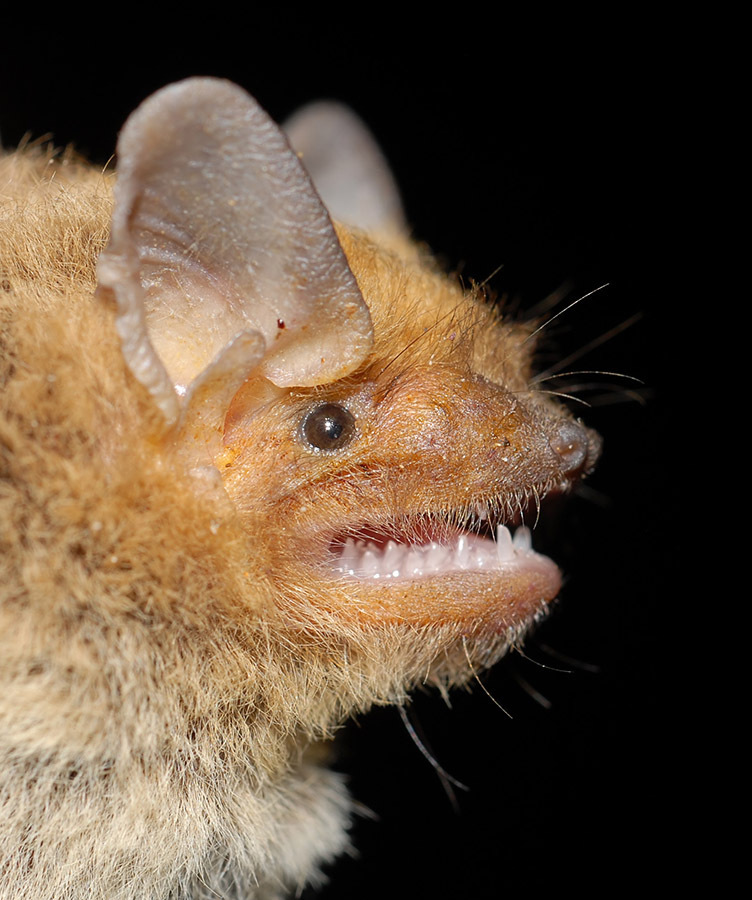
Kuhl's pipistrelle
Pipistrellus kuhlii
Kuhl's pipistrelle (Pipistrellus kuhlii) is a species of vesper bat that lives over large areas of North Africa, southern Europe and Western Asia. It can be found in temperate forests, subtropical or tropical dry shrubland, Mediterranean-type shrubby vegetation, temperate grassland, rural gardens, and urban areas.
From the article Kuhl's pipistrelle on Wikipedia (CC BY-SA), quoted section by section
Description
Kuhl's pipistrelle's fur is dark brown to yellowish, while the wings are black or dark brown. Some individuals have a white stripe at the wing edges. It has a body length of 40–55 mm (1.6–2.2 in) with a 30–45 mm (1.2–1.8 in) long tail, and it weighs around 5–10 g (0.18–0.35 oz). Its wingspan is 210–230 mm (8.3–9.1 in). It is slightly sexually dimorphic, with males larger than the females.
Range & habitat
Kuhl's pipistrelle lives in a variety of habitats, including commonly in urban areas. It occurs from sea-level to an elevation of 2,000 m (6,600 ft). As it is common across a large and increasing range, it is classified as Least Concern on the IUCN Red List.
Wikipedia: “Distribution and habitat”
What it does
Kuhl's pipistrelle is a generalist insectivore, with a widely varying diet depending on the individual and location. In some cases, it may also feed on small amounts of fruit. It feeds by catching its prey in flight by scooping them up in its wings or tail membrane. It typically hunts near other Kuhl's pipistrelles. To attract females, males will emit mating calls distinct from the normal echolocation calls, often in large groups.
Wikipedia: “Behaviour and ecology”
Listen
Looking for field recordings…
Where it lives
Recorded sightings
—
geo-referenced records in GBIF, from museums, herbaria and field observers.
Drag the globe to turn it. Dots are where records exist, not a range map; darker means more records.
In the stacks
Searching the stacks…
Every page naming Pipistrellus kuhlii in the Biodiversity Heritage Library →
This page is assembled live from iNaturalist, GBIF, Wikipedia, the Source Library and the Internet Archive. It is not yet part of the hand-edited codex. iNaturalist taxon 40383.