On eBird ↗
Galapagos Petrel
Live sightings near you, the range map, bar charts of when it is seen, and Macaulay Library photos and recordings.
Galápagos Petrel
Pterodroma phaeopygia
The Galápagos petrel (Pterodroma phaeopygia) is one of the six endemic seabirds of the Galápagos. Its scientific name derives from Ancient Greek: Pterodroma originates from pteron and dromos, meaning "wing" and "runner", and phaeopygia comes from phaios and pugios, meaning "dusky" and "rump". Members of Pterodroma genus are also called the gadfly petrels because their erratic twisting and turning in flight resemble that of gadflies.
Known by locals as pata pegada or "web-footed one", Galápagos petrels are highly adapted to the ocean and spend most of their time at sea eating invertebrates and fish. At sea, they are indistinguishable from the Hawaiian petrels: consequently, they were considered the same species for a while. When breeding season arises, they return to their large colonies located on the highlands of some Galápagos islands.
From the article Galápagos petrel on Wikipedia (CC BY-SA), quoted section by section
Description
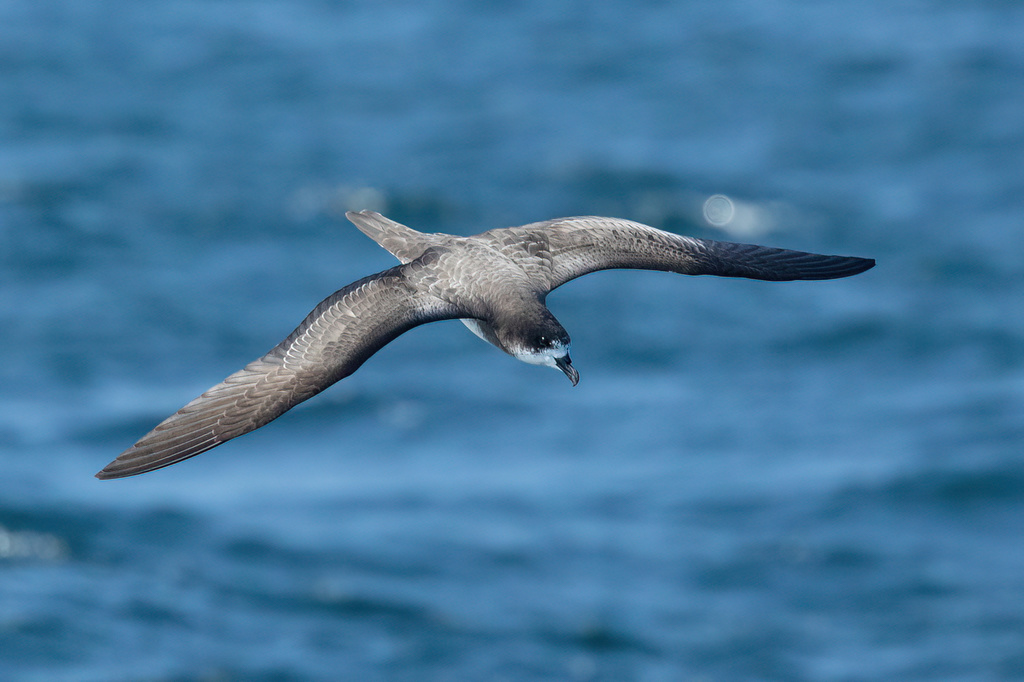
The Galápagos and Hawaiian petrels are very similar. They are large, long-winged gadfly petrels with an overall dark-gray topside which darkens gradually towards the tip of the wings and tail. A narrow white line on each side of their rump is often present. The species are also characterized by a distinct black hood that extends to the sides of their neck. In contrast, their face and underparts are white, but the underwings have black margins and a diagonal bar that extends from the coverts to near the base of the wings. While all Hawaiian petrels have entirely white foreheads, many Galápagos petrels have black freckles. Also, their legs and feet are pink and the webbings, black. Galápagos petrels do not exhibit sexual dimorphism, and juveniles are indistinguishable from the adults. Although adult petrels sometimes acquire a brown tinge due to abrasion, their feathers remain relatively similar throughout the year. Plus, the molting details are not well-known, but it seems like most feathers are replaced during the non-breeding season. Furthermore, like all gadfly petrels, Galápagos petrels have short, stout, hooked bills with sharp edges that are used to seize, manipulate and cut up small prey. …
Range & habitat
The Galápagos petrel is endemic to the Galápagos Islands. They are mainly distributed in the Galápagos Marine Reserve area, but studies revealed that individuals frequently leave the reserve and disperse northeast towards South America and up to 2,000 km (1,200 mi) southwards in the period between January and February. Like other gadfly petrels, these subtropical seabirds are highly pelagic and are maladapted to the terrestrial habitats. Therefore, they are usually found far from the land and will only return to their nest to breed. The nesting colonies are distributed among five islands: Santiago, Floreana, Isabela, Santa Cruz, and San Cristobal, which are all less than 170 km (110 mi) apart. Multiple colonies can occur within one island; each can be as large as 200 m by 300 m and are separated by a distance that varies from 300 m to 5 km. Nowadays, the Galápagos petrels commonly nest on offshore islets because their habitats have been destroyed or displaced by anthropogenic disturbances. Their nests typically occur in highlands that are at least 180 km (110 mi) above the sea. Most can also be found in thickly vegetated sites where the soil is soft enough to burrow deep cavities, but some individuals also choose to nest in volcanic crevices. These ground nests make the species more vulnerable to introduced predators.
Wikipedia: “Habitat and distribution”
What it does
In general, all Procellarids are very mobile and can travel long distances for several months. However, it is still unclear what behavior they exhibit when it is not the breeding season. Sometimes, petrels aggregate around shoals or other rich food sources. All procellarids are adapted to the ocean but not so much to the land. As a result, they only frequent landmasses for a prolonged period during the breeding season. Also, these petrels are gregarious and typically form large discrete breeding colonies. The Galápagos petrels are highly philopatric, meaning that every year they return to their natal colony or the same nesting site with the same partner. Many petrels have nocturnal habits, including the Galápagos form. Indeed, they forage in the evenings and return to feed their offspring during the day. They often fly just above the water to feed on their prey without diving in. Courtship also occurs in the night and the petrels are often seen towering into the sky and flying erratically as a display to attract a female.
Diet. Galápagos petrels are adapted to make efficient use of food resources which are typically distant from the colonies, patchily distributed and have low nutritive value. The petrels mainly take mesopelagic prey such as squids, small fish, crustaceans and other invertebrates. …
Wikipedia: “Behavior”
Listen
Looking for field recordings…
Where it lives
Recorded sightings
—
geo-referenced records in GBIF, from museums, herbaria and field observers.
Drag the globe to turn it. Dots are where records exist, not a range map; darker means more records.
In the stacks
Searching the stacks…
Every page naming Pterodroma phaeopygia in the Biodiversity Heritage Library →
This page is assembled live from iNaturalist, GBIF, Wikipedia, the Source Library and the Internet Archive. It is not yet part of the hand-edited codex. iNaturalist taxon 4041.