- Animals
- ›Chordates
- ›Vertebrates
- ›Mammals
- ›Therians
- ›Placental Mammals
- ›Ungulates, Carnivorans, and Allies
- ›Bats
- ›Yangochiroptera
- ›Vespertilionoid Bats
- ›Evening Bats
- ›Woolly and Trumpet-eared Bats
- ›Kerivoula
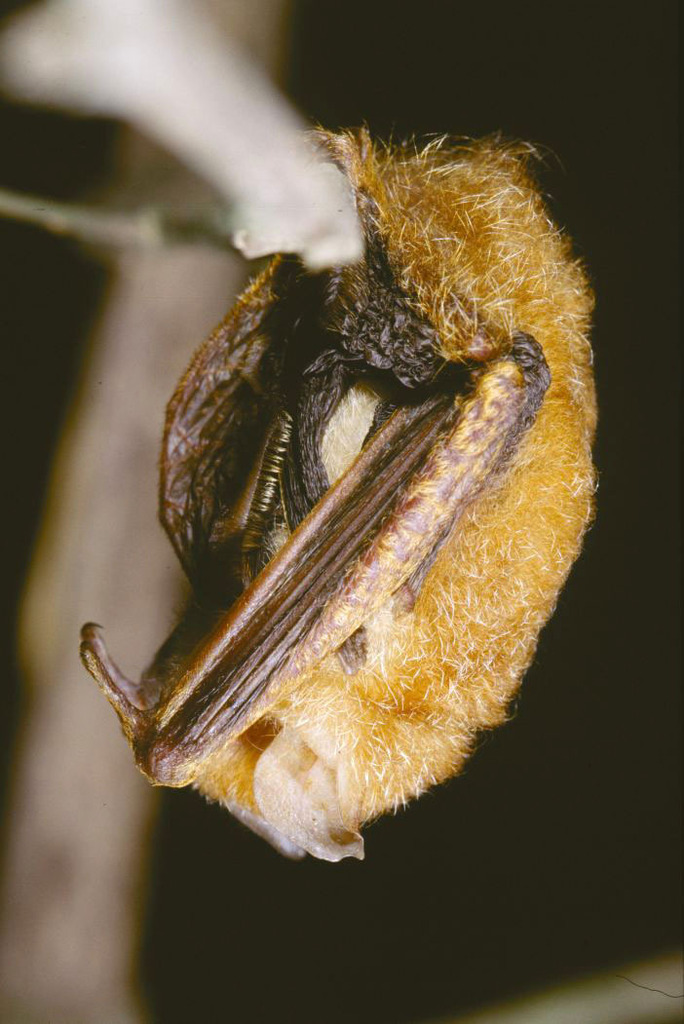
Damara woolly bat
Kerivoula argentata
The Damara woolly bat (Kerivoula argentata) is a nocturnal insectivorous species of vesper bat in the family Vespertilionidae found in Africa. This species typically has reddish brown fur on its back and white fur on its abdomen.
Its natural habitat is moist savanna, although it has also been shown to inhabit woodlands and coastal forests. These bats typically weight about 10 g, and have a low aspect ratio, as well as low wing loading.
From the article Damara woolly bat on Wikipedia (CC BY-SA), quoted section by section
Description
These bats typically have a rich brown mixed with grizzled silver coat of hair on top and grey or whitish hair underneath. The ears are proportionally large compared to their size and have rounded tips. They typically weigh between 6 and 9 g and are between 8.3 and 10 cm long, with an average wingspan of 25 cm. A feature relatively unique to K. argentata is the fringe of hair on the outer edge of interfemoral membrane which stretches between its legs, as this hair is distinctive to this species.
Wikipedia: “Appearance”
What it does
As with several other Kerivoula species, the Damara woolly bat uses abandoned nests of weaverbirds and the scarlet-chested sunbird. Typically, the bats roost alone, but colonies can reach up to six members. The range of the bats extends across much of sub-Saharan Africa and has been identified in Angola, Côte d'Ivoire, Democratic Republic of the Congo, Eswatini, Kenya, Malawi, Mozambique, Namibia, Senegal, South Africa, Tanzania, Uganda, Zambia, and Zimbabwe.
== References ==
Wikipedia: “Ecology”
Listen
Looking for field recordings…
Where it lives
Recorded sightings
—
geo-referenced records in GBIF, from museums, herbaria and field observers.
Drag the globe to turn it. Dots are where records exist, not a range map; darker means more records.
In the stacks
Searching the stacks…
Every page naming Kerivoula argentata in the Biodiversity Heritage Library →
This page is assembled live from iNaturalist, GBIF, Wikipedia, the Source Library and the Internet Archive. It is not yet part of the hand-edited codex. iNaturalist taxon 40456.