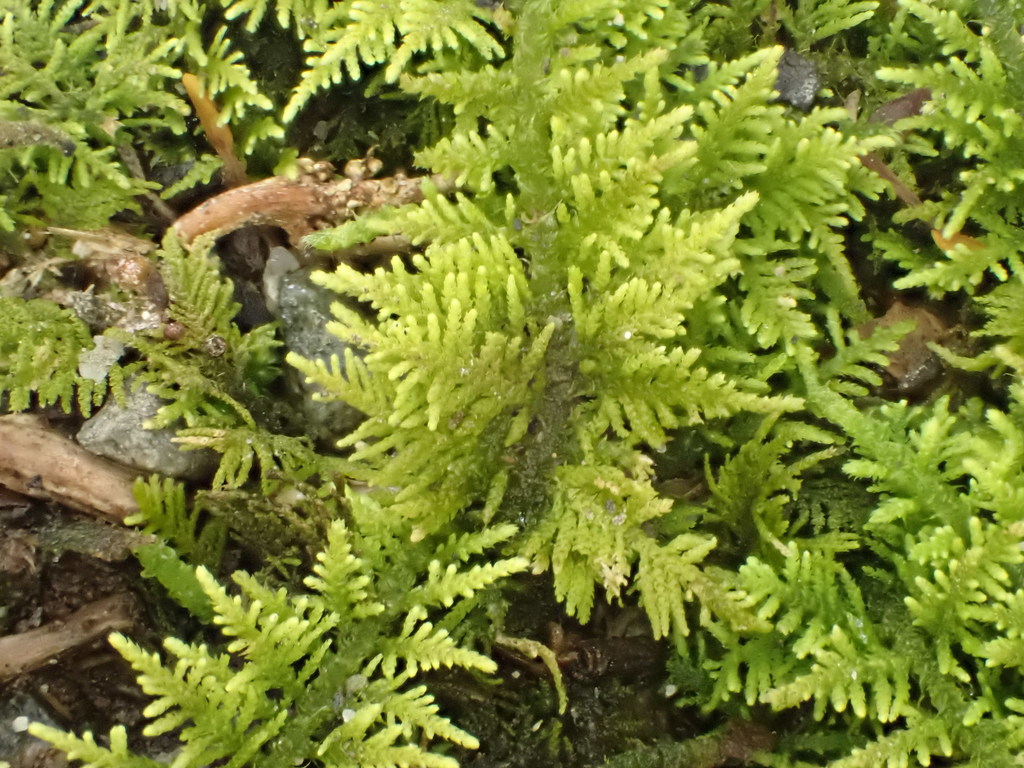
Thuidiopsis furfurosa
Thuidiopsis furfurosa, commonly known as furry thuidium, is a wide-ranging fern moss of the order Hypnales found in southern Australia, New Zealand, and a number of southern Oceania islands as far south as Macquarie Island.
From the article Thuidiopsis furfurosa on Wikipedia (CC BY-SA), quoted section by section
Description
The dioecious gametophyte of this moss species showcases a diverse array of characteristics. These plants typically exhibit colours ranging from yellowish-green to dull green and feature bipinnate to indistinctly pinnate structures. The creeping stems of the moss species range from 12 to 25 cm (4.7 to 9.8 in) in length and commonly exhibit pinnate or bipinnate branching patterns measuring 1 to 1.5 cm (0.39 to 0.59 in) in length which form feathery fronds. Notably, the scale-like leaves (small leafy appendages) are tall and prominent, while smaller branches near the bottom of the plant exhibit a loose, chain-like arrangement (catenulate) when dry. Stem leaves are predominantly triangular, with blunt or tipples at the top, narrowly triangular, or subulate, measuring up to 2 mm (0.08 in) long, while the leaves of smaller branches near the bottom of the plant have narrowly acute apices and measure 0.25 to 0.50 mm (0.01 to 0.02 in) long. The abaxial epidermal cells of the costa may be smooth or bear distal teeth, and median leaf cells typically display unipapillose characteristics, occasionally being 2- or 3-papillose, with predominantly tall, acute, and curved papillae. Inner perichaetial leaves are ciliate, and the moss forms compact to loose matts on various substrates such as soil, rocks, or wood. During the reproductive phase, the sporophyte is distinctly present. …
Range & habitat
Thuidiopsis furfurosa exhibits a wide-ranging distribution, being found in various regions across Australia, including southern New South Wales, the Australian Capital Territory, Victoria, and Tasmania. It is widespread across most areas of New Zealand, it is also present on Norfolk Island, Macquarie Island, the Society Islands, Juan Fernandez Islands, Tristan da Cunha, Gough Island, and possibly in peninsular India. This moss typically inhabits moist shaded environments such as wet eucalypt (sclerophyll) forests, woodlands, rainforests, swamps, subalpine grasslands, and alongside creeks and streams. Occasionally, it forms large patches in grasslands and light bush, demonstrating its ability to adapt to a number environments and elevations, spanning from sea level to within the alpine zone with recorded occurrences up to approximately 1,600 meters (5,200 ft) above sea level in Victoria.
== References ==
Wikipedia: “Habitat and distribution”
In human culture
Furry thuidium was first described by the botanists Sir William Jackson Hooker and William M. Wilson in the Handbook New Zealand Flora in 1867 as Hypnum denticulosum. Numerous attempts to classify T. furfurosa occurred throughout the following years until it was finally reclassified in 1922 by the bryologist Richard Paul Max Fleischer as Thuidiopsis furfurosa in his major monograph Die Musci der Flora von Buitenzorg: zugleich Laubmoosflora von Java.
Wikipedia: “History”
Where it lives
Recorded sightings
—
geo-referenced records in GBIF, from museums, herbaria and field observers.
Drag the globe to turn it. Dots are where records exist, not a range map; darker means more records.
In the stacks
Searching the stacks…
Every page naming Thuidiopsis furfurosa in the Biodiversity Heritage Library →
This page is assembled live from iNaturalist, GBIF, Wikipedia, the Source Library and the Internet Archive. It is not yet part of the hand-edited codex. iNaturalist taxon 406528.