- Animals
- ›Chordates
- ›Vertebrates
- ›Mammals
- ›Therians
- ›Placental Mammals
- ›Ungulates, Carnivorans, and Allies
- ›Bats
- ›Yinpterochiroptera
- ›Rhinolophoid Bats
- ›Horseshoe Bats
- ›Rhinolophus
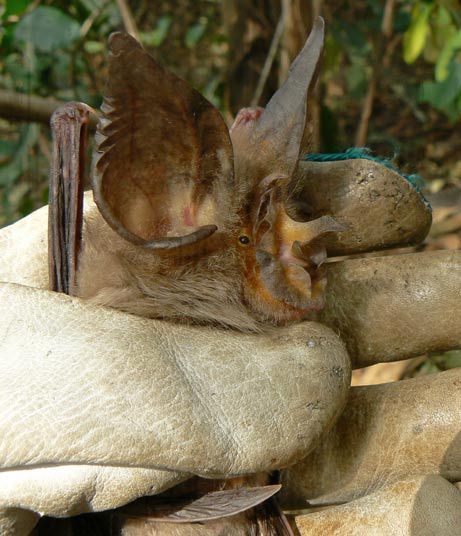
Maclaud's Horseshoe Bat
Rhinolophus maclaudi
Maclaud's horseshoe bat (Rhinolophus maclaudi) is a species of bat in the family Rhinolophidae. It is endemic to Guinea. Its natural habitats are moist savanna, caves, and subterranean habitats (other than caves). It is one of five African microbat species to be listed as endangered by the IUCN. In 2013, Bat Conservation International listed this species as one of the 35 species of its worldwide priority list of conservation. It is threatened by habitat loss.
From the article Maclaud's horseshoe bat on Wikipedia (CC BY-SA), quoted section by section
Description
They are a light chestnut in color. This species has a noseleaf characterized by a forward-slanting sella that has heart-shaped, basal lobes that almost obscure the nostrils. There is a deep indentation between the sella and the lancet. The skulls of this species are slender in appearance, but with heavy snouts. The space between the pterygoid bones of the skull is unusually deep and barrel-like. Their forearms are 64–69 mm (2.5–2.7 in) long. Their ears are 40–46 mm (1.6–1.8 in) long, with 10-12 internal folds. Their leafnoses are 15–16 mm (0.59–0.63 in) wide. Males and females are non-dimorphic in body mass, with adult individuals weighing 30–33 g (1.1–1.2 oz).
Range & habitat
This species has only been found in Guinea, within a 360 km2 (139 mi2) range. Most of the specimens detected so far have been in the Guinean forest-savanna mosaic ecoregion, but the holotype was collected on Conakry Island, which is in the coastal plains ecoregion. The 16 bats discovered in 2007 showed that their range might be larger than previously thought, but still endemic to Guinea. Recently, detections have been concentrated in the Fouta Djallon Plateau. These detections represent a 215 km (134 mi) expansion to the north of previous distribution maps.
Wikipedia: “Range and habitat”
What it does
These bats use caves for roosts during the day, although at least one individual was found inside a house. They roost singly or form small colonies, consisting of up to six individuals. They are found in caves also occupied by Angolan rousette bats, Large-eared slit-faced bats, Guinean horseshoe bats, Rüppell's horseshoe bats, Dent's horseshoe bat, Jones's roundleaf bats, and Noack's roundleaf bats.
Wikipedia: “Behavior”
In human culture
Until 2007, this species was known from only nine specimens collected from four locations. The holotype was collected in 1896, with the remaining eight specimens collected between 1954 and 1968. The species was photographed for the first time in 2007, and had not been sighted the previous 40 years. Altogether in 2007, 16 individuals were discovered in several caves in the Guinea Highlands.
Wikipedia: “History”
Listen
Looking for field recordings…
Where it lives
Recorded sightings
—
geo-referenced records in GBIF, from museums, herbaria and field observers.
Drag the globe to turn it. Dots are where records exist, not a range map; darker means more records.
In the stacks
Searching the stacks…
Every page naming Rhinolophus maclaudi in the Biodiversity Heritage Library →
This page is assembled live from iNaturalist, GBIF, Wikipedia, the Source Library and the Internet Archive. It is not yet part of the hand-edited codex. iNaturalist taxon 40671.