- Animals
- ›Chordates
- ›Vertebrates
- ›Mammals
- ›Therians
- ›Placental Mammals
- ›Ungulates, Carnivorans, and Allies
- ›Bats
- ›Yinpterochiroptera
- ›Rhinolophoid Bats
- ›Old World Leaf-nosed Bats
- ›Hipposideros
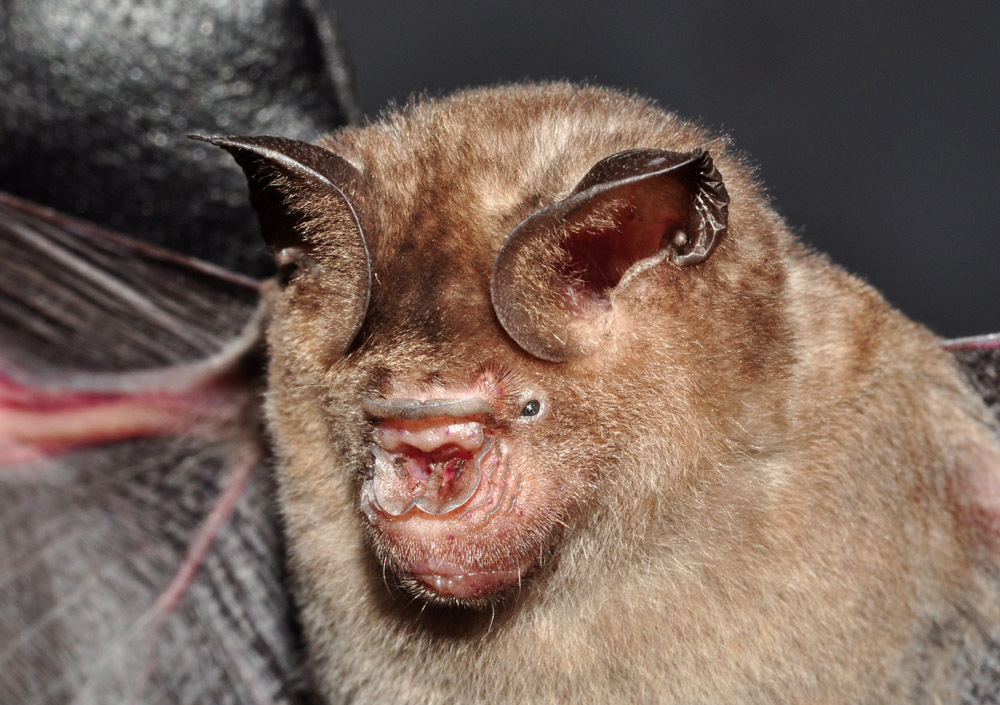
Schneider's roundleaf bat
Hipposideros speoris
Schneider's leaf-nosed bat or Schneider's roundleaf bat (Hipposideros speoris) is a species of bat in the family Hipposideridae. It is found in India and Sri Lanka. Its natural habitats are subtropical or tropical dry forests, caves, and urban areas.
From the article Schneider's leaf-nosed bat on Wikipedia (CC BY-SA), quoted section by section
Description
This species is a small bat. The bat has three additional leaflets on its leaf-nose, with the outer one being smaller than the other two, and the well-developed lappets next to the nostrils are the external characteristics differentiating this species from other species in the genus Hipposideros. A frontal sac is also present above the leaf-nose. H. speoris varies in color from gray to orange-brown, with it being the palest between the shoulders and on the ventral side, and darker on the flanks and the posterior side. It possesses a tiny baculum, which is just 0.57 mm in length, with a blunt tip and slightly expanded base.
Range & habitat
The bat is found in India (Andhra Pradesh, Gujarat, Karnataka, Kerala, Maharashtra, Orissa, Tamil Nadu, Telangana, and Uttarakhand), Sri Lanka, and more recently has also been recorded in Pyay, Myanmar. It has been recorded up to an elevation of 1,285 m (4,216 ft) above sea level. It is commonly found and widespread across its entire range, and roosts in groups of up to 1,000 individuals. The bats tend to roost in caves, caverns, underground cellars, old forts, palaces, under bridges, old disused buildings, temples, tunnels in dry plains or forested hillsides. While the bats in India are more scattered in the roosts, the bats in Sri Lanka roost together closely.
Wikipedia: “Distribution and habitat”
What it does
The bat has a gestation period of 135–140 days, after which a single young is born. The eyes of newborns are closed and the ears are folded laterally. Their body is hairless and has a dark dorsal and a pink ventral side. The eye slits appear after one week, and the eyes are completely opened after two weeks. They raise their ears on the tenth day and ear movements are noticeable two weeks after birth. When the bats are about one month old their fur is as dense as it is in adults but is of a darker color. Juvenile bats attach themselves to the body of their mothers in a reversed position while sucking at one of two pubic teats. Most females carry their newborns with them when they fly out of the cave for foraging and the majority leave their infants inside the cave once they are older than 7 days. Mothers return regularly before midnight and retrieve their young ones. During retrieval the mothers move towards their infants, gently touch it with the forearm, and present the ventral surface, especially the pubic region. When the infant tries to cling on the body of its mother she turns her body about an angle of 45~ by partly spreading her wing membranes. This posture enables the baby to hold the pubic teats of the mother and to release contact from the rock. Then the infant turns towards the mammary glands and after suckling it stretches either one or both of its wings repeatedly. …
Wikipedia: “Reproduction”
Listen
Looking for field recordings…
Where it lives
Recorded sightings
—
geo-referenced records in GBIF, from museums, herbaria and field observers.
Drag the globe to turn it. Dots are where records exist, not a range map; darker means more records.
In the stacks
Searching the stacks…
Every page naming Hipposideros speoris in the Biodiversity Heritage Library →
This page is assembled live from iNaturalist, GBIF, Wikipedia, the Source Library and the Internet Archive. It is not yet part of the hand-edited codex. iNaturalist taxon 40746.