- Animals
- ›Chordates
- ›Vertebrates
- ›Mammals
- ›Therians
- ›Placental Mammals
- ›Ungulates, Carnivorans, and Allies
- ›Bats
- ›Yinpterochiroptera
- ›Rhinolophoid Bats
- ›Old World Leaf-nosed Bats
- ›Hipposideros
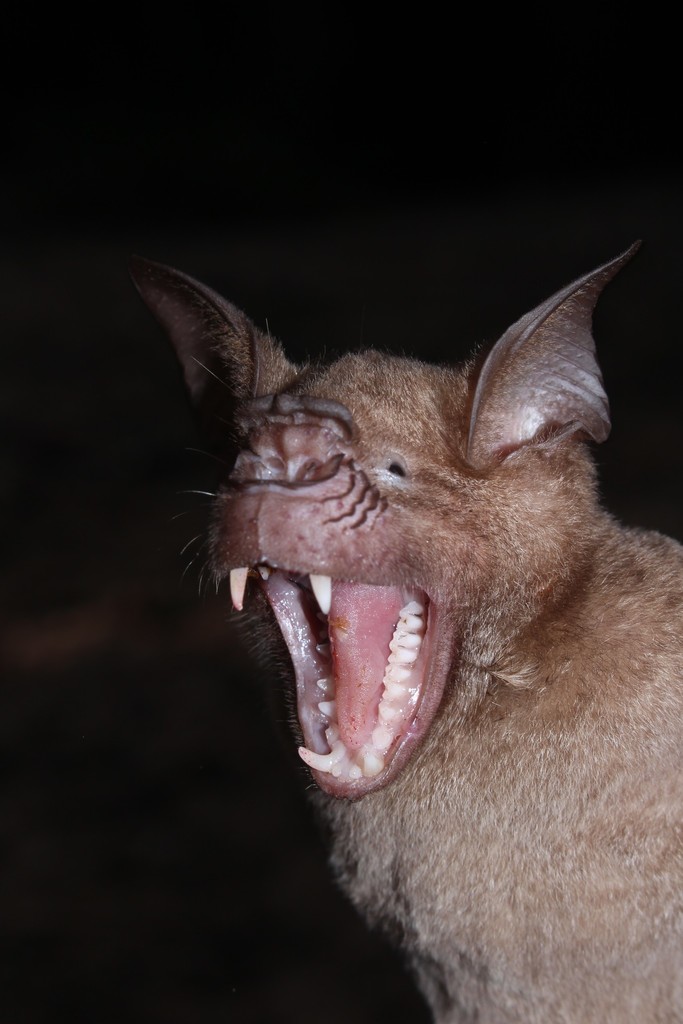
Indian roundleaf bat
Hipposideros lankadiva
The Indian roundleaf bat (Hipposideros lankadiva), also known as the large Ceylon leaf-nosed bat or Kelaart's leaf-nosed bat, is a species of bat in the family Hipposideridae. It is endemic to the Indian subcontinent, with marginal populations also detected in Southeast Asia. Its natural habitats are subtropical or tropical dry forests and caves. The bat has three subspecies that occur in India, Sri Lanka, and Myanmar. The Indian subspecies, H. l. indus, is smaller than the ones found in Sri Lanka and Myanmar, although there are no other characteristics that differentiate the subspecies.
H. lankadiva is a large leaf-nosed bat and is yellowish-brown in color. A key trait of the bats is the reduced fourth supplementary leaflet on the noseleaf, along with a lack of a fleshy elevation behind the posterior nose-leaf and the absence of white patches on the shoulders, which helps differentiate from similar species such as H. armiger and H. diadema.
From the article Indian roundleaf bat on Wikipedia (CC BY-SA), quoted section by section
Description
The Indian roundleaf bat is large species of leaf-nosed bat. The pelage ranges from pale cream to brown and is darker on the head and shoulders, being relatively paler on the belly. They have an average forearm length of 83.5 mm (3.29 in), with a range of 75–99 mm (3.0–3.9 in). The average weight is 59 g (2.1 oz). The bat has four supplementary leaflets on its nose-leaf, with the fourth leaflet being reduced. The intermediate leaf is expanded, with an inflated and swollen central part, and an evenly concave surface. The posterior leaf is brown and its upper border is trilobate. The ears of the species are large and acutely pointed, and had their posterior margins slightly concave behind the tip. The bats found in Myanmar are considerably larger than those found in India, and are comparable in size to those found in Sri Lanka.
Range & habitat
The Indian roundleaf bat is found patchily but widely across the Indian subcontinent, with some records also being found in Myanmar in Southeast Asia. In India, it is found in the states of Andhra Pradesh, Karnataka, Madhya Pradesh, Maharashtra, Manipur, Meghalaya, Mizoram, Orissa, Rajasthan, Telangana, Tripura, and West Bengal. In Sri Lanka, it is found in the Central, Eastern, North Central, Sabaragamuwa, Southern, Uva and Western provinces. It has been recorded in Netrokona in Bangladesh. The bat has also been recorded in Kachin state in Myanmar. The bat has a wide but patchy distribution through a variety of habitats. Despite its wide distribution, the bat is known only from a few locations in India and Sri Lanka. In Sri Lanka, the bat is known from the southern dry zone, lower foothills and wet zone hills. It is found up to an elevation of 1,000 meters above sea level. It is a gregarious species roosting in groups of 50 to several thousand individuals. It roosts in caves, old disused tunnels, old temples, old forts, dark deep channels under dam sites and cellars under old buildings.
Wikipedia: “Distribution and habitat”
What it does
The bats mate once a year. They have a gestation period of 260 days, after which a single young is born.
Wikipedia: “Reproduction”
Listen
Looking for field recordings…
Where it lives
Recorded sightings
—
geo-referenced records in GBIF, from museums, herbaria and field observers.
Drag the globe to turn it. Dots are where records exist, not a range map; darker means more records.
In the stacks
Searching the stacks…
Every page naming Hipposideros lankadiva in the Biodiversity Heritage Library →
This page is assembled live from iNaturalist, GBIF, Wikipedia, the Source Library and the Internet Archive. It is not yet part of the hand-edited codex. iNaturalist taxon 40749.