- Animals
- ›Chordates
- ›Vertebrates
- ›Mammals
- ›Therians
- ›Placental Mammals
- ›Ungulates, Carnivorans, and Allies
- ›Bats
- ›Yinpterochiroptera
- ›Pteropodoidea
- ›Old World Fruit Bats
- ›Rousettinae
- ›Epomophorini
- ›Epomophorus
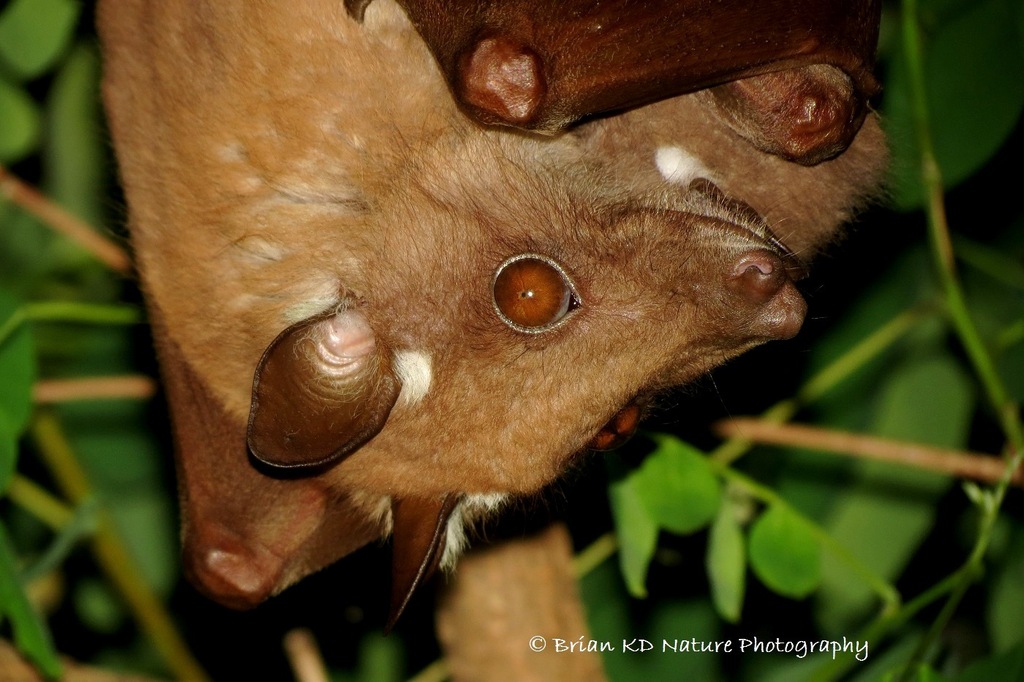
Wahlberg's Epauletted Fruit Bat
Epomophorus wahlbergi
Wahlberg's epauletted fruit bat (Epomophorus wahlbergi) is a species of megabat in the family Pteropodidae. It is commonly found across southern Africa.
From the article Wahlberg's epauletted fruit bat on Wikipedia (CC BY-SA), quoted section by section
Description
Wahlberg's epauletted fruit bat is brown to tawny colored with white hair patches at the base of the ears. Males are typically darker in coloration than females. This species is named for erectable epaulettes of hair that form around large scent glands in males only. Males are also distinguished from females by air sacs on the neck that may increase the volume of courtship calls. Scent glands are located near the white ear patches in both sexes. Wings are broad as compared to other bat species. Adult wingspan is 510–600 mm (20–24 in) and 456–540 mm (18.0–21.3 in) for males and females, respectively. Adults weight 54–125 g (1.9–4.4 oz). The eyes of E. wahlbergi are large. Ears are simple, oval-shaped, and lack a tragus. The nose is also simple, but the lips are highly folded and expansible. Skulls are 44–57 mm (1.7–2.2 in) and 41–49 mm (1.6–1.9 in) long for males and females, respectively. Species of the genus Epomophorus can be distinguished from other megabats (Family Pteropodidae) by their eponymous white epaulettes. A single post-dental palatal ridge in E. wahlbergi distinguishes this species from other members of the genus.
Range & habitat
Wahlberg's epauletted fruit bat is found across southern Africa in forest, shrubland, and savanna habitats at altitudes from sea level up to 2,000 m (6,560 ft). Populations have also been found in wooded urban areas and roosting in man-made structures.
Wikipedia: “Range and Habitat”
What it does
Wahlberg's epauletted fruit bat is frugivorous, its diet mainly consisting of figs, guava, and various fruits of Diospyros species. Collected fruit is typically carried away from the source tree to another tree. The soft tissue and fruit are consumed while the seeds and skins are discarded. Leaves from Balanites species and several insects may also be eaten.
Wikipedia: “Diet”
Listen
Looking for field recordings…
Where it lives
Recorded sightings
—
geo-referenced records in GBIF, from museums, herbaria and field observers.
Drag the globe to turn it. Dots are where records exist, not a range map; darker means more records.
In the stacks
Searching the stacks…
Every page naming Epomophorus wahlbergi in the Biodiversity Heritage Library →
This page is assembled live from iNaturalist, GBIF, Wikipedia, the Source Library and the Internet Archive. It is not yet part of the hand-edited codex. iNaturalist taxon 40811.