- Animals
- ›Chordates
- ›Vertebrates
- ›Mammals
- ›Therians
- ›Placental Mammals
- ›Ungulates, Carnivorans, and Allies
- ›Bats
- ›Yinpterochiroptera
- ›Pteropodoidea
- ›Old World Fruit Bats
- ›Rousettinae
- ›Epomophorini
- ›Epomophorus
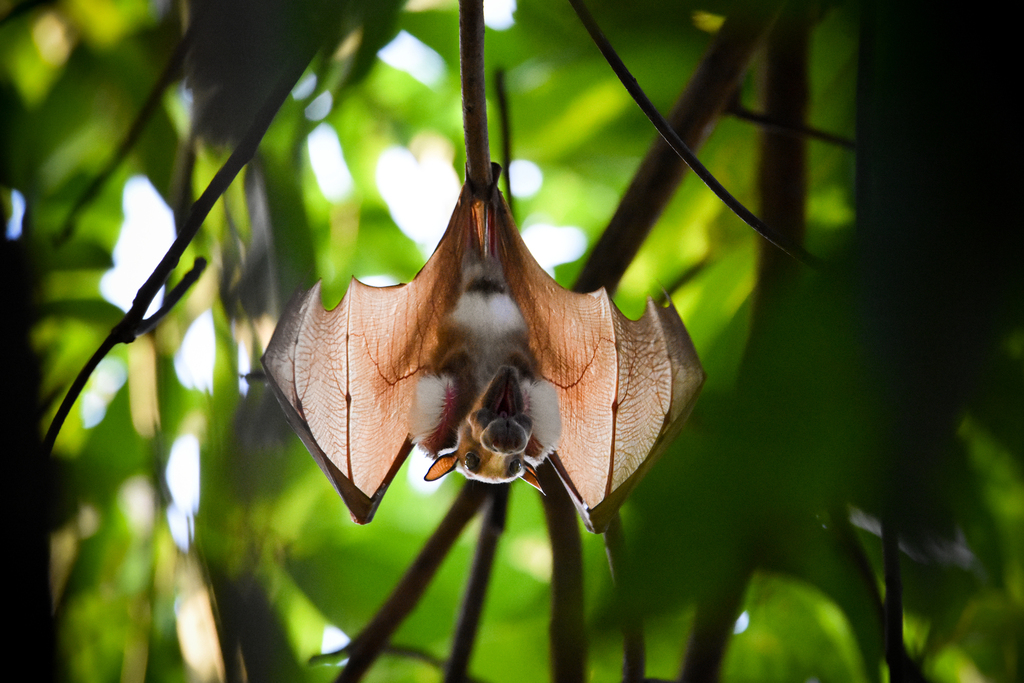
Gambian Epauletted Fruit Bat
Epomophorus gambianus
The Gambian epauletted fruit bat (Epomophorus gambianus) is a species of megabat in the family Pteropodidae. It is found in Benin, Burkina Faso, Cameroon, Central African Republic, Chad, Democratic Republic of the Congo, Ivory Coast, Ethiopia, Gambia, Ghana, Guinea, Guinea-Bissau, Liberia, Mali, Niger, Nigeria, Senegal, Sierra Leone, South Sudan, Sudan, and Togo. Its natural habitats are subtropical or tropical dry forests and savanna.
Populations of epauletted fruit bats are threatened by pesticides on fruit, human disturbance and over-collecting in the past. However, the number one reason it may be threatened is habitat destruction.
From the article Gambian epauletted fruit bat on Wikipedia (CC BY-SA), quoted section by section
Range & habitat
Fruit bats are tropical animals, but some species live in areas with only a limited fruiting season, as in east Africa where the Gambian epauletted fruit bat might feed on figs during the rainy season but in the semi-arid conditions of the rest of the year may have to fly several hundred miles to find a different climate where other trees are still in fruit. The epauletted fruit bat's geographic range is from southern Zaire and Tanzania to eastern South Africa, and southern Sudan and Ethiopia to Senegal and southern Mali. They are typically a lowland species occurring below 500 meters above sea level, however the Ethiopian populations have been found to occur up to 2,000 meters above sea level. It is native to the countries of Angola, Benin, Botswana, Burkina Faso, Cameroon, Central African Republic, Chad, The Democratic Republic of the Congo, Côte d'Ivoire, Ethiopia, Gambia, Ghana, Guinea, Guinea-Bissau, Liberia, Mali, Namibia, Niger, Nigeria, Senegal, Sierra Leone, Sudan, Togo, Zambia, and Zimbabwe. As a fairly adaptable species to many types of environments, they can be found in a variety of habitats ranging from the dry savanna, moist savanna, mosaic, bushland, tropical dry forests, and subtropical dry forests habitats. They have also been reported to inhabit areas of partially degraded forest, mangrove, and swamp forest habitats. …
Wikipedia: “Habitat”
What it does
The Gambian epauletted fruit bats are frugivorous and will appear wherever fig, mango, guava or banana trees are in fruit. The social behavior within fruit-bat camps does not stop at individual family groups. The whole colony is organized, with separate peripheral groups of immatures and non-breeding adults. The epauletted fruit bats travel in small groups of six to twenty bats. When the fruit bats are in flight, they remain together in long processions. The leaders often change, yet they retain the same direction of flight. They frequently sniff at each other's scent glands to establish personal recognition. Which represents high levels of social organization. When one is shot down, they show great concern and gather round swooping low to inspect it; a sign of affinity rather than totally independent behaviour. They roost during the day in mango trees and bamboo reeds or other trees. The Gambian epauletted fruit bats hang upside down alone or in groups up to twenty. The species' droppings support whole ecosystems of unique organisms, including bacteria useful in detoxifying wastes, and producing gasohol. This species feeds on nectar and fruits of many West African trees, presumably acting as pollinator and/or seed disperser. Some flowering trees depend on the bats for pollination. The pack moves during sunset in large flocks from resting areas to feeding areas. …
Wikipedia: “Behavior”
Listen
Looking for field recordings…
Where it lives
Recorded sightings
—
geo-referenced records in GBIF, from museums, herbaria and field observers.
Drag the globe to turn it. Dots are where records exist, not a range map; darker means more records.
In the stacks
Searching the stacks…
Every page naming Epomophorus gambianus in the Biodiversity Heritage Library →
This page is assembled live from iNaturalist, GBIF, Wikipedia, the Source Library and the Internet Archive. It is not yet part of the hand-edited codex. iNaturalist taxon 40812.