- Animals
- ›Chordates
- ›Vertebrates
- ›Mammals
- ›Therians
- ›Placental Mammals
- ›Ungulates, Carnivorans, and Allies
- ›Bats
- ›Yinpterochiroptera
- ›Pteropodoidea
- ›Old World Fruit Bats
- ›Flying-foxes, Monkey-faced Bats and allies
- ›Flying-foxes and allies
- ›Pteropus
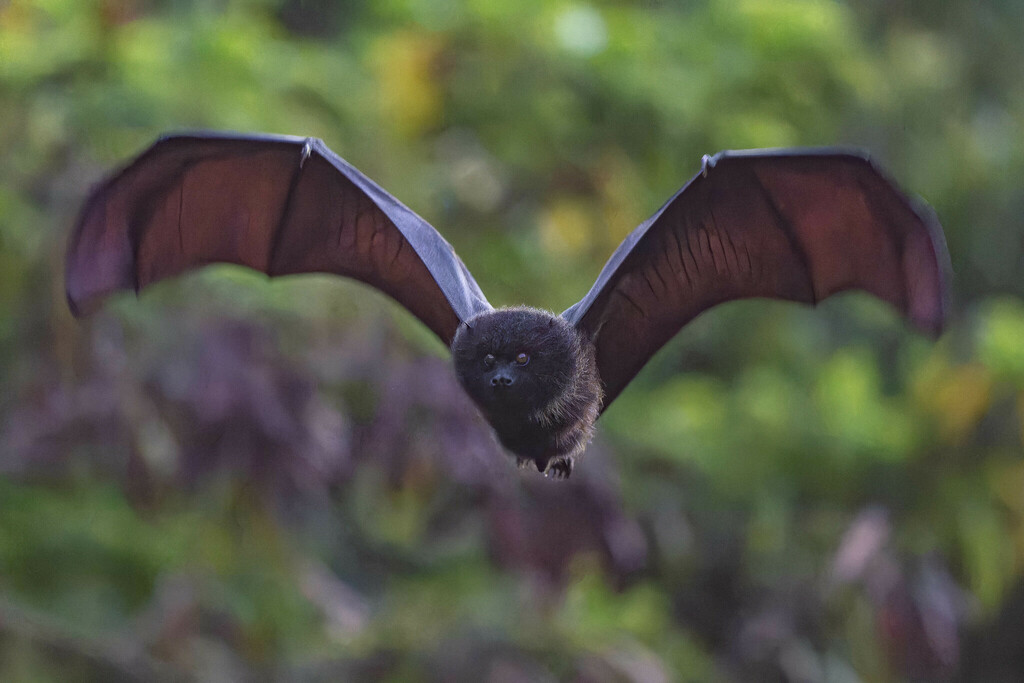
Bonin Flying-fox
Pteropus pselaphon
The Bonin flying fox, Bonin fruit bat (Pteropus pselaphon), or in Japanese Ogasawara giant bat (オガサワラオオコウモリ, Ogasawara ōkōmori) is a species of flying fox in the family Pteropodidae. It is endemic to four islands (Chichijima, Hahajima, North Iwo Jima, and South Iwo Jima) in Ogasawara Islands, Japan. Its natural habitat is subtropical forests. It is threatened by habitat loss.
From the article Bonin flying fox on Wikipedia (CC BY-SA), quoted section by section
Description
Their fur is predominantly black and brown, with silver-tipped hairs interspersed. Their uropatagium is almost completely furred across the dorsal side, but about half furred on its ventral side. The fur along the body is smooth but is frizzled around the head, neck, and shoulders. They have scroll-like nostrils. From their nose to the tip of the uropatagium, they are 254 mm (10.0 in) long. Their wingspan is 787 mm (31.0 in). Their forearms are 132–143 mm (5.2–5.6 in) long. They weigh 403–587 g (14.2–20.7 oz). Young bats (pups) have forearm lengths of less than 125 mm (4.9 in). In captivity, they can live at least 16 years.
Range & habitat
It is one of the northernmost species of flying foxes. It is endemic to the Bonin Islands of Japan, including Chichijima and Hahajima; and the Iwo Islands, including North Iwo Jima, Iwo Jima, and South Iwo Jima. They live in subtropical habitat. The islands where they are found have many steep hills
Wikipedia: “Range and habitat”
What it does
This species is herbivorous. They eat fruits of the Manilkara genus and the Pandanus genus, including screw-pine and thatch screwpine. When eating a piece of fruit, they will suck out the juices and discard the rest instead of consuming it entirely. They consume ornamental plants including Agave americana. They are also known to eat ferns, based on the presence of Asplenium spores in their guano. Other components of their diet include soursop fruit, sugar-apples, banana fruits, leaves, and flowers, traveller's palm flowers, giant white bird of paradise flowers, pitahaya fruit, Indian-almond fruit, Java apple fruit and flowers, guava fruit, weeping paperbark flowers, Albany bottlebrush flowers, litchi fruit, key lime fruits, Meyer lemons, pomelos, grapefruit, amanatsu fruit, sweet oranges, tangerines, mangos, figs, and Chinese mulberries.
Wikipedia: “Diet”
In human culture
The Bonin flying fox was described by British naturalist George Tradescant Lay in 1829. He gave it the species name pselaphon as a reference to "the habit of feeling instead of seeing its way in the day time." Pselaphon is a Neo-Latin word from Ancient Greek psēlaphan 'to grope about'.
Wikipedia: “Etymology”
Listen
Looking for field recordings…
Where it lives
Recorded sightings
—
geo-referenced records in GBIF, from museums, herbaria and field observers.
Drag the globe to turn it. Dots are where records exist, not a range map; darker means more records.
In the stacks
Searching the stacks…
Every page naming Pteropus pselaphon in the Biodiversity Heritage Library →
This page is assembled live from iNaturalist, GBIF, Wikipedia, the Source Library and the Internet Archive. It is not yet part of the hand-edited codex. iNaturalist taxon 40872.